
Join Books.org — it's free

United States Army, United States Army - Military Biography, Reference - General & Miscellaneous, Presidents of the United States - Biography, U.S. Politics & Government - 1952-1961, U.S. Generals & Military Leaders - Military Biography
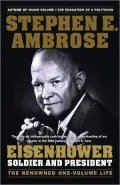
Eisenhower: Soldier and President by Stephen Ambrose β€” book cover

Eisenhower: Soldier and President

by Stephen Ambrose
Write a review
Log in to track your reading progress.

Overview

FOR USE IN SCHOOLS AND LIBRARIES ONLY.

Synopsis

Stephen E. Ambrose draws upon extensive sources, an unprecedented degree of scholarship, and numerous interviews with Eisenhower himself to offer the fullest, richest, most objective rendering yet of the soldier who became president. He gives us a masterly account of the European war theater and Eisenhower's magnificent leadership as Allied Supreme Commander. Ambrose's recounting of Eisenhower's presidency, the first of the Cold War, brings to life a man and a country struggling with issues as diverse as civil rights, atomic weapons, communism, and a new global role. Along the way, Ambrose follows the 34th President's relations with the people closest to him, most of all Mamie, his son John, and Kay Summersby, as well as Franklin D. Roosevelt, Winston Churchill, Charles de Gaulle, Harry Truman, Nixon, Dulles, Khrushchev, Joe McCarthy, and indeed, all the American and world leaders of his time. This superb interpretation of Eisenhower's life confirms Stephen Ambrose's position as one of our finest historians.

About the Author, Stephen Ambrose

Dr. Stephen Ambrose was a renowned historian and acclaimed author of more than 30 books. Among his New York Times best-sellers are: Nothing Like It in the World, Citizen Soldiers, Band of Brothers, D-Day - June 6, 1944, and Undaunted Courage.

He was not only a great author, but also a captivating speaker, with the unique ability to provide insight into the future by employing his profound knowledge of the past. His stories demonstrate how leaders use trust, friendship and shared experiences to work together and thrive during conflict and change. His philosophy about keeping an audience engaged is put best in his own words:

As I sit at my computer, or stand at the podium, I think of myself as sitting around the campfire after a day on the trail, telling stories that I hope will have the members of the audience, or the readers, leaning forward just a bit, wanting to know what happens next.

Dr. Ambrose was a retired Boyd Professor of History at the University of New Orleans. He was the Director Emeritus of the Eisenhower Center in New Orleans, and the founder of the National D-Day Museum. He was also a contributing editor for the Quarterly Journal of Military History, a member of the board of directors for American Rivers, and a member of the Lewis and Clark Bicentennial Council Board.

His talents have not gone unnoticed by the film industry. Dr. Ambrose was the historical consultant for Steven Spielberg's movie Saving Private Ryan. Steven Spielberg and Tom Hanks purchased the film rights to his books Citizen Soldiers and Band of Brothers to make the 13-hour HBO mini-series Band of Brothers.

Hehas also participated in numerous national television programs, including ones for the History Channel and National Geographic.

Biography

"I was ten years old when [World War II] ended," Stephen Ambrose once said. "I thought the returning veterans were giants who had saved the world from barbarism. I still think so." Years after he first watched combat footage in the newsreels, the popular historian brought fresh attention to America's aging WWII veterans through such bestselling books as Band of Brothers, about a company of U.S. paratroopers, and The Wild Blue, about the B-24 bomber pilots who flew over Germany. Though best known for his books on World War II, Ambrose also produced multi-volume biographies of Dwight Eisenhower and Richard Nixon, a history of the building of the transcontinental railroad, and a fascinating account of the Lewis and Clark expedition across the American West.

As a young professor of history, Ambrose was one of many left-wing academics who spoke out against American involvement in the Vietnam War. Yet he revered the veterans of World War II, and he interviewed and wrote about them at a time when many of his colleagues considered military history old-fashioned. "The men I admire most are soldiers, sailors, professional military," Ambrose would later tell The Washington Post. "Way more than politicians."

He labored without much popular acclaim or academic renown until 1994, when his book D-Day June 6, 1944: The Climactic Battle of World War II burst onto the bestseller lists. War heroism was suddenly a hot topic, and Ambrose's approach, which focused on the experiences of soldiers rather than the decisions of high command, was perfectly suited to a popular audience. More bestsellers followed, including Citizen Soldiers, The Victors and Undaunted Courage. Ambrose's vivid narrative accounts were devoured by readers and praised by critics. "The descriptions of individual ordeals on the bloody beach of Omaha make this book outstanding," wrote Raleigh Trevelyan in a New York Times review of D-Day.

Ambrose retired as a professor of history at the University of New Orleans in 1995, but he continued to write one or more books per year. He also founded the National D-Day Museum in New Orleans, worked with his family-owned business organizing historical tours, and served as the historical consultant for the 1998 Steven Spielberg film Saving Private Ryan. Spielberg later turned Ambrose's Band of Brothers into an HBO miniseries.

This rise to fame was accompanied by criticism from some of Ambrose's fellow historians, who charged that he could be careless in his research and editing. In early 2002, he faced accusations of plagiarism when reporters noted that a number of phrases and sentences in his books were lifted from other works. Ambrose responded that he had forgotten to place quotation marks around some quotes, but said he had footnoted all his sources. "I always thought plagiarism meant using another person's words and ideas, pretending they were your own and profiting from it. I do not do that, never have done that and never will," he wrote in a statement on his Web site.

When he was diagnosed with lung cancer a few months later, he began work on a memoir, To America. "I want to tell all the things that are right about America," he said in an interview with the Associated Press. Ambrose died in October 2002, at the age of 66.

Good To Know

Ambrose was a star football player at the University of Wisconsin and played in the Rose Bowl, according to his friend and co-author Douglas Brinkley.

As a college sophomore, Ambrose abandoned his pre-med major for history after he attended a class on "Representative Americans" taught by professor William Hesseltine.

For more than 20 years, Ambrose and his family spent their vacations traveling portions of the Lewis and Clark Trail. They canoed the Missouri and Columbia rivers, endured soaking rains and summer snowstorms, and read from the explorers' journals at night by the light of their campfires.

Ambrose named his house in Mississippi "Merry Weather," after Meriwether Lewis. His Labrador was called Pomp, after the nickname of Sacagawea's son.

Reviews

There are no reviews yet. Log in to write one.

Editorials

From Barnes & Noble

The definitive one-volume biography of Eisenhower. Ambrose combines extensive and varied sources, an unprecedented degree of scholarship, and numerous interviews with Eisenhower himself to present a comprehensive and objective biography of the soldier who became president.

Publishers Weekly - Publisher's Weekly

In this admiring and enormously readable revision/condensation of his acclaimed two-volume biography, published in 1983 and 1984, Ambrose reminds us that this "great and good man'' was the most successful general of the greatest war ever fought and the only president of this century to preside over eight years of peace and prosperity. Tracing Eisenhower's family background, education, military and political careers, and influence as elder statesman, the author chronicles Eisenhower's triumphs and failures and at the same time provides a vivid picture of the off-duty Ike. As Allied Supreme Commander, he is revealed once again as a coalition leader of extraordinary ability (and "an intensely alive human being who enjoyed his job immensely''). As our 34th president, he was a statesman who guided the free world through one of the most dangerous decades of the Cold War. Ambrose argues that Eisenhower has much to say to us today on such fundamental issues as national defense, arms expenditures, the importance of a balanced budget and the desirability of a United States of Europe with an all-European army. This is the definitive one-volume biography of Eisenhower.

Book Details

Published
August 1, 1991
Publisher
Turtleback Books
Pages
635
Format
Prebound
ISBN
9780613501279

More by Stephen Ambrose

Similar books