
Executive Branch, U.S. Armed Forces - Biography, United States History - 20th Century - 1945 to 2000, U.S. - Political Biography, United States Armed Forces, World War II
Log in to track your reading progress.
Overview
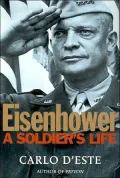
Born to hardscrabble poverty in rural Kansas, the son of stern pacifists, Dwight David Eisenhower graduated from high school more likely to teach history than to make it. With full access to his private papers and letters, Carlo D'Este traces Eisenhower's rise to high command and identifies the complex and contradictory character behind Ike's famous grin and air of calm self-assurance.Editorials
From Barnes & Noble
Carlo D'Este, who established himself as a first-rank World War II historian with Patton: A Genius for War, presents future president Dwight David Eisenhower as he assumes the role of supreme commander of Allied forces in Europe. Utilizing unlimited access to Eisenhower's papers and letters, D'Este reveals the general's complex and contradictory personality traits and describes how they affected his leadership decisions. The author's examination of Eisenhower's relationships with other generals is particularly strong. Although Eisenhower: A Soldier's Life is, as the title suggests, a military biography, it does not neglect aspects of Eisenhower's private life, including his marriage and his much-publicized wartime romance with Kay Summersby.Booklist
D'Este structures his biography of Eisenhower around his career as an officer. He specifically concentrates on Eisenhower's "apprenticeship" in the 1920s and 1930s and his conduct as supreme Allied commander in Europe. Himself a former Army officer, D'Este has written a meticulously researched, professional appraisal of Eisenhower's military record, but readers need not fear that his narrative is as dry as an efficiency report. D'Este has built a premier and popular reputation as a military historian (e.g., Patton: A Genius for War, 1995) and enlivens Ike's story by recounting his competitive relationships with his brothers, his strained one with wife Mamie, and his gossip-producing liaison with wartime chauffeur Kay Summersby. Yet Ike's military performance is D'Este's primary concern, and he is not a cheerleader; he calls it "miserable" in Tunisia in 1942-42. An expert on the Battle of Normandy, D'Este critiques Ike's strategy there, but improves his opinions of Ike's actions in ensuing controversies—and sympathizes with his abrasions with British generals Brooke and Montgomery. A weighty and significant contribution to Ikenography.Publishers Weekly
A lieutenant colonel at 50 with no military future ahead of him in the stifling between-the-wars promotion system, Eisenhower became, in little more than three years and three months, a five-star general. D'Este (Patton: A Genius for War) sees Ike's rise as predicated upon his having been recognized as "the ultimate career bureaucrat he so disdained." Never having had hands-on command of a unit in combat, Eisenhower would pay heavy prices for his inexperience. Yet D'Este seems to agree with General Omar Bradley that Ike lived an "extraordinarily charmed life" on the basis of likability, desk-officer brilliance and the active patronage of influential men. Although D'Este, who carries Eisenhower's career only through victory in Europe in May 1945, leans heavily upon Russell Weigley's masterly Eisenhower's Lieutenants, he goes well beyond Weigley in indicting the supreme commander for so grossly playing favorites as to keep incompetents in major positions, for command indecision and indifference about such crucial dimensions of combat as logistics, and for a litany of strategic blunders that lengthened and raised the price of the war. He also attempts but fails to bypass the delicate matter of Eisenhower's attentions to his British chauffeur and aide, Kay Summersby. Although at first he contends loyally that their names would be "wrongly" linked, later he notes that it was "common knowledge among war correspondents that something was going on between them." At the close, our knowledge of the future eminence of D'Este's flawed hero seems to validate the implied if reluctant verdict of a charmed life. Still, its dramatic objectivity about Eisenhower's significantly flawed career as a WWII commander will earn this volume attention and controversy. 16 pages of b&w illustrations, 4 maps not seen by PW. (June 4) Copyright 2002 Cahners Business Information.Library Journal
Having assayed Patton, retired U.S. Army lieutenant D'Este here fries an even bigger fish. Copyright 2001 Cahners Business Information.Kirkus Reviews
Exhaustive, highly readable study of Ike the soldier, from his modest Kansas origins through V-E Day. Descended from a long line of religious pacifists, Dwight D. Eisenhower was to end his political career by decrying the “military-industrial complex.” Yet, retired US Army officer and military historian D'Este (Patton: A Genius for War) points out, although he was president of the US, Eisenhower “would have been elated merely to be remembered as a soldier.” Thus, D'Este limits his treatment to Ike's military accomplishments. The first was graduating in the class of 1915 at West Point, where his indifference to discipline won him many demerits. After WWI, which he sat out as a trainer of the infant Tank Corps, Eisenhower distinguished himself in staff assignments, through associations with key officers who aided his climb up the Army ladder. D'Este portrays his subject as a complex personality, beneath whose sunny smile and easygoing manner lay ruthless ambition and a first-rate intelligence. After an important stint in 1925 at the Staff School in Fort Leavenworth, Eisenhower commenced a career as a high-level staff officer, mostly engaged in turbulent service stateside and in the Philippines to the imperious, histrionic Douglas MacArthur. After WWII began, Eisenhower's mastery of the problems of industrial mobilization endeared him to George Marshall and won him assignments as strategic planner for the Mediterranean campaigns. The bulk of D'Este's account is devoted to Ike's masterful command of the Allied effort in Europe, which entailed brilliant diplomacy as much as military acumen. The biographer not only conveys the strategic problems Eisenhower faced, but shows how thegeneral’s personal qualities—his unpretentiousness, single-minded dedication to the task, and sensitivity to the difficulty of forging unity between two proud allies who were often mistrustful of each other—ultimately drove the Allied war machine to victory. An absorbing portrait of the growth of Eisenhower the man and a fine analysis of the accomplishments of Eisenhower the general.From the Publisher
“A persuasive picture . . . D’Este brings to his subject a deep understanding of World War II.” —The New York Times Book Review“D’Este’s thorough research and careful analysis show us an Eisenhower feeling his way into command.” —Chicago Tribune
“A distinguished historian of World War II . . . Not only a breezy read but a thought-provoking one too.” —The Wall Street Journal
Book Details
Published
June 1, 2002
Publisher
New York : Henry Holt & Co., 2002.
Pages
672
Format
Hardcover
ISBN
9780805056860