
Literary Criticism, American
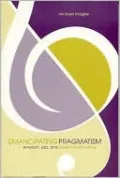
Emancipating Pragmatism: Emerson, Jazz, and Experimental Writing
Michael Magee, Charles Bernstein (Editor), Hank Lazer
Available on Bookshop
Write a review
Books.org participates in affiliate programs including Bookshop.org and the Amazon Services LLC Associates Program. We may earn a commission from qualifying purchases made through links on this page, at no additional cost to you.
Log in to track your reading progress.
Synopsis
Review “Nowhere else, that I am aware of, can one read such an apt commingling of Emerson and Ellison, jazz and writing, Williams, Stein, Baraka, and O'Hara. . . . [Emancipating Pragmatism] is a remarkable synthesis of these figures who have been the subjects of disparate studies before, but whose linkages through philosophical approaches to pragmatism have never been so carefully examined in parallel.” —-Aldon Nielsen, author of Black Chant: Languages of African-American Postmodernism “Michael Magee has written a book about the links between pragmatism, Emerson, jazz and experimental writing that is so wonderfully playful that Dewey could only have admired it. James may have tried to mimic it. But only Santayana could have pulled it off. Okay, not even Santayana, perhaps! It is a gem.” —Henry Levinson, Transactions of the Charles S. Peirce Society Product Description A radical rereading of Emerson that posits African- American culture, literature, and jazz as the very continuation and embodiment of pragmatic thought and democratic traditionEmancipating Pragmatism is a radical rereading of Emerson that posits African- American culture, literature, and jazz as the very continuation and embodiment of pragmatic thought and democratic tradition. It traces Emerson's philosophical legacy through the 19th and 20th centuries to discover how Emersonian thought continues to inform issues of race, aesthetics, and poetic discourse. Emerson’s pragmatism derives from his abolitionism, Michael Magee argues, and any pragmatic thought that aspires toward democracy cannot ignore and must reckon with its racial roots. Magee looks at the ties between pragmatism and African-American culture as they manifest themselves in key texts and movements, such as William Carlos Williams’s poetry; Ralph Ellison’s discourse in Invisible Man and Juneteenth and his essays on jazz; the poetic works of Robert Creeley, Amiri Baraka, and Frank O'Hara; as well as the “new jazz” being forged at clubs like The Five Spot in New York. Ultimately, Magee calls into question traditional maps of pragmatist lineage and ties pragmatism to the avant-garde American tradition. About the Author Michael Magee teaches at the Rhode Island School of Design in Pawtucket.Book Details
Published
April 1, 2004
Publisher
University of Alabama Press
Pages
264
Format
Hardcover
ISBN
9780817313906