
Musical Instrumentalists - Biography, Violoncello (Cello)
Log in to track your reading progress.
Overview
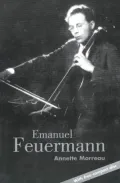
The meteoric career of the Austrian cellist Emanuel Feuermann ended with his sudden and tragic death in 1942, aged only thirty-nine. A brilliant soloist and chamber performer, many expected him to inherit from Pablo Casals the reputation of the greatest cellist of all time. The trio he formed with Jasha Heifetz and Artur Rubinstein was considered the leading chamber ensemble in the world. This new biography of Feuermann—a rich combination of documentary and oral history and gripping narrative—discusses his life, work, and legacy and awards him the place in musical history that he was denied by his early death.Born one hundred years ago in a humble Galician shtetl, Feuermann grew to maturity in a tumultuous era. Annette Morreau gives an account of the world wars, politics, music culture, and recording history that form the context of his achievements. She also provides invaluable detail about Feuermann’s life, drawing on interviews and private letters of family, colleagues, students, and friends, as well as on a wealth of first-hand recollections from some of the most distinguished musicians of the twentieth century. Morreau describes Feuermann’s unique style of playing, basing her assessments on the many surviving recordings he made and on contemporary press reviews gathered worldwide.
Synopsis
The meteoric career of the Austrian cellist Emanuel Feuermann ended with his sudden and tragic death in 1942, aged only thirty-nine. A brilliant soloist and chamber performer, many expected him to inherit from Pablo Casals the reputation of the greatest cellist of all time. The trio he formed with Jasha Heifetz and Artur Rubinstein was considered the leading chamber ensemble in the world. This new biography of Feuermann—a rich combination of documentary and oral history and gripping narrative—discusses his life, work, and legacy and awards him the place in musical history that he was denied by his early death.Born one hundred years ago in a humble Galician shtetl, Feuermann grew to maturity in a tumultuous era. Annette Morreau gives an account of the world wars, politics, music culture, and recording history that form the context of his achievements. She also provides invaluable detail about Feuermann’s life, drawing on interviews and private letters of family, colleagues, students, and friends, as well as on a wealth of first-hand recollections from some of the most distinguished musicians of the twentieth century. Morreau describes Feuermann’s unique style of playing, basing her assessments on the many surviving recordings he made and on contemporary press reviews gathered worldwide.
So that readers can judge Feuermann's extraordinary talent for themselves, a digital download with examples of his performances is included with the ebook.
Editorials
The New Yorker
Although Pablo Casals remains the popular ideal of a cellist, cellists themselves tend to prefer the more obscure Emanuel Feuermann, who was born a century ago, in Jewish Galicia, and died in 1942, at the age of thirty-nine. One of the greatest musical prodigies of the twentieth century -- he was made a conservatory professor at sixteen -- Feuermann had a flawless technique and all but created the modern cello sound. Morreau's exemplary biography reveals a personality in which artistry, careerism, and naïveté crowded out any glimmer of self-doubt. "Difficulties do not exist for Mr. Feuermann," a critic said of one performance, and these words apply equally well to the cellist's boundless energy and confidence. Having moved to America to escape the Nazis, Feuermann was on the verge of stardom when he died. Photographs here show him slouching against his Buick, advertising Chesterfields, and performing in front of the Stars and Stripes -- a tantalizing glimpse of the household name that might have been.Library Journal
London music critic Morreau has produced a fine account of the life and legacy of cellist Emanuel Feuermann. Born in 1902 into a poor Jewish family in Austria, Feuermann was thought by many to be a better cellist than Pablo Casals, but his life was cut short at the age of 39 during a somewhat mysterious botched operation. As a youth, Feuermann struggled to find a place in his father's heart and in the world of the Reifenbergs of Cologne, upper-class Jews who had been baptized and whose youngest daughter Feuermann eventually married. Morreau is especially good at describing Feuermann's cultural milieu and the uncertainties and complexities inherent in climbing the social ladder. In fact, because the cellist married outside of his caste, his parents and his wife's parents never met, and the book's one drawback is that Morreau does not examine as completely as one would like the extent to which her subject consciously "put aside" his birth family. The book includes a chapter on Feuermann's writing, teaching, and performing, as well as two chapters on his recorded legacy. Three appendixes (listing Feuermann's fees, instruments and strings, and known recordings) round out the text. Seymour Itzkoff's Emanuel Feuermann, Virtuoso: A Biography (1979) contains many interesting sidelights, but Morreau's account is fully attributed and will be the standard biography. Highly recommended for large public and academic libraries and libraries interested in classical music. (Accompanying CD not available for review.)-Bruce R. Schueneman, Texas A&M Univ. Lib., Kingsville Copyright 2002 Cahners Business Information.Book Details
Published
October 1, 2008
Publisher
Yale University Press
Pages
456
ISBN
9780300183931