
German History - Religious Aspects, 18th Century German Philosophy, Enlightenment
Log in to track your reading progress.
Overview
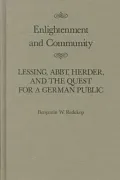
Jürgen Habermas' pioneering work has provoked intense discussion about the rise of a modern public sphere and civil society. Redekop revises and expands the Habermasian thesis by demonstrating that, rather than being particularly "bourgeois," the eighteenth-century German public was a problematic, amorphous entity that was not based on a single social grouping - a beckoning figure that led Lessing, Abbt, and Herder on unique but comparable quests to give it shape and form. His perspective provides an important new understanding of the work of authors who have often been placed in overly narrow and restrictive categories.
Editorials
Booknews
Argues that the Enlightenment project was more than the misguided turning towards instrument rationality that some hold it to be. The author examines three north-central German Enlightenment writers and finds in them a genuine communitarian search for the construction of a German public sphere. After placing the writers in the general social, political, and literary contexts of their time, he looks at the different approaches (literary, political, and philosophical) the author applied to their goal. Annotation c. Book News, Inc., Portland, OR (booknews.com)Book Details
Published
March 1, 2000
Publisher
Montreal : McGill-Queen's University Press, c2000.
Pages
288
Format
Hardcover
ISBN
9780773510265