
Women's Biography, Russian & Soviet History, Peoples & Cultures - Biography, 1917-1991 (Soviet Union) - History, Family Memoirs - Biography, Women's Biography, Jewish - Biography
Log in to track your reading progress.
Overview
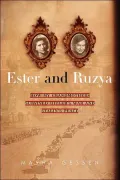
"In the 1930s, as waves of war and persecution were crashing over Europe, two young Jewish women began separate journeys of survival. One, a Polish-born woman from Bialystok, where virtually the entire Jewish community would soon be sent to the ghetto and from there to Hitler's concentration camps, was determined not only to live but to live with pride and defiance. The other, a Russian-born intellectual and introvert, would eventually become a high-level censor under Stalin's regime. At war's end, both women found themselves in Moscow, where informers lurked on every corner and anti-Semitism reigned. It was there that Ester and Ruzya would first cross paths, there that they became the closest of friends and learned to trust each other with their lives." "In this family memoir, journalist Masha Gessen tells the story of her two beloved grandmothers: Ester, the quicksilver rebel who continually battled the forces of tyranny; Ruzya, a single mother who joined the Communist Party under duress and made the compromises the regime exacted of all its citizens. Both lost their first loves in the war. Both suffered unhappy unions. Both were gifted linguists who made their living as translators. And both had children - Ester a boy, and Ruzya a girl - who would grow up, fall in love, and have two children of their own: Masha and her younger brother." With meticulous research, Gessen peels back the layers of secrecy surrounding her grandmothers' lives. As she follows them through this remarkable period in history - from the Stalin purges to the Holocaust, from the rise of Zionism to the fall of communism - she describes how each of her grandmothers, and before them her great-grandfather, tried to navigate a dangerous line between conscience and compromise.Editorials
Katha Pollitt
Gessen has little use for glorious pointless deaths or for the grand ideologies that have caused so many of them. What interests her is how people preserve their individuality and their humanity in deeply repressive societies, where if you want to talk openly with your best friend, it's a good idea to cross-country ski a few miles away from anyone who might overhear you. The friendship between Ester and Ruzya -- a stronger bond than marriage -- along with their children, their literary work and a talent for skepticism, helped them survive and eventually flourish through decades of fear and privation.— The New York Times
Susan B. Glasser
In the end, Gessen tries to make sense of these confused lessons in a dialogue with her grandmother Ruzya. "So where is the moral high ground here?" Gessen demands. It is a question that her book hurls at the reader time and time again. And it is a question that inevitably circles back to the impossible choices of life under totalitarianism, leaving this "grandmother alone with her compromise, again."— The Washington PostPublishers Weekly
After leaving Russia in 1981 when she was 14, journalist Gessen visited 10 years later and moved back a few years after that. The transition represents the two major themes of her memoir: displacement and familial ties. After reconnecting with her Russian kin, Gessen seeks to explore her roots. Rather than tell her own story, Gessen reaches into her family's past, weaving together the stories of her two grandmothers as they live through the turmoil and terror of the first half of the 20th century. The two Jewish women, born in separate countries, meet and become friends in 1949, after fleeing persecution and war in Poland and Russia. The terrors strengthen their friendship, Gessen writes: "It was probably most like family: a bond that once established, was believed permanent." Both have children, who then fall in love with each other and have children of their own, including Gessen. By using the present tense, Gessen gives the memoir a sense of immediacy. She also deftly puts her grandmothers' experiences in context by describing the brutal realities of Stalin's regime and the desperation of Jews trying to escape Nazi concentration camps. This blend of historical depth with personal experience is a powerful mix, illuminating how family and friendship can grow in even the darkest eras. Agent, Elyse Cheney. (Nov.) Copyright 2004 Reed Business Information.Kirkus Reviews
A journalist's memoir of her grandmothers also paints an eloquent portrait of two totalitarian powers, the havoc they wrought, and the countless burdens they imposed on ordinary families. Gessen, who emigrated to America as a teenager but moved back to Moscow in 1994, deftly weaves the story of the two women's lives with her reactions to their experience. Like all people who survive authoritarian regimes, both made certain compromises: Ruzya served as an official censor for many years under Stalin, and Ester accepted a position as an NKVD lieutenant, only to be turned down when she failed the physical. Gessen doesn't gloss over these events, but comes to appreciate the realities of her grandmothers' lives and understand their respective situations. Both were Jewish, which made their already difficult lives even more fraught. Ester, born in Bialystok in what was then Poland, lost most of her family in the Holocaust; she escaped because she was a student in Moscow. It was there, in the late 1940s, that she met native-born Ruzya at a mutual friend's party. Postwar life was perilous for Jews, accused by Stalin of plotting against the state and frequently denied jobs; they feared strangers and socialized only with trusted friends. Ester and Ruzya formed a bond, affectionately evoked by their granddaughter, that sustained them over the years. Ruyza, widowed during the war, later remarried; Ester was divorced in 1957 and also remarried. Their friendship began when their children were young, and Sasha, Ester's son, grew up to marry Ruzya's daughter, Yolochka. Anti-Semitism, which had continued to scar their mothers' lives, led the couple to leave for the US in 1981. Finally, with perestroika,they were able to return to see their mothers in 1988 and arrange for Ester and Ruzya make visits to America. A masterful chronicle of dark and dangerous years, and a distinguished addition to the history of totalitarianism. Agent: Elyse Cheney/Greenburger AssociateBook Details
Published
October 1, 2004
Publisher
New York : Dial Press, c2004.
Pages
384
Format
Hardcover
ISBN
9780385336048