
Presidental Elections & Candidates, African Americans - Politics and Government - History, 20th Century American History - Civil Rights, U.S. Politics & Government - 1945 - 1989, U.S. Politics & Government - 1945 to Present, 20th Century American History
Log in to track your reading progress.
Overview
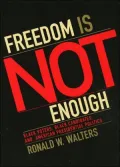
Ron Walters traces the history of the black vote since 1965, celebrates its 40th anniversary in 2005, and shows why passing a law is not the same as ensuring its enforcement, legitimacy, and opportunity.
Editorials
Roll Call
Walter's message is one of empowerment and self-determination. . . . At a time when Republicans are trying to court the black community by talking up the benefits of President Bush's 'ownership society' and making known their desire to be active participants in the reauthorization of the Voting RIghts Act. . . . Walters's message is important, both to Republicans and Democrats.Booklist
This is a must-read for those interested in black voting power as an important avenue for political inclusion.Russell Simmons
The most American thing you can do is vote. History informs the present, action shapes the future. Freedom is Not Enough reminds us we must understand where we've been as a society if we are to move forward to realize a new American dream for all people.Katherine Tate
Freedom is Not Enough constitutes a serious evaluation of the current status of Black voters in the American political system by a distinguished political scientist. I recommend the book highly and would assign it as required reading in my courses on African American and minority politics.Mary Frances Berry
Walters carefully explains why the Democratic Party's most faithful constituency—African Americans—is the least rewarded and appreciated and what can be done about it. His solution: an independent political strategy for African Americans.Rev. Jesse L. Jackson
Professor Ronald Walters reminds us of the empowerment objective of black voting, that was so much the goal of those whose work and sacrifices led to the passage of the Voting Rights Act. That goal was at the center of my campaigns for President of the United States in 1984 and 1988, and Walters expertly summarizes and even codifies them, suggesting that if other such campaigns are mounted in the context of a movement for social change, they may also fuel the large turnouts necessary to use elections as a potent resource to improve the lives of those who participate.Publishers Weekly
Assessing black political power from the start of the civil rights era to the aftermath of the 2004 election, Walters (Black Presidential Politics in America) shows how the ongoing struggle for black voting power involves not just heroic individuals, but black-led committees and networks, some famous, some little known. Compared to the early 1960s, there are many more African-Americans in local office and in Congress, but black influence on presidential politics, Walters argues, comes only through "leverage"-when black primary candidates get enough power to bargain with the Democratic party and its nominee. The "new, bold and exciting" Jackson campaigns of 1984 (on which Walters worked) and 1988 did just that, in part because black churches supported them, in part because they felt like grassroots movements. Walters also illuminates recent electoral failures: in 2004, "difficulties Blacks experienced in attempting to vote were caused not by the mechanical aspects of voting but by human interference." Walters's prose can sound inflated or vague (he wants to "determine the impact of macro-system issues"), but his combination of statistics, theory, history and analysis puts a lot of crucial information in one place. (July) Copyright 2005 Reed Business Information.Library Journal
Abolitionists and civil rights activists have fought long and hard for black suffrage and voting rights, arguing that freedom is meaningless without full citizenship and the right to vote. In this work, published to coincide with the 40th anniversary of the Voting Rights Act of 1965, Walters (government & politics, Univ. of Maryland, College Park; White Nationalism, Black Interests: Conservative Public Policy and the Black Community) examines the impact of the black vote on presidential elections since the signing of the law. Jessie Jackson's 1984 and 1988 presidential campaigns are featured as high points in black political participation. Jackson was able to mobilize the black community and use the substantial black vote as leverage in shaping the Democratic Party's political agenda. Considerable attention is given to black disenfranchisement in the 2000 and 2004 elections and how leverage politics played out in the 2004 Sharpton and Mosley Braun campaigns. This book offers useful background information on black voting habits and how the black vote is both obtained and obstructed, with an emphasis on voter turnout rather than the issues blacks should base their votes upon. Suitable for academic and public libraries.-Sherri L. Barnes, Univ. of California, Santa Barbara Libs. Copyright 2005 Reed Business Information.Book Details
Published
June 28, 2005
Publisher
Lanham, Md. : Rowan & Littlefield Publishers : c2005.
Pages
256
Format
Hardcover
ISBN
9780742538375