
Literary Criticism - General & Miscellaneous, United States Studies - General & Miscellaneous, Literary Theory - General & Miscellaneous, Literary Criticism - U.S. Fiction & Prose Literature - General & Miscellaneous, Philosophy & Literature, Religion & L
Available on Bookshop
Write a review
Books.org participates in affiliate programs including Bookshop.org and the Amazon Services LLC Associates Program. We may earn a commission from qualifying purchases made through links on this page, at no additional cost to you.
Log in to track your reading progress.
Overview
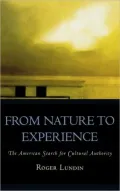
In this remarkable work, Roger Lundin seeks the source of American moral and cultural authority in the shift from nature to experience figured in the thought of Ralph Waldo Emerson. While the pragmatic tradition concludes that experience must generate the very light that will lead us out of its own darkness, From Nature to Experience returns to religion for illumination and truth. This is a story of nineteenth-century sources and twenty-first-century consequences in which literature, history, philosophy, and theology are joined in order to form a truly original critique of American culture.About the Author:
Roger Lundin is Blanchard Professor of English at Wheaton College
Synopsis
Roger Lundin traces how pragmatism and its reliance on experience eclipsed nature and religion as the ultimate moral authority. He explores why Americans prize experience as highly as they do, what they build out of it in works of culture and their daily lives, how they manage to make sense of it, and where people might turn when they reach the limits of experience.
Editorials
Christianity Today
Roger Lundin has provided a powerful 'genealogy of moral authority.'— Mark Noll
Touchstone
A thoroughly documented, closely reasoned critique of the religious and literary temperament of Europe and the United States during the last two centuries.— John Harmon McElroy
Journal of American History
From Nature to Experience is both learned and provocative.— Maurice S. Lee
Choice
This book is an important contribution to the study of the history of American pragmatism, modern methods of literary criticism and hermeneutics, and 20th-century Protestant theology. . . . Highly recommended. Graduate and research collections.Books & Culture
Re-enchanting Emerson for a post-critical America while simultaneously reasserting the possibility of a supernatural source of authority beyond history, From Nature to Experience is itself an exemplary work of the critical (and hopeful) imagination.— Harold K. Bush
H-Net: Humanities and Social Science Reviews Online
Lundin is to be commended for his book's scope. . . . Lundin demonstrates considerable talent in unraveling the complex story of cultural authority's shift from nature and revealed religion to personal experience. . . . From Nature to Experience is one of the best examples of a work written from a religious perspective on a subject whose scholars tend to err on the side of freethinking. . . . Lundin has produced a truly inspiring addition to the field of American intellectual history.Journal of Religion
From Nature to Experience charts the development and weighs the consequences of American pragmatism. . . . Lundin's book is convincing and frequently quite moving. . . . As it stands From Nature to Experience registers as a modest, yet uncompromising, brief against pragmatism and the consequences of its place as American culture's status quo.Peter Lawler
Lundin has written a brilliant, incredibly comprehensive, and erudite account of American idealism as rooted in sheer experience disconnected from God and the Good. He shows that our idealists—from Emerson through our earlier pragmatists such as William James and Dewey and our contemporary 'neopragmatists' (such as Rorty)—participate in a project that is somehow both Protestant and post-Christian, a sort of Christianity both without Christ and without any conception for the real human persons. This project, in Rorty's hands, claims to be Nietzschean, but Lundin better appropriates what's true and noble about Nietzscheans' criticism of the soft mendacity of modern democracy: We should have nothing but contempt for vague Christian sentiment divorced from Christian belief.Ralph C. Wood
In this remarkable book, Roger Lundin diagnoses the dangers inherent in the American dream of overcoming the harsh limits of history and the thick densities of religion in favor of direct, unmediated experience of the Ultimate. From Emerson and Thoreau to James and Dewey forward to Richard Rorty and Stanley Fish, he traces our dark descent into the abyss of gnostic individualism. Yet Lundin writes no mere jeremiad. He points, instead, to a way out of our tragedy-and-tradition denying culture—through the witness made by Hawthorne and Melville, Faulkner and Auden, Gadamer and Bonhoeffer and Barth.Stanley Hauerwas
Lundin does nothing less than provide extraordinary readings of Emerson and William James to set the American loss of authority in terms of a dialectic between nature and experience. Lundin then exposes the limits of that dialectic through masterful reading of literary theory represented by New Criticism, issues in authorial intentionality, and the challenge Faulkner presents for understanding our lives. Drawing on fiction and poetry, Lundin illumines the philosophical issues he explores while never losing the thread of argument. This could well be one of the more important books written in recent times, and hopefully it will receive the wide readership it so richly deserves.Christianity Today -
Roger Lundin has provided a powerful 'genealogy of moral authority.'Denis Donoghue
In this immensely moving, intelligent, and beautifully written book, Roger Lundin considers 'the shift from nature to experience as the locus of authority in American culture' from Emerson to (say) Don De Lillo. His thesis is contentious. Other scholars of American culture might offer as its God-term such rival values as culture, history, society, or language. I can imagine a spirited conversation on the issue. One or two scholars might even claim that nature has not been superseded—not entirely—by experience, and might quote evidence from Thoreau to Richard Wilbur. No matter. Lundin has made a formidable case: his companions in the debate will find it a difficult case to refute.Touchstone -
A thoroughly documented, closely reasoned critique of the religious and literary temperament of Europe and the United States during the last two centuries.Books and Culture -
Re-enchanting Emerson for a post-critical America while simultaneously reasserting the possibility of a supernatural source of authority beyond history, From Nature to Experience is itself an exemplary work of the critical (and hopeful) imagination.Journal of American History -
From Nature to Experience is both learned and provocative.H-Net: Humanities and Social Science Reviews Online
Lundin is to be commended for his book's scope. . . . Lundin demonstrates considerable talent in unraveling the complex story of cultural authority's shift from nature and revealed religion to personal experience. . . . From Nature to Experience is one of the best examples of a work written from a religious perspective on a subject whose scholars tend to err on the side of freethinking. . . . Lundin has produced a truly inspiring addition to the field of American intellectual history.Journal Of Religion
From Nature to Experience charts the development and weighs the consequences of American pragmatism. . . . Lundin's book is convincing and frequently quite moving. . . . As it stands From Nature to Experience registers as a modest, yet uncompromising, brief against pragmatism and the consequences of its place as American culture's status quo.Journal Of American History
From Nature to Experience is both learned and provocative.— Lee, Maurice S.
H-Net
Lundin is to be commended for his book's scope. . . . Lundin demonstrates considerable talent in unraveling the complex story of cultural authority's shift from nature and revealed religion to personal experience. . . . From Nature to Experience is one of the best examples of a work written from a religious perspective on a subject whose scholars tend to err on the side of freethinking. . . . Lundin has produced a truly inspiring addition to the field of American intellectual history.Books and Culture
Re-enchanting Emerson for a post-critical America while simultaneously reasserting the possibility of a supernatural source of authority beyond history, From Nature to Experience is itself an exemplary work of the critical (and hopeful) imagination.— Harold K. Bush
CHOICE
This book is an important contribution to the study of the history of American pragmatism, modern methods of literary criticism and hermeneutics, and 20th-century Protestant theology. . . . Highly recommended. Graduate and research collections.First Things
Full of striking insight.Cultural Encounters
Roger Lundin's 'story of nineteenth-century sources and twenty-first-century consequences' narrates the American disenchantment of nature and the ensuing rise (and fall) of experience with admirable subtlety; along the way offering a devastating deconstruction of that ongoing philosophical champion of experience, pragmatism.Book Details
Published
February 1, 2006
Publisher
The Rowman & Littlefield Publishing Group Inc
Pages
278
Format
Hardcover
ISBN
9780742521742