
Immigrants - United States, Immigration & Emigration - History, General & Miscellaneous European History, United States - Ethnic & Race Relations, United States History - Ethnic Histories, Immigrants - Biography, United States History - General & Miscella
Log in to track your reading progress.
Overview
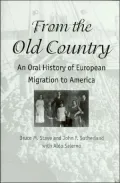
For nearly a century, the symbol of the American "melting pot" - namely that all cultures are transformed into a single American identity - has enjoyed considerable popularity. Bruce M. Stave and John F. Sutherland offer the reader an opportunity to explore and question this and other concepts in From the Old Country, an oral history comprising the voices of the early European immigrants - the Irish, Scandinavians, Italians, Jews, Poles, Slavs, and others - who came to America by the millions between the late nineteenth to early twentieth century. The authors, both practicing oral historians, have compiled their interviews and others conducted by the Works Progress Administration (WPA) in the 1930s. This resulting blend is a new and enlightening, sometimes disturbing, perspective on the forefathers and foremothers who gave so much to the country that they have adopted as their own. Their interviews, combined with those of the WPA, enable the authors to offer the reader a perspective of at least three generations of immigrant experience. From the Old Country presents the concept that while there were, and are, many common experiences encountered by the American immigrant, there are also experiences that are not shared by all ethnic groups and individuals. For example, the myth of the uprooted, sequestered immigrant is dispelled, and revealed are the support networks of friends and families that helped to find jobs, homes, and in general, helped to relieve the sense of alienation that was often felt by the newcomers. Especially intriguing is the candidness with which many of the WPA interviewees express the prejudices and bigotries felt towards other ethnic groups, and at times even of the internal suspicions that served to divide rather than strengthen. Stave and Sutherland, in this clearly narrated collection of oral testimonies, follow the entire immigrant experience including the role that the family unit played, both economically and socially. Of special intEditorials
Library Journal
The interviews appearing here are drawn from both the Work Projects Administration (WPA) Ethnic Group Survey conducted from 1938 to 1940 in Connecticut and more recent interviews conducted in the 1970s. They are divided into six chapters, which discuss the immigrants' experiences in their homeland, the transatlantic crossing, securing employment, family life, gender roles, and prejudice. Beyond the actual story of these immigrants, the book also gives good insight into the development and practice of oral history. Overall, this title dovetails nicely with David Cohen's America, the Dream of My Life (Rutgers Univ. Pr., 1990). Although limited in its geographical scope, this work is recommended for public libraries throughout the country with strong history collections.-- Daniel Liestman, Seattle Pacific Univ. Lib.Book Details
Published
March 1, 1999
Publisher
Hanover, NH : University Press of New England, 1999.
Pages
317
Format
Paperback
ISBN
9780874519082