
United States Civil War - Resolution & Aftermath, United States Civil War - Individual Battles & Campaigns, Pennsylvania - State & Local History
Log in to track your reading progress.
Overview
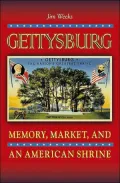
"Described as "the most American place in America," Gettysburg is defended against commercial desecration like no other historic site. Yet even as schoolchildren learn to revere the place where Lincoln delivered his most famous speech, Gettysburg's image generates millions of dollars every year from tourism, souvenirs, reenactments, films, games, collecting, and the Internet." Gettysburg entered the market not with recent interest in the Civil War nor even with twentieth-century tourism but immediately after the battle. Founded by a modern industrial society with the capacity to deliver uniform images to millions, Gettysburg, from the very beginning, reflected the nation's marketing trends as much as its patriotism. Gettysburg's pilgrims - be they veterans, families on vacation, or Civil War reenactors - have always been modern consumers escaping from the world of work and responsibility even as they commemorate. And it is precisely this commodification of sacred ground, this tension between commerce and commemoration, that animates Gettysburg's popularity.Editorials
Library Journal
Perhaps no other place except Independence Hall has a greater claim to the meaning and memory of America than does Gettysburg, which over time has metamorphosed from a battlefield marking Union victory to a national shrine honoring the nobility of American character and almost divorced from the causes of the war that brought armies there in 1863. In a book of rare intelligence and eloquence, Weeks (American history, Pennsylvania State Univ.) sifts through the tangled mass of memorabilia, images, remembrances, promotional literature, travel guides, and more to show how this "hallowed ground" was created and exploited for myriad interests. In monument, memory, and marketing, Gettysburg became the touchstone for multiple meanings to generations variously seeking redemption, repose, and recreation. He makes clear that the current preoccupation with "authenticity" in supposedly restoring the "true ground" is part of a long process of re-creating particular memories to serve contemporary interests. From the beginning, marketing merged with memory to shape Gettysburg, and it still does. As Americans struggle with "sanctifying" new sacred ground after 9/11, they would learn much by reading Weeks's astute observations on the malleability and management of national symbols. A book for our time.-Randall M. Miller, Saint Joseph's Univ., Philadelphia Copyright 2003 Reed Business Information.Choice
Thoughtfully written, well illustrated with contemporary imagery, and meticulously documented, this volume makes a valuable contribution to our understanding of the utility of the past.History Today
The story told here is a multifaceted one. Most obviously it offers a fresh perspective on the contested memory of the Civil War. It is no less important as a window on the social history of leisure and tourism.— Adam Smith
Reason
Weeks makes a convincing case that Gettysburg owes its special status to the marketplace. Nationalists might not like to hear it, but the shrine that prompts so much flag waving and solemn devotion is also a major moneymaker.— Damon W. Root
Blue & Gray Magazine
As both hallowed shrine and theme park, Gettysburg paradoxically offers Americans a sacred haven from our obsessive commercialism and an exciting marketplace experience. How local promoters began this process almost as soon as the shooting stopped, and how even today's park purists maintain this subtle, clever masking, make Weeks' Gettysburg an absorbing venture in cultural history.Civil War History
[This] work not only fills a long-unaddressed gap in Gettysburg's vast historiography but also provides a noteworthy contribution to the larger debate over battlefield preservation and interpretation.— Joseph Pierro
History Today -
The story told here is a multifaceted one. Most obviously it offers a fresh perspective on the contested memory of the Civil War. It is no less important as a window on the social history of leisure and tourism.Reason -
Weeks makes a convincing case that Gettysburg owes its special status to the marketplace. Nationalists might not like to hear it, but the shrine that prompts so much flag waving and solemn devotion is also a major moneymaker.Civil War History -
[This] work not only fills a long-unaddressed gap in Gettysburg's vast historiography but also provides a noteworthy contribution to the larger debate over battlefield preservation and interpretation.Book Details
Published
April 7, 2003
Publisher
Princeton, N.J. : Princeton University Press, c2003.
Pages
288
Format
Hardcover
ISBN
9780691102719