
Terrorism - History, Serial Killers & Mass Murderers - Biography, Serial Killings & Mass Murders, Criminals - General & Miscellaneous - Biography, Radicals & Extremists - Biography, Criminals - Murderers - Biography
Log in to track your reading progress.
Overview
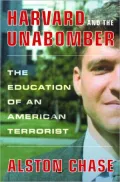
"On the basis of research and much previously unpublished material, Alston Chase presents a radically new interpretation of the infamous Unabomber. He projects Ted Kaczynski's life against the sinister backdrop of the Cold War, when the prospect of nuclear conflict generated on college campuses a fear of technology and a culture of despair. On those same campuses, federal agencies enlisted psychologists in a covert search for technologies of mind control and encouraged ethically questionable experiments of unwitting students." Harvard and the Unabomber is both a page-turner and a cautionary tale about modern evil. The conditions that provoked Kaczynski's alienation remain in place. In fact, they may be getting worse, as the War on Terrorism replaces the Cold War in American policy and imagination.Editorials
Publishers Weekly
Chase adds an important element to our understanding of the infamous Unabomber, Ted Kaczynski. Part of what made Kaczynski an iconic figure after his arrest in 1996 for 16 mail bombings (resulting in three deaths) between 1978 and 1995 was his unusual background as a highly gifted, Harvard-educated mathematician. While the media found comfort in writing him off as a mental case, more remarkable was how seemingly typical Kaczynski was. Bucking the conventional wisdom, Chase (In a Dark Wood) identifies Kaczynski as a victim more of the anxious and contradictory Cold War 1950s than of the incendiary 1960s. With a background strikingly similar to Kaczynski's-including both a Harvard degree and self-imposed exile in Montana-Chase is in a unique position to probe the underlying tensions that led Kaczynski to commit dispassionate murder in the name of ideals. Chase persuasively isolates the turning point in his subject's years at Harvard, "where lasting human relations are more rare than championship football teams." In Cambridge he faced the typical Harvard pressures but, more importantly, was a subject of three years' worth of what many will agree were wildly irresponsible psychological experiments led by maverick psychology pioneer Henry A. Murray. While the conclusions Chase draws are unimpeachable, his description of the fateful experiments feels truncated, no doubt because some records remain sealed. Chase's disenchanted indictment of academia (represented here by Harvard) as lackey to the military-industrial complex is all the more compelling for the author's unruffled sense of perspective. With its unusual emphasis and sometimes surprisingly personal tone, this may become the definitive Kaczynski volume. 16 pages of photos not seen by PW. Agent, Deborah Grosvenor. (Mar.) Forecast: Chase's revelations about Murray's experiment could generate wide interest and controversy; no doubt this will be widely reviewed. Copyright 2003 Cahners Business Information.Library Journal
Ted Kaczynski, the recluse whose compulsion to see his ideas printed in the nation's best newspapers ostensibly ended a murder spree that had lasted for years, here receives a sensitive intellectual dissection from former philosophy professor Chase, a near-contemporary fellow Harvard graduate and Montana transplant. At this book's core is the revision of a long article by Chase that ran in the Atlantic Monthly in June 2002 examining Kaczynski's not atypical isolation at Harvard in the early 1960s and his service as a human subject in an experiment conducted with indirect Cold War implications by now disfavored psychologist Henry Murray. Though his study is brilliantly conceived, Chase's execution is frustratingly clumsy; most of the facts of the Unabomber case are ultimately laid out, often repeatedly, but with no narrative cohesion. (A chronology at the end is a helpful corrective.) Readers will never quite learn just how the Murray experiment affected Kaczynski but will certainly understand some of the Unabomber's life and the social and political events behind his anger. A story this complex and painful cannot be told simply; recommended for all public libraries.-Scott H. Silverman, Bryn Mawr Coll., PA Copyright 2003 Reed Business Information.Kirkus Reviews
Sprawling cultural history attempts to link the Unabomber’s crimes to his educational background. "What effects did Harvard have on [Ted] Kaczynski?" asks environmentalist Chase (In a Dark Wood, 1995, etc.), who, like his subject, attended Harvard in the 1950s, felt alienated from the institution during tumultuous times, and later sought solitude in rural Montana. The author focuses on Kaczynski’s undergraduate participation in an "ethically questionable" psychological experiment conducted by renowned behavioral expert Henry Murray during the last years of his covert Cold War research. To Chase, Murray epitomizes the postwar science establishment in his collusion with the federal government on morally compromised projects such as the CIA’s notorious hallucinogen tests, which drew on Murray’s personality theories. The author sees the young Kaczynski--smart, socially maladjusted, in flight from an oppressive family life--as an embodiment of the ’50s "Silent Generation," seething with rage beneath a conformist veneer. Chase argues that Kaczynski’s part in Murray’s experiment, which by most accounts involved extensive verbal abuse and trickery, may have provoked his eventual homicidal obsessions. Thanks to his unfortunate Harvard experiences (grinds like Kaczynski were ostracized by the preppy students) and the ’50s "culture of despair," which directly informed his Unabomber "manifesto," Kaczynski was radicalized well before his graduate study at Berkeley in the late ’60s, asserts the author. Indeed, he already planned to move somewhere rural and begin a campaign of vengeance. Chase is a solid if sometimes dour writer, and does thorough work here, including actual correspondence with thecantankerous Kaczynski. Readers of his previous, highly controversial environmental writings will not be surprised by his contention that, although mainstream academia shunned Kaczynski’s manifesto, its ideas actually presage the coming of a new generation of eco-radicals. While his broad view of educational and psychiatric transformations during the ’50s and ’60s is provocative, some may feel he strays too far from his purported target, the enigmatic, murderous Kaczynski. Worthy examination of our "smartest" serial killer. Agent: Deborah Grosvenor/Grosvenor Literary AgencyBook Details
Published
August 8, 2003
Publisher
New York : W.W. Norton, c2003.
Pages
352
Format
Hardcover
ISBN
9780393020021