
Europe - 19th Century Architecture, Individual Architects, Designers, & Planners, General & Miscellaneous Architectural History & Criticism, Historical Biography - Royalty & Nobility, France - Political Biography, Urban Renewal, City Planning & Urban Desi
Log in to track your reading progress.
Overview
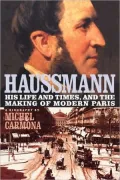
Baron Haussmann, the famous “architect” of modern Paris, has been an enigma for historians for more than a century. But in Michel Carmona, the baron has found a biographer worthy of his fascinating and influential life. Haussmann is not, however, a book only about the controversial prefect of the Seine: Mr. Carmona has effectively set his life against the background of nineteenth-century European society. Exhaustively researched and written with remarkable balance, the book is as much a social and political history as it is a biography. We see Haussmann’s early years and his entry into civic life as an administrator; the problems of urban existence faced by the city of Paris; Haussmann’s reign as the designated chief of Napoléon III’s grand scheme for the renewal of the French capital; and the so-called ”Haussmannization” of Paris. Some observers today still see Haussmann’s grands travaux as the criminal work of a modern Nero—a man intent on destroying old Paris and willing to cook the books and throw poor people out of their homes in order to achieve his ends. Others see him as a clairvoyant creator of the modern, hygienic, and organized city, who created a style that would become a model for urban transformation. Mr. Carmona has examined the record and has written a superb biography that will be of special interest to architects, urban planners, and anyone interested in the life of great cities. With 12 pages of black-and-white illustrations.Synopsis
Mr. Carmona sets the life of Baron Haussmann, the famous architect of modern Paris, against the background of nineteenth-century European society. He looks at the problems of urban existence faced by the city of Paris and shows how the controversial baron created a style that would become a model for urban transformation.
PARU.COM
Michel Carmona recounts, with much clarity and mastery, the biography of Napoléon III's great prefect.
Editorials
Les Echos
An exhaustive and remarkably well-balanced book.Paru.Com
Michel Carmona recounts, with much clarity and mastery, the biography of Napoléon III's great prefect.La Tribune
A particularly instructive look at the upheavals of an entire society and the description of a life occupied by service to the nation.The Washington Times
Anyone who loves Paris, and never mind the Parisians, will enjoy this book.Book Review Digest
Comprehensive, readable, and meticulously researched, this is a sympathetic yet balanced biography of the architect of modern Paris.Smithsonian
Lovers of Paris will find Carmona's chronicle a treasurehouse of urban lore.Jean-Philippe Dumas
Michel Carmona is full of sympathy and respect for his subject, and he successfully brings him to life.Witold Rybczynski
This engaging book traces the potent mix of vision, power, and real estate that created the Paris that we know today.MARIE MARMO MULLANEY
Comprehensive, readable, and meticulously researched, this is a sympathetic yet balanced biography of the architect of modern Paris.—BOOK REVIEW DIGEST
WITOLD RYBCZYNSKI
This engaging book traces the potent mix of vision, power, and real estate that created the Paris that we know today.LA TRIBUNE
A particularly instructive look at the upheavals of an entire society and the description of a life occupied by service to the nation.LES ECHOS
An exhaustive and remarkably well-balanced book.PARU.COM
Michel Carmona recounts, with much clarity and mastery, the biography of Napoléon III's great prefect.JEAN-PHILIPPE DUMAS
Michel Carmona is full of sympathy and respect for his subject, and he successfully brings him to life.Washington Times
Anyone who loves Paris, and never mind the Parisians, will enjoy this book.Publishers Weekly
The notorious city planner for Napol on III, and prefect of the Seine region, Baron Georges-Eug ne Haussmann turned Paris from a still medieval urban area to a triumphant imperial city Haussmann makes New York's Robert Moses look timid by comparison. Haussmann believed in cutting across straight lines for wide boulevards, no matter what was standing in the way. He drove tens of thousands of poor residents out of the city's center and destroyed many ancient sites. Yet Paris did not follow obediently according to Haussmann's plans, and press campaigns, Carmona shows, finally made the public reject his work. In four main sections, Carmona, a professor of urban studies at the Universit Paris IV-Sorbonne (who has written untranslated biographies of historical figures like Queen Marie de M dicis and Cardinal Richelieu), provides a reliable survey in academic prose of the rich source material available about Haussmann. In a utilitarian rather than elegant translation, this new book can get lost in some fairly tedious detail, but it hits all the necessary marks and then some, showing, for instance, that for all his imperial obsessions, even Napoleon III was not enamored of the giant radiating grands boulevards that make Paris so terrifying for pedestrians today. (June) Forecast: This book's judiciously chosen bibliography (of titles mostly in French) is sure to aid further research, although it omits the main English-language study currently in print, David Jordan's Transforming Paris: The Life and Labors of Baron Haussmann (Free Press), an informative political bio. Further English-language studies of Haussmann date back 30 years to David H. Pinckney's Napoleon III and the Rebuilding of Paris and Anthony Sutcliffe's The Autumn of Central Paris. Copyright 2002 Cahners Business Information.Library Journal
Comprehensive, readable, and meticulously researched, this is a sympathetic yet balanced biography of the architect of modern Paris. Carmona (Sorbonne) tells the story of Haussmann's life and career through the prism of 19th-century European political, social, and economic history. He explains how the personal and political collaboration between Haussmann, who was the prefect of the Seine department, and Emperor Napoleon III facilitated the transformation of Paris from a medieval to a modern city. He explains in sharp analytical detail the vision and principles that guided both men, an analysis that will make this book of interest to students of urban architecture and planning as well as to French historians. Carmona is also frank in explaining why his subject remains so controversial. Autocratic and at times imprudent, he was seen by contemporary opponents as insensitive both to the "deportation of the poor" and to the class segregation that resulted from his ambitious grand plans. Nonetheless, Carmona concludes that his "authoritarian, pragmatic, and efficient" personality was necessary in planning and executing such a visionary project of urban transformation. Recommended for academic libraries and specialized collections. [For a view of Haussmann's role in modern Paris that is more about the city than the man, see David P. Jordan's Transforming Paris. Ed.] Marie Marmo Mullaney, Caldwell Coll., NJ Copyright 2002 Cahners Business Information.Booknews
Attributing to Georges-Eug<'e>ne Haussmann (1809-91) the transformation of Paris from an unruly capital into a prestigious metropolis, Carmona (geography and country planning, Sorbonne, Paris) recounts his career as a city administrator appointed by Napoleon III in 1853. The original was published by Librarie Arth<'e>me Fayard in 2000 and translated from the French by Patrick Camiller. Annotation c. Book News, Inc., Portland, OR (booknews.com)Kirkus Reviews
A plodding but useful life of a man well known to French readers as the architect behind the great plazas, parks, and avenues of Paris. Georges Eugene Haussmann (1809-91) didn't come up with the ambitious 19th-century plan that leveled medieval Paris and put in its place the spacious metropolis familiar to moderns; the credit for that wholesale remaking belongs to Napoleon III, the real hero of this long narrative. But, writes Carmona (History/Sorbonne), Haussmann had the steely will such work required: "authoritarian, pragmatic, and efficient, he was concerned that there should be order in all things." And never mind the cost; he was so committed to the emperor's vision of a modern city free of choleric swamps and congested alleys that he tore down his childhood home without a second thought. Haussmann emerges here as a type familiar to any visitor to France: the consummate bureaucrat, convinced of the virtues of central authority, planning, reports-and, of course, of the righteousness of his ways. This self-confident vision formed early on, his biographer asserts, and owes much to an offhand remark Haussmann's grandfather once made to him: "We don't know well enough how many resources France contains and how rich and powerful it would become if it were well governed-above all, well administered." Haussmann filled the bill, ably overseeing the complex and at the time highly controversial work of resettling tens of thousands of people so that such marvels as the Place de la Concorde, Place du Trocadero, and Champs Elysees could be built. Though Carmona's narrative lacks the human interest of Robert Caro's life of Robert Moses, the urban leveler and creator to whom Haussmann is oftencompared, it capably depicts the man and his time. Of much interest to students of urban planning and modern European history.Book Details
Published
January 1, 2002
Publisher
Dee, Ivan R. Publisher
Pages
512
Format
Hardcover
ISBN
9781566634274