
Fiction - Entertainment & The Arts, Fiction - Animals - Mammals, Fiction - Historical People, Fiction - General & Miscellaneous
Log in to track your reading progress.
Overview
A debut to sing about!
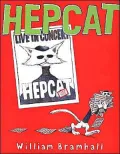
What's a musical cat to do when he's lost his groove? When his beat has up and beat it-on the eve of his big concert? Slip outside and find some new tunes, that's what! From The Beatles to Elvis to Little Richard (Good Golly, Miss Molly!), some of rock music's greatest legends make cameos in renowned editorial cartoonist William Bramhall's debut picture book. Rock on, Hepcat, you're the coooolest cat in town.
Hepcat suffers from stage fright until four beetles remind him that music is everywhere, and he ventures outside to find new inspiration.
Editorials
The New York Times
The rock 'n' roll references will go over most children's heads...And yes, Hepcat's beatnik phrases are slightly grating. But his adventure should go over well with children who like their silliness unrestrained.—Abby McGanney NolanPublishers Weekly
In this jaunty debut picture book, a cool cat gets cold paws about his big piano concert, and hits the street to find the beat. Just before show time, Hepcat is besieged by jitters. ("I'm so nervous. I've lost my groove!") When he hears music coming from beneath the floorboards of the concert stage, the feline investigates and discovers four beetles-who resemble the Beatles and employ their lyrics-and sagely tell him, "Music is everywhere." A search that includes stops at the city's avenues and alleys as well as a pond, treetop and bell tower fills Hepcat with much-needed aural inspiration. Bramhall's text bounces along at a fun-to-read clip that will hook younger readers, while adults will appreciate the visual and verbal homages to the works of such music legends as Elvis Presley, Little Richard and Chuck Berry. Bramhall, a newspaper cartoonist, composes energetic pen-and-inks of the aforementioned stars and creates a memorably thin Hepcat sporting the requisite hep black turtleneck and beret. An emphasis on black-and-white- la the beat-era wardrobe, sheet music, piano keys-works to great effect. What this book does best is convey the message that music can be found wherever the imagination alights. Ages 3-up. (June) Copyright 2004 Reed Business Information.Children's Literature
Hepcat was so nervous about his big concert that he lost the music inside him. As he twisted about on his piano bench, he heard music coming from under the stage's floorboards. He ripped them up to find four small beetles with familiar faces. They suggested that he cruise the scene outside and just listen. As Hepcat walked through the city, he heard music everywhere. He jived to the beats of traffic jams, lovebirds cooing, frogs croaking, thunder rumbling, wind whistling, and the clang of a big brass bell. Some of the characters he passed resembled such rock stars as Elvis Presley, Little Richard, and Liberace. He arrived back at the concert hall just in time to put on the best performance of his life. A tall thin Hepcat twists himself into unusual and humorous shapes as he explores his world in black and white illustrations touched with pastel colors. A good source of inspiration when the creative juices seem to stop flowing. A fun read aloud anytime. 2004, Philomel, Ages 5 to 10.—Phyllis Kennemer, Ph.D.
School Library Journal
PreS-Gr 3-Hepcat finds that his "vibes have vanished" on the night of his big piano concert. Four beetles (instrument-playing insects with the heads of the Beatles) tell him to "cruise the scene" to find music. The feline walks through city streets and country fields, but only notices noise. Finally Hepcat realizes that the car horns, thunder, birds, and wind that he has heard actually are music and he returns to give a great concert. Visual references such as Elvis on a street corner, Chuck Berry's car, and a piano-playing frog that looks like Little Richard may be lost on children. Attempts to incorporate well-known lyrics into Hepcat's comments seem awkward, as when he shouts: "Whoa, be good, Johnny" to Berry's passing car. There is also inconsistency in the cat's search for music. It makes sense that he misses hearing it in wind and traffic, but the harmonica-playing hound dog and whistling lovebirds are more obviously musical. Despite these flaws, the illustrations add flavor to the text. The feline's slinky, elongated figure is just right for a cool cat bopping around town. Most scenes are in shades of brown, black, and gray, while splashes of color call attention to the melodious elements that the protagonist overlooks. Hepcat's world has some visual appeal, but his story doesn't flow as smoothly as it should.-Steven Engelfried, Beaverton City Library, OR Copyright 2004 Reed Business Information.Kirkus Reviews
Thin in more ways than one, this debut from a newspaper cartoonist features a long, skinny feline beatnik in beret and shades, frantically searching for his suddenly lost groove. Hepcat's quest starts out promisingly enough, as he encounters four mop-topped "beetles," a rumpled Elvis warming his hands at a trashcan fire, and a stride piano-playing frog with a Little Richard pompadour, all of whom offer familiar advice or general comments ("Take a sad song and make it better")-but then Bramhall's invention peters out into a succession of generic street and storm noises that Hepcat brushes past at first, before eventually realizing how fundamentally musical they are. Even younger viewers will probably recognize the caricatured Pop icons, but that parade stops almost before it starts, and next to the likes of Mordicai Gerstein's What Charlie Heard (2002), the theme of music's ubiquity in the world all around gets a conventional rendition. (Picture book. 6-8)Book Details
Published
June 1, 2004
Publisher
New York : Philomel Books, c2004.
Pages
32
Format
Hardcover
ISBN
9780399238963