
Economic Theory & Schools of Thought, Social Services & Welfare, Economics & Politics, Economics, Labor & Politics, Ethics & Moral Philosophy
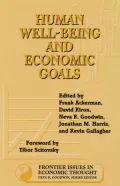
Human Well-Being and Economic Goals
Frank Ackerman, Frank Ackerman (Editor), Jonathan Harris (Editor), Neva R. Goodwin (Editor), David Kiron (Editor)
Available on Bookshop
Write a review
Books.org participates in affiliate programs including Bookshop.org and the Amazon Services LLC Associates Program. We may earn a commission from qualifying purchases made through links on this page, at no additional cost to you.
Log in to track your reading progress.
Overview
What are the ends of economic activity? According to neoclassical theory, efficient interaction of the profit-maximizing "ideal producer" and the utility-maximizing "ideal consumer" will eventually lead to some sort of social optimum. But is that social optimum the same as human well-being? Human Well-Being and Economic Goals addresses that issue, considering such questions as:
•Does the maximization of individual welfare really lead to social welfare?
•How can we deal with questions of relative welfare and of equity?
•How do we define, or at least understand, individual and social welfare?
•And how can these things be measured, or even assessed?
Human Well-Being and Economic Goals brings together more than 75 concise summaries of the most significant literature in the field that consider issues of present and future individual and social welfare, national development, consumption, and equity. Like its predecessors in the Frontier Issues in Economic Thought series, it takes a multidisciplinary approach to economic concerns, examining their sociological, philosophical, and psychological aspects and implications as well as their economic underpinnings.
Human Well-Being and Economic Goals provides a powerful introduction to the current and historical writings that examine the concept of human well-being in ways that can help us to set goals for economic activity and judge its success. It is a valuable summary and overview for students, economists, and social scientists concerned with these issues.
Synopsis
What are the ends of economic activity? According to neoclassical theory, efficient interaction of the profit-maximizing "ideal producer" and the utility-maximizing "ideal consumer" will eventually lead to some sort of social optimum. But is that social optimum the same as human well-being? Human Well-Being and Economic Goals addresses that issue, considering such questions as: Does the maximization of individual welfare really lead to social welfare? How can we deal with questions of relative welfare and of equity? How do we define, or at least understand, individual and social welfare? And how can these things be measured, or even assessed? Human Well-Being and Economic Goals brings together more than 75 concise summaries of the most significant literature in the field that consider issues of present and future individual and social welfare, national development, consumption, and equity. Like its predecessors in the Frontier Issues in Economic Thought series, it takes a multidisciplinary approach to economic concerns, examining their sociological, philosophical, and psychological aspects and implications as well as their economic underpinnings. Human Well-Being and Economic Goals provides a powerful introduction to the current and historical writings that examine the concept of human well-being in ways that can help us to set goals for economic activity and judge its success. It is a valuable summary and overview for students, economists, and social scientists concerned with these issues.Book Details
Published
March 22, 2013
Publisher
Island Press
Pages
458
Format
Hardcover
ISBN
9781597262446