
Mathematics & Measurement, Astronomy, Scientists, Naturalists & Engineers - Biography, Physics
Log in to track your reading progress.
Overview
Acclaimed author-illustrator Bonnie Christensen adopts the voice of Galileo and lets him tell his own tale in this outstanding picture book biography. The first person narration gives this book a friendly, personal feel that makes Galileo's remarkable achievements and ideas completely accessible to young readers. And Christensen's artwork glows with the light of the stars he studied.Galileo's contributions were so numerous—the telescope! the microscope!—and his ideas so world-changing—the sun-centric solar system!—that Albert Einstein called him "the father of modern science." But in his own time he was branded a heretic and imprisoned in his home. He was a man who insisted on his right to pursue the truth, no matter what the cost—making his life as interesting and instructive as his ideas.
Editorials
Publishers Weekly
Written in the first person, Christensen’s (Django) vivid biography opens with the aging Galileo Galilei sitting inside his garden walls, sentenced to house arrest. “Though I’m ending in darkness, I clearly recall the sun-filled hours of my early years,” he says as he recounts his life from childhood onward, highlighting his education and scientific discoveries. The explanatory style, accessible language, and diagrams keep science concepts understandable. Oil paint and gouache resist illustrations resemble woodcuts, with thick black outlines and borders setting off deep jewel hues. Particularly compelling is a claustrophobic scene of Galileo facing the Inquisition, the trial displayed in a small circular vignette, surrounded by a vast swirl of evening-sky royal blue—a nod to Galileo’s stargazing—that fills the spread. Foreshadowing time and truth as his rightful judges, Galileo sounds a hopeful note on the last page: “The old man is a prisoner, but the truth? The truth has a way of escaping into the light.” Extensive endnotes include a chronology of Galileo’s life, summaries of his experiments and inventions, a glossary, and bibliography. Ages 8–12. Agent: Marcia Wernick, Wernick & Pratt Agency. (June)Kirkus Reviews
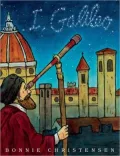
It was Galileo's passion that got him into trouble, but his dedication to finding the truth meant that his work endures. This distillation of the famed astronomer's life focuses on his exceptional talent for scientific inquiry. Christensen uses a first-person narration that brings readers close to Galileo's development as a scholar and a scientist. The narrative recounts his childhood in Pisa ("center of my parents' universe"), surrounded by music and mathematics and encouraged to ask questions in search of the truth. He describes his rise in the academic community and his invention of a calculating compass and "the world's first truly scientific telescope." Finally, he details the events that led to his humiliation and imprisonment for his scholarship in support of a Copernican view of the solar system. Christensen's bold lines and bright, warm gouache wash illustration support every part of the account. The handsome cover and title-page opening emphasize Galileo's particular delight in observing the stars and the movements of heavenly bodies with a telescope of his own design. A small illuminated circle, the room in which Galileo met the Inquisition, is set against a somber blue-black background, a striking contrast with earlier pages showing the warm and heavenly blue of the night sky under Galileo's observation. Maps and diagrams within the narrative help guide readers. A timeline spanning the years both before and after Galileo's life, brief lists of his inventions, experiments and discoveries, a glossary and list of sources extend the work. An accessible, inviting and attractive introduction to Galileo. (Picture book/biography. 6-10)The New York Times
Following up on her illustrated biographies for older readers (Woody Guthrie, The Daring Nellie Bly, Django), Bonnie Christensen dials back several centuries in I, Galileo, demonstrating once again how a well-conceived and executed picture book can deliver a serious story—in this case, of one of history's great independent thinkers—in a beautiful, enriching way for those readers who've supposedly "moved on" to chapter books.—Pamela Paul
Children's Literature -
This story of Galileo Galilei, 16th century scientist imprisoned for his proposal of a sun-centered solar system, is told by the early astronomer himself. Writing as a blind old man, he recalls his early years, when he was taught music and mathematics by his father who encouraged him to ask questions and seek truth. Galileo quit the university but soon was lecturing there. He recalls his experiments with objects in motion, his invention of an "ingenious compass," and his refinement of the newly invented spyglass. With this telescope he views the moon, sun, and planets, and decides that Copernicus was correct about the sun as the center. But he runs into trouble with the Pope and the Church; he is charged with heresy. He ends his life imprisoned. Christensen uses a gouache resist with oil paints to project a rich visual quality to scenes and diagrams suggesting paintings of the Renaissance. The illustrations provide information about the technology and the environment in which the scientist worked, in ways that express the strong emotional content of events. End pages offer a decorative map of Italy with the locations of the cities involved in the story. Notes add information about Galileo, his experiments, inventions and improvements, and astronomic discoveries as well as a chronology, glossary, bibliography, and websites. Reviewer: Ken Marantz and Sylvia MarantzSchool Library Journal
Gr 3–8—Narrated by "the father of modern science"' himself, this exquisite picture-book biography conveys both the tragedy and triumph of Galileo's life's work. A preface describes what the world was like in 1564, opposite an illustration of the universe as Aristotle and Ptolemy believed it to be, with Earth at its center. The child of a musical theorist whose "revolutionary views challenged musical tradition and angered authorities," young Galileo learned to question accepted theories and think for himself. Christensen allows her subject to relate his story sequentially, also expounding on popular thought and detailing his experiments and discoveries. While Copernicus is credited for promoting the theory that the sun was the center of the universe 50 years earlier, it was Galileo who proved it. The inventor of the geometric and military compass, a telescope that revealed the heavens, a microscope, and a pendulum clock kept quiet for seven years, but when he dared to publish his findings, he was condemned for heresy and sentenced to imprisonment in his own home for the rest of his life. A chronology of Galileo's life as well as of important events in his world, a description of his experiments, and lists of his inventions and discoveries are appended. The vibrant illustrations were created with a gouache resist and oil paints, outlined in black and resemble stained glass. The first-person narration renders the text both engaging and accessible; charts, diagrams, and thumbnails explicate the science. Libraries that already own Leonard Everett Fisher's Galileo (Atheneum, 1992) or Peter Sís's Starry Messenger (Farrar, 1996) will still want this accomplished volume.—Barbara Auerbach, PS 217, Brooklyn, NYBook Details
Published
June 12, 2012
Publisher
Random House Children's Books
Pages
40
Format
Hardcover
ISBN
9780375867538