
Economic Conditions in Asia, Asian Studies - South Asia - India, Indian History - Social Aspects, India - Politics & Government, Indian History - Economics Aspects, Indian History - Republic of India (1947-Present)
Available on Bookshop
Write a review
Books.org participates in affiliate programs including Bookshop.org and the Amazon Services LLC Associates Program. We may earn a commission from qualifying purchases made through links on this page, at no additional cost to you.
Log in to track your reading progress.
Overview
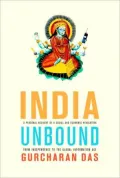
India today is a vibrant free-market democracy and has begun to flex its muscles in the global information economy and on the world stage. Now, acclaimed columnist Gurcharan Das traces India's recent social and economic transformations in an eminently readable, impassioned narrative.Das tells the stories of the major players in a period of rapid and profound change—from schoolchildren inspired by Nehru's speeches in the early days of Independence to the current software impresarios—and makes comprehensible and compelling the economic and political development responsible for these changes. He weaves his personal story into the larger context of contemporary history: his family's move to America in the mid-1950s, his education at Harvard, his years in India as a young marketing executive wrestling with a socialist system he feared would undermine the country's vast potential. He also shows us the reasons behind his optimism for his nation's future, among which is the exciting landscape of information technology today.
Das argues that the changes of the past fifty years have, at last, amounted to a revolution—and it is one that has not been chronicled before. With India Unbound, he gives us a book that is at once vigorously analytical and vividly written—an essential insider's road map to India, then and now.
From the Hardcover edition.
Editorials
From Barnes & Noble
The advent of the digital age, coupled with the liberalization of the Indian economy, has inaugurated what Gurcharan Das -- novelist, playwright, and former CEO of Procter & Gamble India -- calls a "silent revolution" in the heart of the world's most populous democracy. In his latest book, an impassioned and eloquent blending of history, autobiography, and economic analysis, Das argues that within a generation, 50 percent of India's population, which itself accounts for one-sixth of all the world's people, will become members of the middle class. The implications of this statement for the nation and for the global marketplace are staggering. As Das says, "In information technology we may finally have found the engine that can drive India's takeoff and transform our country."Pete Engardio
Anecdotes like this one grace nearly every chapter of Das's book, India Unbound. And they help make it one of the most readable and insightful books to appear on India's tortuous economic path in its 54 years since shaking off British rule.— BusinessWeek
Akash Kapur
Das had a ringside seat at the events he describes, and the result is an engaging account that moves easily from the big picture to the telling anecdote...— New York Times Book Review
Publishers Weekly
Das, an Indian venture capitalist and columnist for the Times of India (and former CEO of Procter & Gamble India), uses his own experiences as a businessman as the context in which to comment on India's postcolonial economic policies. He begins with Nehru's mixed economy (which he argues achieved democracy but ignored entrepreneurship and competition, resulting in an absence of industrial development) and continues through to the economic reforms of 1991 under Prime Minister Narasimha Rao (whom he labels a "reluctant liberalizer"), demonstrating how India has abandoned state-directed industrialization and finally become a free-market democracy with a burgeoning middle class. He also points out how India's late (and incomplete) entry into the international economy continues to hamper its growth, as compared to other late entries, such as that of China, which had a lower per capita income than India did in the mid-'60s and today boasts one twice as large as India's. Nevertheless, Das remains optimistic that "the new India is increasingly one of competition and decentralization," particularly because of the Internet and the boom in software entrepreneurship. In explaining India's economic policies, he gives much credence to theories about high-caste Brahmins being averse to making money and the government's fears that capitalism would crush the poor; but Das only mentions in passing Russia's ideological sway at the time of India's independence and does not discuss the Cold War or the context for India's belief that import substitution was necessary to make India less dependent on the outside world for its survival. Business readers with an interest in Third World development will learn much from Das. (Feb. 26) Copyright 2001 Cahners Business Information.Library Journal
In 1991, four decades of Nehruvian socialism fell before the economic reforms of Indian Prime Minister Narasimha Rao. In the subsequent decade of India's deregulation, the national debt has decreased, the middle class has doubled in size, inflation has declined, and the restraints of industrial licensing have been abolished. Das, a former CEO of Proctor & Gamble and presently a business consultant and journalist, exudes an evangelical zeal for India's entry into the world economy. Arguing that India never experienced an industrial revolution, he asserts that because of its conceptual nature, the information age his country is now embracing is a superior fit with its caste system. Das also envisions India's economic growth as paralleling that of China, Japan, Korea, and Indonesia. Told with verve and excitement, Das's tale is loosely organized around a chronology of his life. He eschews mention of worker exploitation, environmental pollution, and new forms of corruption, but his story is an exciting, hopeful account that can be read by all with profit, as long as discretion is exercised.--John F. Riddick, Central Michigan Univ. Lib., Mt. Pleasant Copyright 2001 Cahners Business Information.Booknews
Das sees a great drama and hope in India's economic and social transformation of the past 20 years; it is "the struggle of one-sixth of humanity for dignity and prosperity," and it has consequences for the future of the rest of the world as well. Within a generation, he writes, the middle class<-->which now makes up about 18 percent of the Indian population<-->is expected to increase to 50 percent. He tells the story of the nation's free-market revolution in the first person, using his own history to illustrate greater historic truths about India's prosperity and poverty. Das is a venture capitalist and newspaper columnist based in New Delhi. Annotation c. Book News, Inc., Portland, OR (booknews.com)Kirkus Reviews
A sturdy—and highly optimistic—analysis of Indian politics and economics. Times of India columnist Das was once a youthful idealist who believed passionately in Nehru's version of socialism and later kept faith in India's mixed-economy path to market democracy. Both models failed, for complex reasons having mostly to do, Das suggests, with incompetence and corruption in the official sector. The worst moments came between 1965 and 1991, when, "instead of changing our course as many countries did, we tightened our system, making it more rigid and bureaucratic"—even as occasional experiments in deregulation showed promise of replacing scarcity with plenty. Now convinced that "alleviating poverty is more important than achieving quality," and that the creation of wealth is as important as its just distribution, Das heralds India's sweeping reforms of 1991, which lifted government controls over industries and markets, encouraged foreign trade, and coordinated efforts to build a modern infrastructure. One now-evident result, Das holds, is India's thriving information-technology sector, which has drawn on an immense pool of "intellectual capital" (i.e., highly educated workers) to create an industry that promises to rival that of Silicon Valley. Much remains to be done to make India competitive as an information-technology power, Das allows, inasmuch as it has only 3 computers for every 1,000 people (and will likely raise that figure only to 20 or so by 2008). Even so, he urges, high-tech is the best path to eradicating India's persistent poverty. "We have realized," he writes, "that our great strength is our people. Our great weakness is our government.Ourgreat hopeis the Internet." Extremely useful reading for anyone seeking to invest in or do business with India, and for students of the global economy generally.Book Details
Published
June 27, 2001
Publisher
Knopf Doubleday Publishing Group
ISBN
9780375413445