
Historical Biography - United States - 19th Century, Cabinet Members - 18th & 19th Century - Biography, Confederate States of America - General & Miscellaneous, Confederate States of America - Armed Forces, United States Civil War - Individual Battles & C
Log in to track your reading progress.
Overview
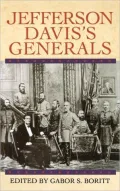
Confederate General P.G.T.Beauregard once wrote that "no people ever warred for independence with more relative advantages than the Confederates." If there was any doubt as to what Beauregard sought to imply, he later to chose to spell it out: the failure of the Confederacy lay with the Confederate president Jefferson Davis. In Jefferson Davis' Generals, a team of the nation's most distinguished Civil War historians present fascinating examinations of the men who led the Confederacy through our nation's bloodiest conflict, focusing in particular on Jefferson Davis' relationships with five key generals who held independent commands: Joseph E. Johnston, Robert E. Lee, P.G.T. Beauregard, Braxton Bragg, and John Bell Hood. Craig Symonds examines the underlying implications of a withering trust between Johnston and his friend Jefferson Davis. And was there really harmony between Davis and Robert E. Lee? A tenuous harmony at best, according to Emory Thomas. Michael Parrish explores how Beauregard and Davis worked through a deep and mutual loathing, while Steven E. Woodworth and Herman Hattaway make contrasting evaluations of the competence of Generals Braxton Bragg and John Bell Hood. Taking a different angle on Davis' ill-fated commanders, Lesley Gordon probes the private side of war through the roles of the generals' wives, and Harold Holzer investigates public perceptions of the Confederate leadership through printed images created by artists of the day. Pulitzer Prize-winner James M. McPherson's final chapter ties the individual essays together and offers a new perspective on Confederate strategy as a whole. Jefferson Davis' Generals provides stimulating new insights into one of the most vociferously debated topics in Civil War history.Editorials
David Rolfe
Jefferson Davis's Generals is a lively collection of essays by various historians that call into question the popular views on several key Confederate generals... paying close attention to the part each general's relationships with Confederate President Jefferson Davis played in the generals' success or failures.—Greensboro Journal
Kristin Putchinksi
Jefferson Davis's Generals, a collection of essays from eight renowned Civil War historians that illustrates, primarily, how war affects personal relationships in the military sphere and how these relationships might have affected the outcome of the war. These historians examine the relationship and lives of five important generals, their wives, and their commander in chief, Jefferson Davis.This collection is intended for the reader wishing to learn more about the interpersonal relationship of Davis and his top ranking military leaders.
— ForeWord Magazine
William W. Starr
Confederate President Davis either didn't get along with his generals or got along with them perhaps too well....There's enough provoking controversy in these pages to fuel an entire winter's debate.— The State, Columbia, S.C.
Library Journal
In this new edited work from Boritt (Why the Civil War Came, Oxford Univ., 1996), eight essayists catalog Confederate States of America president Jefferson Davis's personality flaws and his dysfunctional relationships with his five commanders. A study of Davis and Gen. Joseph E. Johnston shows them at odds over conflicting strategies, loss of mutual confidence and respect, and a breakdown of communication. Pierre Beauregard's hatred of Davis spanned the war, and yet the general willingly cooperated with his president. Braxton Bragg's western campaign suffered from executive meddling, hostile subordinates, and an overabundance of Davis cronies on his staff. John Bell Hood is seen as the incompetent beneficiary of the president's favoritism. Surprisingly, a final contribution by historian James McPherson deflates the book's argument, contending that battlefield strategy far outweighed personalities. While this is a worthy addition to Civil War historiography, the fine sections on the role of the generals' wives and Davis iconography could have been more effectively integrated, and in the summary chapter the contributors appear to be in a civil war of their own making concerning the book's thesis. Recommended for public and academic libraries.--John Carver Edwards, Univ. of Georgia Libs., Athens Copyright 1999 Cahners Business Information.Book Details
Published
June 14, 1999
Publisher
Oxford University Press, USA
ISBN
9780199923779