
Join Books.org — it's free

Jewish Biography, Bible - Stories, Royalty - Biography, Middle East - Peoples & Places
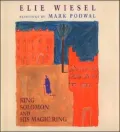
King Solomon and His Magic Ring by Elie Wiesel, Mark H. Podwal β€” book cover

King Solomon and His Magic Ring

by Elie Wiesel, Mark H. Podwal
Write a review
Log in to track your reading progress.

Overview

So begins Elie Wiesel's harmonious retelling of twenty mysterious and wonderfully compelling stories about King Solomon--rarely heard tales that span the revered ruler's life, from the time he took the throne at age twelve, to the building of the Temple in Jerusalem, to the disintegration of the kingdom upon his death. Rich, rewarding, gracefully told, this keepsake book is illustrated by Mark Podwal, whose fluid and symbolic paintings grace every spread.

Recounts some of the stories of the wisdom and folly in the life of the legendary King Solomon.

About the Author, Elie Wiesel, Mark H. Podwal

Elie Wiesel is the author of more than forty books of fiction and nonfiction. He is Andrew Mellon Professor in the Humanities at Boston University. In 1986 Elie Wiesel received the Nobel Peace Prize.

Biography

"Never shall I forget that night, the first night in camp, which has turned my life into one long night, seven times cursed and seven times sealed. Never shall I forget that smoke. Never shall I forget the little faces of the children, whose bodies I saw turned into wreaths of smoke beneath a silent blue sky." Since the publication of this passage in Night, Elie Wiesel has devoted his life to ensuring that the world never forgets the horrors of the Holocaust, and to fostering the hope that they never happen again.

Wiesel was 15 years old when the Nazis invaded his hometown of Sighet, Romania. He and his family were taken to Auschwitz, where his mother and the youngest of his three sisters died. He and his father were later transported to Buchenwald, where his father died shortly before Allied forces liberated the camp in 1945. After the war, Wiesel attended the Sorbonne in Paris and worked for a while as a journalist. He met the Nobel Prize-winning writer Francois Mauriac, who helped persuade Wiesel to break his private vow never to speak of his experiences in the death camps.

During a long recuperation from a car accident in New York City in 1956, Wiesel decided to make his home in the United States. His memoir Night, which appeared two years later (compressed from an earlier, longer work, And the World Remained Silent), was initially met with skepticism. "The Holocaust was not something people wanted to know about in those days," Wiesel later said in a Time magazine interview.

But eventually the book drew recognition and readers. "A slim volume of terrifying power" (The New York Times), Night remains one of the most widely read works on the Holocaust. It was followed by over 40 more books, including novels, essay collections and plays. Wiesel's writings often explore the paradoxes raised by his memories: he finds it impossible to speak about the Holocaust, yet impossible to remain silent; impossible to believe in God, yet impossible not to believe.

Wiesel has also worked to bring attention to the plight of oppressed people around the world. "When human lives are endangered, when human dignity is in jeopardy, national borders and sensitivities become irrelevant," he said in his acceptance speech for the Nobel Peace Prize in 1986. "Wherever men and women are persecuted because of their race, religion, or political views, that place must -- at that moment -- become the center of the universe."

Though lauded by many as a crusader for justice, Wiesel has also been criticized for his part in what some see as the commercialization of the Holocaust. In his 2000 memoir And the Sea Is Never Full, Wiesel shares some of his own qualms about fame and politics, but reiterates what he sees as his duty as a survivor and witness:

''The one among us who would survive would testify for all of us. He would speak and demand justice on our behalf; as our spokesman he would make certain that our memory would penetrate that of humanity. He would do nothing else.''

Good To Know

Use of the term "Holocaust" to describe the extermination of six million Jews and millions of other civilians by the Nazis is widely thought to have originated in Night.

Two of Wiesel's subsequent works , Dawn and The Accident, form a kind of trilogy with Night. "These stories live deeply in all that I have written and all that I am ever going to write," the author has said.

President Jimmy Carter appointed Wiesel to be chairman of the President's Commission on the Holocaust in 1978. In 1980, Wiesel became founding chairman of the United States Holocaust Memorial Council. He is also the founding president of the Paris-based Universal Academy of Cultures and cofounder of the Elie Wiesel Foundation for Humanity.

Since 1969, Marion Wiesel has translated her husband Elie's books from French into English. They live in New York City and have one son.

Reviews

There are no reviews yet. Log in to write one.

Editorials

Washington Post

As we read it we feel as though we are sitting in the presence of a master storyteller who has opened up is hand to show that it is full of pearls...This is augmented by the dreamy artwork of Mark Podwal, making for a book that is as beautiful as it is uplifting.

Publishers Weekly - Publisher's Weekly

In a loosely spun collection of legends about King Solomon, Nobel laureate Wiesel adopts a friendly, conversational style--almost as if he were spending a Shabbat afternoon regaling children with snippets of tales from the Talmud and Midrash. The angel Michael brings Solomon the ring of the title: "With it you will conquer all the demons of this world, and with their labor, you shall build the Temple of Jerusalem." Anecdotes tell how the king travels on a flying carpet; trades quips with ants and birds; unwisely takes the Pharaoh's daughter as one of his 1000 wives; gets tricked by Ashmedai, the king of the demons; etc. The narrative is fluid, with one episode easily giving way to the next. However, some readers--particularly presiding adults unfamiliar with the roles of the Talmud and Midrash--may wish the author had provided more of a context for his storytelling than is offered in the minimal source notes at the end. Podwal, previously paired with Wiesel for A Passover Haggadah, adheres to his customary style, eschewing clearly narrative visuals in favor of a series of almost mythic images. If Wiesel's text evokes the atmosphere of his Carpathian boyhood, Podwal's palette hints of the South of France, and his carefully modulated abstractions are as striking in their embrace of the 20th century as is the text's pleasure in tradition. Ages 5-up. (Aug.) Copyright 1999 Cahners Business Information.

Children's Literature - Rebecca Joseph

This simple, elegant book relates some of the stories of wisdom and folly in the life of the legendary King Solomon. From the building of the great Temple in Jerusalem to God's gift of a special magic ring, Solomon received more than he ever expected from God. When he lets the power of the ring outweigh the wisdom of ruling intelligently, he suffers greatly. The beautiful words of Elie Wiesel are accompanied by the lovely paintings of Mark Podwal.

School Library Journal

K-Gr 4 Vividly retold legends of King Solomon have been interwoven with Biblical accounts of his reign to present an exciting picture of his life. The text is filled with magic: a ring from God, a flying carpet, the language of animals, and power over demons. The Temple in Jerusalem is built and Solomon's wisdom is renowned, until the demon king, Ashmedai, steals his throne with a clever trick. Although Solomon eventually regains his kingdom, his life is never the same. Podwal's distinctive, imaginative illustrations done in gouache, acrylics, and colored pencil have a deceptively simple at times almost surreal quality, eye-catching in their rich colors, basic forms, variety of perspectives, and intriguingly menacing demons. Source notes are appended. Patricia Pearl Dole, formerly at First Presbyterian School, Martinsville, VA Copyright 1999 Cahners Business Information.

Book Details

Published
March 23, 2000
Publisher
HarperCollins (USA)
Pages
56
Format
Hardcover
ISBN
9780688169596

Similar books