
Reference - Dictionaries
Available on Bookshop
Write a review
Books.org participates in affiliate programs including Bookshop.org and the Amazon Services LLC Associates Program. We may earn a commission from qualifying purchases made through links on this page, at no additional cost to you.
Log in to track your reading progress.
Overview
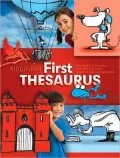
Fully updated for 2004, this revised and updated thesaurus is an easy-to-use word finder containing more than 100 key words and more than 1,000 secondary words, as well as synonyms and antonyms. Simple example sentences and amusing cartoons clarify and visually reinforce word meanings while making learning fun.
An illustrated thesaurus containing over 100 key words accompanied by their synonyms, antonyms, and homonyms. Also includes example sentences to explain shades of meaning and games to play with words.
Editorials
Children's Literature -
Navigating a thesaurus as a young child can often be overwhelming. This thesaurus is accessible for the very youngest readers and writers. While more advanced writers will need a thesaurus with more words, this thesaurus includes detailed entries for very common words that a young writer might need a synonym for. Each entry word is set in its own blue sidebar. Each sidebar includes the part of speech, definition, a sentence using the word in context, and multiple synonyms. The synonyms are used in sentences so the user can pick out the best synonym based on how it is used. Some entries include antonyms. On each page, only one entry word is featured in full, however, other words are cross-referenced to other similar words, just like in a regular thesaurus. Another helpful feature in this thesaurus is picture-related words. For example, the word container is featured on a two-page spread. Thirty-four containers are illustrated and labeled, such as a mug, crate, chest, safe, and more. This would be an invaluable resource for kindergarten teachers and English as a Second Language teachers. Most of the entires are also illustrated with simple drawings. A list of common homophones is listed in the back of the book. This reference book is highly recommended for classrooms. If you know a child that is a budding writer, but is just becoming comfortable with reading and writing, then this would make a great home reference as well. Reviewer: Marcie Flinchum AtkinsPublishers Weekly
New and updated reference guides for beginning readers aim to improve vocabulary and all-around knowledge. According to PW, Kingfisher First Dictionary by John Grisewood and Angela Crawley sports "a highly accessible design," with its copious illustrations, photos and examples. Kingfisher First Thesaurus by George Beal, illus. by Martin Chatterton, also updated, employs line illustrations over the requisite synonyms, antonyms and homonyms. Games and more in-depth looks at selected topics broaden its appeal. Copyright 2004 Reed Business Information.Children's Literature
An introduction gives a basic review of specific word choices and synonyms. It includes directions for using the thesaurus and clearly describes the organization by key words and cross references. A discussion of antonyms and homonyms follows with the promise of games on special topic pages. The games are fun. They provide a challenge above the suggested grade level and answers appear on the final page. Students who like to read will continue to browse the words long after they have finished the puzzles. Chatterton's funny drawings make a huge contribution to the books success, and large size print and light blue sidebars appeal to reluctant readers without insulting the fluent. The cover clearly targets children age eight and under, but the vocabulary is appropriate for older or remedial students as well. It is a valuable reference for school or home, and a lot more fun than the synonym finder in any word processing program. 2004, Kingfisher/Houghton Mifflin, Ages 5 to 8.—Tina Dybvik
School Library Journal
Gr 1-4-Both of these resources are geared to beginning readers, but the similarity ends there. Thesaurus offers 100 entries in black type against blue boxes-a concern for new readers. Each entry shows part of speech, definition, and 2 to 6 synonyms with examples of use in a sentence, an approach that fails to convey shades of meaning. Many also include "opposite words." Unfortunately, many of the definitions and examples are far too difficult for the intended audience (e.g., Big: "Something is called big because it is sizable or important"), and the introduction, written for children, contains extremely sophisticated vocabulary and syntax. Dictionary includes 1500 words or phrases that children hear every day, including both simple terms such as "dry" as well as more complicated ones like "mystery." All definitions are presented in complete sentences, with defined words in bold type, and common dictionary terms are replaced with simpler language; for example, cross-references tell users to "look at" another word. The layout, featuring copious color illustrations and photos, an excellent use of white space, and a contextual "letter string" down the side of each page, is especially appropriate for this age group. Pronunciation guides appear for words with difficult spellings, but this feature is inconsistent. On the whole, Dictionary, with its limited scope and useful features, is a far better match for the skills and needs of this audience than Thesaurus.-Kathleen Kelly MacMillan, Maryland School for the Deaf, Columbia Copyright 2004 Reed Business Information.From the Publisher
Children's Literature It is a valuable reference for school or home, and a lot more fun than the synonym finder in any word processing program. 2004, Kingfisher/Houghton Mifflin, Ages 5 to 8.Book Details
Published
July 19, 2011
Publisher
Kingfisher
Pages
144
Format
Paperback
ISBN
9780753465868