
Classical Composers - Biography, Modern Classical Music - General & Miscellaneous
Log in to track your reading progress.
Overview
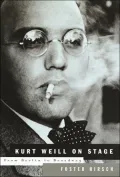
"The words are by Bertolt Brecht. The music is by Kurt Weill. The song is "Mack the Knife," the number-one song of Weill's internationally famous Threepenny Opera, originally performed on a stage in the Weimar Berlin of 1928. Its tough, sexy sound became, a quarter-century later, a signature song of America's greatest recording stars, among them Ella Fitzgerald and Frank Sinatra." "And when in 1933 Weill, already Germany's most renowned composer, fled the Nazis to come to America ("For every age there is a place about which fantasies are written. In Mozart's time it was Turkey. For Shakespeare, it was Italy. For us in Germany, it was always America"), he joined his appetite for the United States to his European roots and classical training and soon became one of the most admired composers of the American musical stage." "He wrote one successful Broadway show after another - Lady in the Dark, Knickerbocker Holiday, One Touch of Venus, Street Scene, Lost in the Stars, among others. He worked with such theatrical greats as Gertrude Lawrence, Ira Gershwin, Maxwell Anderson, Mary Martin, Agnes de Mille, Joshua Logan, Ogden Nash, Harold Clurman, Walter Huston, E. Y. Harburg, and Elia Kazan. Always at the center of his life was his great love of thirty years, his leading lady, interpreter of his music, his wife (they were divorced in Berlin in 1933 but remarried four years later in America), the actress-singer Lotte Lenya." Foster Hirsch, using Weill's letters, journals, and notes, and interviewing Weill's friends and colleagues, writes about his life, his experimental, political composing in Germany, his Broadway music in America - both aspects of his work being a source of controversy among music lovers for years.Editorials
Publishers Weekly
A provocative but uneven look at the composer of The Threepenny Opera, Lady in the Dark and other well-known musicals, this biography traces Weill's career from his satirical Weimar collaborations with Brecht to the musicals he created for Broadway after fleeing the Nazis in 1933. Brooklyn College film professor Hirsch (Harold Prince and the American Musical Theater) draws on extensive documentation from New York's Kurt Weill Foundation and new interviews with surviving participants to argue that the distinction most writers make between "Berlin Weill" and "Broadway Weill" is artificial. He explores, instead, what remained constant in Weill's creative personality despite the divergent styles of the Broadway and Berlin years. This intriguing approach is somewhat undermined by questionable assertions throughout the book. (For example, he cites the notoriously anti-Semitic music critic Virgil Thomson as an authority for the dubious notion that Weill's music evoked "the Jewish underworld of Berlin.") The book does, however, offer a textured portrait of Weill's Broadway career, and there are useful details about how his widow, the gifted performer Lotte Lenya, helped resuscitate his reputation with the 1950s production of Threepenny Opera in Greenwich Village. Hirsch's volume is good for casual enthusiasts and larger theater collections, though music fans may find the absence of analytical comment on Weill's compositions a drawback. (Mar.) Copyright 2001 Cahners Business Information.Library Journal
The Berlin premiere of The Threepenny Opera in 1928 was a pivotal event for Kurt Weill, securing him wide notoriety as a composer for musical theater and provoking a number of raised eyebrows from traditional figures in Weimar Germany. His exotic rhythms, evocative harmonic changes, and unique jazzy flavor all combined to produce a distinctive sound. Hirsch (film, CUNY, Brooklyn Coll.) traces Weill's illustrious career from these early days through his immigration to the United States, his ultimate destination after fleeing from the Nazis. Here, Weill wrote the scores for such memorable shows as Lady in the Dark, Knickerbocker Holiday, Lost in the Stars, and others. Hirsch provides details about each production, including an analysis of its artistic, theatrical, and social components as well as commentary on its public reception. Insights are offered into Weill's relationships, including his complex marriage to Lotte Lenya, his collaborations with the mercurial Bertolt Brecht, and his associations with Ira Gershwin, Alan Jay Lerner, Agnes de Mille, and countless others. In addition to his basic research, Hirsch incorporates material based upon a number of interviews that he recently conducted with prominent individuals (Harold Prince, Fred Ebb, etc.), enabling him to present additional perspectives on Weill's life and work as compared to previous biographies. This absorbing and well-researched work should be especially appealing to those interested in the history and evolution of musical theater. Carol J. Binkowski, Bloomfield, NJ Copyright 2002 Cahners Business Information.Booknews
Hirsch (film, City U. of New York-Brooklyn College) draws on composer Weill's (1900-50) letters, journals and notes, and interviews with his friends and colleagues to explore his life, his experimental and political composing in Germany, and his Broadway music in America. He details the writing, casting, and production of his 11 hit shows. Annotation c. Book News, Inc., Portland, OR (booknews.com)Kirkus Reviews
A first-rate survey of the enigmatic but brilliant composer's life and work. A star pupil of composer/intellectual Ferruccio Busoni, Kurt Weill (1900-50) promised much and did not disappoint. By his early 20s, he had produced prodigious amounts of high-quality instrumental and vocal music. Directing his attention to the theater, he created with playwright Bertolt Brecht Mahagonny-Songspiel, which got him attention, and Die Dreigroschenoper (The Threepenny Opera), which got him fame. The Jewish composer was at the height of his powers when driven from Germany by the Nazis. In New York, he turned to the Broadway musical. While he enjoyed success, this career move away from "serious" music was to earn him opprobrium from critics and intellectuals in Europe and America that lasts to the present day. Theater historian Hirsch (Film/Brooklyn College; Harold Prince and the American Musical Theater, not reviewed, etc.) contends that Weill was as much as an innovator in America as he was in Germany; just as he had challenged the conventions that obtained in opera, the dominant musical culture in his homeland, he strove to enlarge the horizons of the American equivalent, the Broadway musical. Hirsch further argues that future innovators like Leonard Bernstein and Stephen Sondheim owe much to Weill. Displaying an easy familiarity with musical structures and vast knowledge of theater, the author parses Weill's major theatrical works thoroughly and for the most part persuasively, despite an occasional stretch like the description of the opening of Lost in the Stars. ("The number's undulating movement suggests the geographical divisions between the rich upper hills where the white families live and theparched lower hills . . . occupied by blacks.") Hirsch is also a splendid biographer. Making extensive use of primary sources, he succeeds at stripping away Weill's cerebral public persona and revealing the passionate man beneath. Most enjoyable are the letters to his wife, Lotte Lenya, whose stunningly frank content would no doubt have shocked adversaries who saw only his public, easygoing face. For the specialist and generalist alike, a wonderful portrayal of a fascinating and likable genius.Book Details
Published
March 1, 2002
Publisher
Alfred A. Knopf
Pages
416
Format
Hardcover
ISBN
9780375403750