
Racial Discrimination, South Africa - History, Political Protest & Dissent, Africa - Ethnic & Race Relations, Journalists - News & Media Biography, South African Politics & Government, Zimbabwe - History
Log in to track your reading progress.
Overview
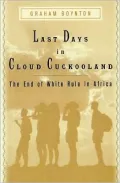
Last Days in Cloud Cuckooland is Graham Boynton's account of the final gasps of white culture on the continent, from the flight of the Belgian refugees from the Congo in 1960 through the first years of Nelson Mandela's presidency in South Africa. In a series of graphic accounts of the human dramas marking this disorderly retreat, he illuminates the complexity and ambiguity of the role of the whites in Africa. They "were never a unified gang of cold-hearted supremacists," he writes, "any more than the blacks in Africa have been a saintly group of idealists and altruists." It is an evocative story, and as it unfolds the author is drawn toward a controversial conclusion. If the white colonials did a rather poor job of making Africa work, he argues, then their African successors have done considerably worse.Editorials
Publishers Weekly -
Reared in Rhodesia, educated at a university in South Africa, Boynton has worked for publications in Britain and the United States but keeps returning to Africa. This bookpart memoir, part reportageconsists of engaging tales hobbled somewhat awkwardly by white Africans from different countries and different eras. Boynton opens with a pessimistic picture of democratic South Africa: white suburbanites, terrified of burgeoning crime, live behind layers of security. Though Boynton says he long resisted white shibboleths about decline under black governments, he found himself hankering for the "benign paternalism" of colonial rule. After describing contemporary Afrikaners "on the run from black Africa," he flashes back to the 1960s, when white Belgian colonialists sought refuge in his Rhodesian homeland and he confronted his own ambivalent colonial identity. Perhaps the most interesting chapter involves Rick Turner, the academic who led white antiapartheid activists in Durban, South Africa, and was murdered in 1978, allegedly by the government. Other tales involve poor white South Africans who have been arrested for killing, Boynton's return visit to a corrupt Zimbabwe, white conservationists bickering with Western organizations that wanted to ban the ivory and rhino-horn trade and three right-wing South Africans ignominiously killed in the days before elections, which were finally held in the country in 1994. Boynton concludes with deep skepticism about black rule in Africa, though he acknowledges that South Africa's future looks better than its past. While he claims that black rule has been mostly bad, Boynton's seeming endorsement of partial recolonization insultingly dismisses those black Africans who support democracy and fight corruption and inefficiency. Photos. (Aug.)Library Journal
As Britain began to divest itself of its African colonies, insecure whites began to move southward to the more welcome clime of apartheid South Africa, where the Boers, who had been there since 1652, felt they were "Africans" and were determined to retreat no further. Margaret Thatcher stated in 1987 that anyone who thought Mandela's African National Congress would govern South Africa was living in "Cloud Cuckooland." Revealing how wrong Thatcher was, Boynton, a former anti-aparthied journalist, explores the end of white rule in Africa. Unfortunately, many books on this topic are already available, including Patti Waldmeir's excellent Anatomy of a Miracle: The End of Apartheid and the Building of a New South Africa (LJ 3/1/97). Boynton adds nothing new but has some interesting insights on Rhodesia, now Zimbabwe, where he grew up. For large collections. [Previewed in Prepub Alert, LJ 4/1/97 as The Last White Man in Africa.]Louise F. Leonard, Univ. of Florida Libs., GainesvilleBook Details
Published
September 24, 1998
Publisher
New York : Random House, c1997.
Pages
304
Format
Hardcover
ISBN
9780679432043