
Historical Biography - United States - 19th Century - Civil War Narratives, U.S. Politics & Government - 19th Century, 19th Century American History - Politics & Government - General & Miscellaneous, 19th Century American History - Politics & Government -
Log in to track your reading progress.
Overview
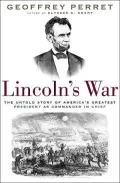
Drawing on newly discovered documents in the National Archives, Lincoln's War is the only full-length account to date on Abraham Lincoln as Com-mander in Chief. For the first time, readers will see the war unfold as Lincoln saw it.This wide-ranging account casts new light on Lincoln and his generals, his admirals, his controversial Secretary of War Edwin Stanton, and his outspoken confidant Gideon Welles, Secretary of the Navy. The reader will also learn the true story of Lincoln's experiences as a soldier and encounter Lincoln as amateur strategist, Lincoln in his relationship with black servicemen, Lincoln in his dealings with the Committee on the Conduct of the War, and Lincoln in his friendship with weapons pioneer Christopher Spencer, the creator of the Spencer repeater. And Lincoln's War is filled with myriad illuminating anecdotes--including how the President, a frustrated inventor, liked to conduct his own hands-on weapons tests on waste ground near the White House.
It was Lincoln who, over the course of four years, created the role of Commander in Chief as we know it today. In doing so he saved the Union and changed the nation. This was the most important of his duties, and his greatest success. In Lincoln's War, Geoffrey Perret--the acclaimed biographer of Ulysses S. Grant, Douglas MacArthur, Dwight D. Eisenhower, and John F. Kennedy, and the author of four well-received works of military history, including A Country Made by War--offers an original, vivid portrait of both a great leader and a tumultuous conflict.
Editorials
Publishers Weekly
Americans have grown so accustomed to presidents asserting and exercising extensive powers in that role that Perret's thesis may prove as surprising as it is accurate. Until "Lincoln's War," Perret (Ulysses S. Grant) argues, there were serious questions as to how far the president's powers to determine military policy extended or whether, indeed, they existed at all. The Constitution assigned the great issues, declaring war, raising armed forces, ratifying treaties, to Congress. At the other end of the spectrum the Mexican War had created a precedent of leaving strategy and operations to the professionals, particularly Gen. Winfield Scott. Perret argues convincingly that Scott's initial plan against the Confederacy, far from calling for its gradual economic strangulation, provided for replicating his triumph in Mexico by combining a holding action in the east and a decisive thrust down the Mississippi, designed to cut the Confederacy in half by the spring of 1862. Lincoln saw even that delay as unacceptable. While he did not have an expanded idea of presidential power at the time of his election, the comprehensive threat to national survival posed by the South's secession changed his mind. Perret uses archival and published sources to show how Lincoln, pragmatic in this respect as in so many others, put national survival above military, political and legal restraints. Creating by stages a "war power" nowhere described in the Constitution that made him a virtual dictator, Lincoln at the same time consistently appealed for support and validation to Congress, the court system and public opinion, themselves all significantly divided on how best to proceed. The president worked closely as well with a fractious high command incorporating military professionals, like Grant and Henry Halleck, and amateur "political soldiers," like Ben Butler. Developing increasing sophistication in coordinating battlefield victories with the wider political objectives of restoring and reintegrating the union, Abraham Lincoln won his war and in the process redefined the presidency. (Apr. 27) Copyright 2004 Reed Business Information.Forbes Magazine
A very readable account of how Abraham Lincoln shaped the modern role of the President as Commander-in-Chief. The Constitution never defined the scope and limits of the President's powers during wartime. Perret demonstrates that Lincoln's concept of the role was far broader than that of any of his predecessors or successors. (4 Oct 2004)—Steve Forbes
Library Journal
Well-known military historian Perret (A Country Made by War) casts new light on Lincoln as war president by emphasizing the ways Lincoln used the implicit powers of commander in chief to mobilize an army, suspend habeas corpus, issue money, free the slaves, and suppress a rebellion. Although the story of Lincoln as commander in chief is hardly unknown, no one since T. Harry Williams in Lincoln and His Generals has looked so closely at Lincoln's progress in developing and applying those powers. Especially important in Perret's account are his corrections of old standbys on the origins and purpose of the so-called Anaconda Plan, Lincoln's preoccupation with taking Richmond, and his understanding of military operations. If the book is more anecdotal than analytical, it also is intelligent and informed and an excellent introduction to big questions about war-making, Lincoln's learning curve as president, and the politics of command in Washington and among commanders. For all large public and academic libraries.-Randall M. Miller, St. Joseph's Univ., Philadelphia Copyright 2004 Reed Business Information.Kirkus Reviews
A military historian considers Lincoln as military leader-a far from nominal position. A veteran of battle, Lincoln had disparaged James Polk's touching off the Mexican War: "So far as Lincoln was concerned," Perret (Jack: A Life Like No Other, 2001, etc.) writes, "Polk had gone to war with Mexico to revive the political fortunes of the Democratic Party, and not for any higher aim." Similar charges would be leveled at Lincoln, with Republican Party founder William H. Seward urging him to "change the question before the Public from one of Slavery, or about Slavery to a question upon Union or Disunion." But Lincoln took his abolitionist fight seriously-and, as many modern historians have observed, as the primary purpose for waging war on the South. Lincoln-who claimed that his greatest success in life was commanding a militia detachment in the Black Hawk War-was closely involved in the daily conduct of the war, Perret shows. Lincoln saw to it that generals were appointed by federal authority, not that of the states. He planned operations and logistics, and he wasn't being hyperbolic when he famously remarked of a recalcitrant combat leader, "If General McClellan does not want to use the Army, I would like to borrow it." He promoted leaders, and he broke them, as when he removed the military commander of occupied New Orleans for looting. He imposed strategy on his greatest commanders, including Ulysses S. Grant. And he even showed up for combat on a couple of occasions, though one Union officer sensibly warned him, "There is nothing in the Constitution authorizing the Commander in Chief to expose himself to the enemy's fire where he can do no good!" Perret does an admirable job of weavingthese episodes into a readable narrative. The subtitle notwithstanding, there's hardly an untold story to be found here, but a worthy distillation all the same. Agency: Don Congdon AssociatesBook Details
Published
April 1, 2004
Publisher
New York : Random House, c2004.
Pages
470
Format
Hardcover
ISBN
9780375507380