
Regional British History - London, Public Opinion - Regional, Imperialism, Colonialism & Imperialism - General & Miscellaneous
Log in to track your reading progress.
Overview
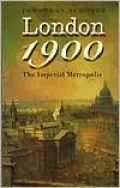
In 1900 London was the capital of an empire that spanned the globe. This engrossing book is the first to examine the powerful city and its relationship with the British empire at the turn of the century.Synopsis
In 1900 London was the capital of an empire that spanned the globe. This engrossing book is the first to examine the powerful city and its relationship with the British empire at the turn of the century.
Janet Watts
A work of magisterial scholarship.
Editorials
David Cannadine
A very rich and wide-ranging book. The evocation of a great city is vivid and memorable.Janet Watts
A work of magisterial scholarship.Publishers Weekly
The throb and hum of 1900 London reverberates in this superbly researched and richly detailed work of cultural history. Enormous, diverse London was the imperial capital of the day, surpassing Paris, Vienna, Rome, New York and Peking in importance. On the docks of the Thames, thousands of workmen unloaded the riches of the globe -- spices, herbs, furs, jute, hemp -- while in the Square Mile of the financial district, thousands of lawyers, bankers, insurance agents, stockbrokers, importers and exporters made their fortunes. Historian Schneer of the Georgia Institute of Technology illustrates how imperial symbols permeated the architecture, culture and institutions of this colossal money-making machine. Zoo elephants evoked the exotic reaches of British dominion; the city's revamped streets provided an imposing backdrop for parades of "sunburned heroes returning from the veldt"; and the white man's burden echoed as a theme in cigarette advertisements, school textbooks and music hall songs. Nor does this fine study neglect the dialectical contradictions of an empire of 400 million people. Schneer identifies racial stereotypes in the Sherlock Holmes stories but also shows how Irish, Indian and African nationalists applied liberal ideologies born and honed in Britain to their own nascent independence movements. Finally, he analyzes imperialist and anti-imperialist sentiments articulated by politicians in the general election of 1900, called the Khaki Election for the color of the uniforms during the Boer War. Schneer's writing occasionally loses its fluidity when he gets bogged down in too much minutiae. But he offers a lively portrait of a city that was not just the capital of a country but the capital of the world in a way that perhaps no other city has ever been.Library Journal
London in 1900 was being transformed, physically and culturally, by the empire it controlled, and Schneer (history, Georgia Inst. of Technology) sketches several aspects of that transformation. The book's best section describes the politics of the physical transformation, with a major new boulevard being built through central London. The cultural city was also changing, as the discussion of minority organizations (Indian, African, Irish) suggests. There were even early glimpses of feminism: Schneer provides portraits of activist women like Times writer Flora Shaw. A section focusing on West African gold mines seems out of place, though, having only a limited connection to London's banking circles. Though many of the people described seem interesting, the book itself is somewhat choppy, more a collection of profiles than a coherent whole. Recommended for academic libraries only.Janet Watts
A work of magisterial scholarship.—Sunday Times, London
Kirkus Reviews
A thorough, impressive tour of imperial London a century ago and of the dissenting voices that finally helped the sun set on this bastion of Eurocentrism. History professor Schneer (Georgia Institute of Technology) lets readers view the grimy streets, polished offices, and dockside warehouses of old London, as well as the hearts and minds of its elitist, racist denizens. History's greatest empire, controlling 400 million people, was governed from a metropolis of 6 million, with a vast port and financial center. Yet while the horns of African rhinos and skins of Canadian seals piled up alongside mineral and material wealth taken in "tribute" from the West Indies, South Africa, Australia, India, etc., Schneer produces those who defied the "continual barrage of imperialist propaganda." Beginning with half a million Irish and swelled by eastern and central Europeans, Jews, and Asians, there were sufficient foreigners and people of color to bristle at the exotic, caged "darkie" and animal spectacles and to join liberals, unionists, and early feminists who fought the many injustices of Britannia. Schneer documents the battles of several individuals who saw beyond the profits of near-slave labor on Chinese railroads, Latin American sugarcane fields, African mines, Borneo rubber plantations, and Ceylonese tea farms. Just as Ben Tillet's Stevedores Union took on London shipping, Lord George Hamilton "did not believe that Indians should serve as cannon fodder" as conflicts beside the Boer War flared. A cultural hero and pioneer of anthropological relativism was Mary Kingsley, who explored deepest Africa and shockingly concluded that blacks are different, not inferior. Schneer's masterful workreminds us how far we've come in our ongoing Copernican revolution to prove that the globe doesn't revolve around white English-speaking men. (40 illustrations, not seen)Book Details
Published
August 1, 1999
Publisher
Yale University Press
Pages
350
Format
Hardcover
ISBN
9780300076257