
Join Books.org — it's free

Terrorism - General & Miscellaneous, Middle East - Diplomatic Relations with the U.S., September 11th Terrorist Attacks, 2001, World Politics, 20th Century American History - Relations - General & Miscellaneous, New York City - History, War on Terrorism,
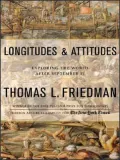
Longitudes and Attitudes: Exploring the World After September 11 by Thomas L. Friedman — book cover

Longitudes and Attitudes: Exploring the World After September 11

by Thomas L. Friedman
Write a review
Log in to track your reading progress.

Overview

In 2002, Thomas L. Friedman won his third Pulitzer Prize “for his clarity of vision, based on extensive reporting, in commenting on the worldwide impact of the terrorist threat” after the attacks of September 11, 2001. This virtually unprecedented recognition underlines Friedman’s unique ability to interpret and illuminate the world for Americans clearly, insightfully, and memorably.

Longitudes and Attitudes is made up of Friedman’s New York Times columns as well as a diary of his private experiences and reflections as he travels to Europe, the Mideast, and the Far East. He talks with the major players in the story and to men and women in the street as he develops and refines his unique perspective on the new kind of war America finds itself fighting. And he helps us to understand who “they” are, and reassures us about who “we” are.

In the author’s words, the result is “a ‘word album’ that captures and preserves the raw, unpolished emotional and analytical responses that illustrate how I, and others, felt as we tried to grapple with September 11 and its aftermath.” More than any other journalist writing today, Friedman gives voice to America’s awakening sense of a radically new world and our own complex place in it.

About the Author, Thomas L. Friedman

Thomas L. Friedman has won the Pulitzer Prize three times for his work at The New York Times, where he serves as the foreign affairs columnist. He is the author of three other bestselling books, including 2005’s The World Is Flat, which was given the first Financial Times and Goldman Sachs Business Book of the Year Award. Friedman was also named one of America’s Best Leaders by U.S. News & World Report. He lives in Bethesda, Maryland, with his family.

Biography

When September 11 drastically reshifted America's focus and priorities, Thomas L. Friedman was the author readers turned to as a guide to the dynamics of the Middle East. In a mediascape crowded with pundits, the New York Times foreign affairs columnist and author has emerged as the preeminent commentator in his field, informed by his 20-plus years as a journalist covering the rapidly shifting politics in the region.

The title of his first book, From Beirut to Jerusalem, describes his trajectory as New York Times bureau chief in both cities in the '80s. He interrupted his journalism career in 1988 when the Guggenheim Foundation awarded him a fellowship to write a book about his experiences. The result was a personal narrative that described not only his harrowing experiences in Lebanon and Israel but also contained exposition about the roots of his interest in the Middle East, a visit to Israel that burgeoned into a full-blown obsession. Friedman himself put it best, in the book's prelude: "It is a strange, funny, sometimes violent, and always unpredictable road, this road from Beirut to Jerusalem, and in many ways, I have been traveling it all my adult life." From Beirut to Jerusalem won the National Book Award and spent a year on the Times bestseller list.

This road analogy is one of several Friedman will make over the course of a column or book. He reduces the intimidation factor of complex subjects by offering ample (but not copious) background, plain but intelligent language, and occasional humor. On Iraq's history before Saddam: "Romper Room it was not." On globalization: "If [it] were a sport, it would be the 100-meter dash, over and over and over. And no matter how many times you win, you have to race again the next day."

Friedman again offered complex concepts in appealingly dramatic terms in 1989's The Lexus and the Olive Tree, his distillation of the new global economy. He sets up the contrast between the old, Cold War system ("sumo wrestling") and the new globalization system (the 100-meter dash). Another part of why Friedman can be so readable is that he sometimes makes it seem as if his life is one big kaffeeklatsch with the scholars and decision makers of the world. In a chapter from The Lexus and the Olive Tree, he mentions a comment made by a friend who is also "the leading political columnist in Jordan." The day after seeing this friend, Friedman writes, "I happen to go to Israel and meet with Jacob Frenkel, then governor of Israel's Central Bank and a University of Chicago-trained economist." Thus another illustrative point is made. Friedman frames the world not just as he sees it, but also includes the perspective of the many citizens he has made it a point to include in the dialogue.

In 2002, Friedman won a third Pulitzer for his writing in the New York Times, and the demand for his perspicacity post-September 11 makes the release of Longitudes and Attitudes: Exploring the World After September 11 almost a foregone conclusion. Breaking the book into before, during, and after, Friedman presents what he calls a "word album" of America's response to the tragedy. It is undeniably a changed world, and Friedman is undeniably the man to help readers make sense of it.

Good To Know

Friedman lives with his wife Ann and daughters Orly and Natalie in Bethesda, Maryland, a suburb of Washington.

In high school, Friedman became "insufferable" in his obsession with Israel, he says. He wrote in From Beirut to Jersualem: "When the Syrians arrested thirteen Jews in Damascus, I wore a button for weeks that said Free the Damascus 13, which most of my high-school classmates thought referred to an underground offshoot of the Chicago 7. I recall my mother saying to me gently, 'Is that really necessary?' when I put the button on one Sunday morning to wear to our country-club brunch."

As the chief diplomatic correspondent for the New York Times from 1989 to 1992, Friedman logged some 500,000 miles following Secretary of State James Baker and chronicling the end of the Cold War.

Reviews

There are no reviews yet. Log in to write one.

Editorials

From the Publisher

"This lucid book, consisting of Friedman's exceptionally frank and convincing columns and an insightful post-September 11 diary, prods at the questions surrounding that day and offers an invaluable reporter's perspective on the world from outside U.S. borders. The previously unpublished diary offers the most insight to the state of the world after September 11."-Publishers Weekly

Book Details

Published
January 1, 2003
Publisher
Thorndike Press
Pages
581
Format
Hardcover
ISBN
9780786249237

More by Thomas L. Friedman

Similar books