
United States History - Social Aspects, Home Economics
Log in to track your reading progress.
Overview
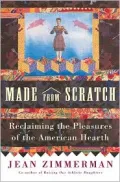
Made from Scratch tells the story of the unsung heroines of the hearth, investigating the history of female domesticity and charting its cultural changes over centuries. Zimmerman traces the lives of her own family's homemakers - from her tiny but indomitable grandmother, who managed a farm, strangled chickens with her bare hands, and sewed all the family clothing, to her mother, who rejected her country upbringing yet kept a fastidious suburban home where the gender divide stayed firmly in place, to her own experiences as a wife and mother weaned on the Women's Movement of the 1970s, with its emphatic view that housework was a dirty word and that the domestic sphere was to be fled rather than cherished. In this book Zimmerman questions the unexamined trade-off we have made in a shockingly brief time span, as we've "progressed" from home-raised chickens to frozen TV dinners to McNuggets from the food court at the mall. What is lost when we no longer engage, as individuals and as a community, in the ancient rituals of food, craft, and shelter?Editorials
Publishers Weekly
In the past century, homemakers have become a dying breed. The domestic achievements of our mothers and grandmothers have been devalued and replaced by the easy options of fast food, hired help and prefabricated products of all kinds; meanwhile, the arts of cooking, needlework and gardening become the province of a dedicated few. Zimmerman (Breaking with Tradition: Women and Work) urges both men and women to honor and preserve the domestic achievements of our female ancestors. "In the small private act of stirring a pot of homemade soup or knitting a scarf for a loved one we preserve the rich heritage of the home and keep back the swelling tide of mediocrity and commodification that is fast replacing it-and, most important, nourish our own souls." Although Zimmerman asserts that revaluing "women's work" is a feminist act, her argument occasionally downplays the positive impact the feminist revolution has had on American women in the past four decades. In the end, Zimmerman advocates for a mild domestic revolution of her own: "I would like to see every person perform just one small domestic act." It's a startling request in its simplicity, and yet it highlights the very best that modern feminism has offered women: nowadays, for some women, to perform a small domestic act is a choice. Though the book's gender politics may raise a few hackles, the author offers a thoughtful and engaging defense of domesticity. (May) Forecast: Many women still have no choice about performing domestic acts, so Zimmerman's audience may be the small percentage of women who can afford not to do such chores-high-income women who may take issue with her thesis altogether. Copyright 2003 Reed Business Information.Library Journal
Poking fun at home guru Martha Stewart mollifies conflicting emotions about our own lack of connection with the home arts. Zimmerman (Tailspin: Women at War in the Wake of Tailhook) leads us through a discourse on "homeways," her proposed term for the arts of homemaking. She places her own enjoyment of the home arts in the context of the feminist movement and the recent surge in popularity of the Food Network and books like Cheryl Mendelson's Home Comforts, calling for a renewed appreciation of domestic accomplishments by men and women alike. With 13 pages of footnotes and a seven-page bibliography, Zimmerman's book is an impressive academic undertaking on domesticity in mythology and history, ranging from ancient times to today's popular culture. Peppered with personal reminiscences, it may herald America's interest in bringing back honor and dignity to the home cooked and homemade. This volume will complement Susan Strasser's Never Done: A History of Housework (1982) and is recommended for academic and larger public libraries.-Paula N. Arnold, M.L.S., Brighton, MA Copyright 2003 Reed Business Information.Kirkus Reviews
A confused tribute to women's traditional roles. Nostalgic for a past she never experienced, Zimmerman (Raising Our Athletic Daughters, 1999, etc.) sets out to document the "dying art" of domestic science. The author's grandmother, born in 1913, was "the last of the old-fashioned American homemakers," she states; her mother rejected sewing and time-consuming cooking but was still a fairly typical 1950s housewife. Zimmerman herself initially disdained all things domestic, but now she proposes that women "take back" domesticity. Since women have entered the workforce in large numbers, she argues, the domestic arts have taken a nosedive-cooking especially, but also housecleaning and sewing. "The fact is that men never responded to feminists' demand that they do half the household chores," which means, in her view, that they remain women's tasks. The author doesn't examine class- or race-based perspectives on homemaking; her focus is entirely on white, middle-class women, though she never says so explicitly. Conflicts abound. Zimmerman laments the death of baked goods, yet serves her guests strawberry cake made with prepackaged cake mix and occasionally gives her daughter an Oscar Mayer lunch kit to take to school. She is "shocked" to see a woman at the grocery store buying pre-made cookie mix and frozen strudel, yet her own dinner fare includes taco dinner kits and boxed macaroni and cheese. Some of the chapters are sharply focused and provide detailed histories of domestic science. The author chronicles the rise of home economics as an academic discipline, noting that many women were able to springboard from home ec to the hard sciences and careers in teaching or manufacturing. A chapter onthe evolution of processed food is also well researched and illuminating. It's a shame, then, that Zimmerman overromanticizes homemaking as a "source of personal strength and dignity" to all women and lets melodrama overtake logic in declarations such as: "The loss of our homeways portends the death of the home itself." Exasperating and thoughtful in equal portions. . . .Book Details
Published
July 1, 2003
Publisher
New York ; Free Press, c2003.
Pages
288
Format
Hardcover
ISBN
9780684869599