
African Americans - Politics and Government - History, 20th Century American History - Civil Rights, Civil Rights - African American History, African Americans - Law, Politics, & Government, African American Political & Historical Biography, Civil Rights
Log in to track your reading progress.
Overview
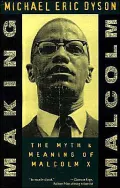
Analyzes selected writings by and about Malcolm X, compares Malcolm to such figures as Martin Luther King and Louis Farrakhan, and discusses his influence on young African American males.A bold critical examination of the life and legacy of Malcolm X. Minister and educator Dyson casts new light on the life and career of Malcolm X--and also on the aspirations and passions of the growing numbers who have seized on his l ife for insight and inspiration. An important work for the future of race relations.
Editorials
Publishers Weekly -
Dyson sees Malcolm X as a symbol of the self-discipline, self-esteem and moral leadership necessary to combat the spiritual and economic corruption of poor African American communities. This thoughtful, scholarly essay on the charismatic political leader, assassinated in 1965, scrutinizes his reemergence as a cultural hero. Dyson, a Baptist minister and professor of communications at the University of North Carolina, calls for a new progressive black politics anchored in radical democracy, redistribution of wealth through taxation and restructuring of opportunities for the neediest. The legacy of both Malcolm X and Martin Luther King Jr. to progressive blacks, he maintains, is the imagination and energy to build bridges with Latinos, gays, feminists, environmental activists and others seeking equality and economic democracy. Calling the Malcolm portrayed in Spike Lee's recent film ``a potent and valuable figure,'' Dyson nevertheless faults Lee for leaving largely untouched Malcolm's broadening of his ideological perspective in his final years. (Nov.)School Library Journal
YA-In the first section of this scholarly discourse, Dyson analyzes a selective group of writings by and about Malcolm X, discussing various interpretations of events, Malcolm's evolving philosophy, and its perceived place in today's world. The larger, second section is an attempt to place Malcolm into historical context by comparing him to Martin Luther King, Jr., and to figures such as Louis Farrakhan, and to interpret his strong influence on young African American males through films and music. The author shows in thorough and definitive detail just how important Malcolm is to disenfranchised youth. Unfortunately, his writing style is pompous and repetitive, and the vocabulary is difficult. In addition, there are times when his personal viewpoints and experiences intrude upon and interrupt the flow of his narrative. However, if students are willing to put forth the effort, they will find some interesting perspectives and creative analyses of a powerful cultural icon of the 20th century.-Pat Royal, Crossland High School, Camp Springs, MDFrom Barnes & Noble
One of our most complex black leaders, Malcolm X still influences pop culture, searing the edges of an academy that once froze him out. Dyson examines the many different "Malcolms"--saint, hero, public moralist, & revolutionary.Book Details
Published
January 25, 1996
Publisher
Oxford University Press
Pages
215
Format
Hardcover
ISBN
9780641719561