
Epidemiology & Biostatistics, Public Health & Preventive Medicine, Personality & Identity Psychology, General & Miscellaneous - Medicine, Pathology, Sociology - General & Miscellaneous, General & Miscellaneous Health Policies, Family & General Practice, M
Available on Bookshop
Write a review
Books.org participates in affiliate programs including Bookshop.org and the Amazon Services LLC Associates Program. We may earn a commission from qualifying purchases made through links on this page, at no additional cost to you.
Log in to track your reading progress.
Overview
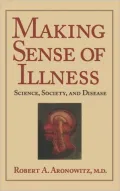
In Making Sense of Illness Robert Aronowitz offers historical essays about how diseases change their meaning. Each of the diseases or etiologic hypotheses in this book has had a controversial and contested history: psychosomatic views of ulcerative colitis, twentieth century chronic fatigue syndromes, Lyme disease, angina pectoris, risk factors for coronary heart disease, and the type A hypothesis. At the core of these controversies are disagreements among investigators, clinicians, and patients over the best way to deal with what individuals bring to disease. By juxtaposing the history of the different diseases, Aronowitz shows how values and interests have determined research programs, public health activities, clinical decisions, and the patient's experience of illness.The book contains no figures.
Editorials
From The Critics
Reviewer: Christopher Crenner, MD, PhD(University of Kansas Medical Center)Description: This original and thought-provoking book charts the history of several new diseases that have emerged during the twentieth century. The author invites his readers to consider how modern medicine defines and gives meaning to disease.
Purpose: The author argues that the recognition of a new disease results from complex negotiations among physicians, scientists, and patients.
Audience: People who are concerned about medical diagnoses, either because they make them, have them, or use them, will gain from this book.
Features: The author links six case studies of new diseases into a subtle and convincing analysis of the process of acknowledging and defining illness. He examines Lyme disease, chronic fatigue syndrome, psychosomatic ulcerative colitis, coronary heart disease, coronary risk factors, and type-A personality. The history of a contentious condition like chronic fatigue syndrome, or type-A personality, highlights the importance of successful negotiations among social groups in creating diseases. The author extends this insight to his analysis of other conditions, like coronary heart disease, that have developed a more durable, empirical grounding. There are limitations to the social analysis of disease concepts. Such an analysis may seem an embellishment to our understanding of a disease with accepted empirical grounding. Alternately, it may serve to undermine the legitimacy of a disease that lacks such grounding. The author does an unrivaled job of identifying and overcoming these limitations. His arguments work to wonderful effect in the case of Lyme disease. He shows that the boundary between Lyme disease and the contentious diagnosis of chronic Lyme disease is itself negotiated, and is contingent upon agreements among different groups about such things as the interpretation of empirical evidence.
Assessment: The author does not tackle directly the problem of reckoning with the stigmatized, subjective elements in all illness. He makes a bold attempt to diagram the implications of medicine's avoidance of subjectivity and idiosyncrasy in explaining disease. He successfully pursues a line of analysis suggested by several authors in Framing Disease: Studies in Cultural History (Rutgers Univ Pr 1992) edited by Charles Rosenberg and Janet Golden. Comparable historical analysis of changing disease categories appears in Allan Young, The Harmony of Illusions: Inventing Post-Traumatic Stress Disorder (Princeton Univ Pr 1996), and Mark Micale, Approaching Hysteria: Disease and Its Interpretations (Princeton Univ Pr 1995).
Christopher Crenner
This original and thought-provoking book charts the history of several new diseases that have emerged during the twentieth century. The author invites his readers to consider how modern medicine defines and gives meaning to disease. The author argues that the recognition of a new disease results from complex negotiations among physicians, scientists, and patients. People who are concerned about medical diagnoses, either because they make them, have them, or use them, will gain from this book. The author links six case studies of new diseases into a subtle and convincing analysis of the process of acknowledging and defining illness. He examines Lyme disease, chronic fatigue syndrome, psychosomatic ulcerative colitis, coronary heart disease, coronary risk factors, and type-A personality. The history of a contentious condition like chronic fatigue syndrome, or type-A personality, highlights the importance of successful negotiations among social groups in creating diseases. The author extends this insight to his analysis of other conditions, like coronary heart disease, that have developed a more durable, empirical grounding. There are limitations to the social analysis of disease concepts. Such an analysis may seem an embellishment to our understanding of a disease with accepted empirical grounding. Alternately, it may serve to undermine the legitimacy of a disease that lacks such grounding. The author does an unrivaled job of identifying and overcoming these limitations. His arguments work to wonderful effect in the case of Lyme disease. He shows that the boundary between Lyme disease and the contentious diagnosis of chronic Lyme disease is itself negotiated, and is contingentupon agreements among different groups about such things as the interpretation of empirical evidence. The author does not tackle directly the problem of reckoning with the stigmatized, subjective elements in all illness. He makes a bold attempt to diagram the implications of medicine's avoidance of subjectivity and idiosyncrasy in explaining disease. He successfully pursues a line of analysis suggested by several authors in Framing Disease: Studies in Cultural History (Rutgers Univ Pr 1992) edited by Charles Rosenberg and Janet Golden. Comparable historical analysis of changing disease categories appears in Allan Young, The Harmony of Illusions: Inventing Post-Traumatic Stress Disorder (Princeton Univ Pr 1996), and Mark Micale, Approaching Hysteria: Disease and Its Interpretations (Princeton Univ Pr 1995).3 Stars from Doody
Book Details
Published
February 13, 1998
Publisher
Cambridge, U.K. ; Cambridge University Press, 1998.
Pages
267
Format
Hardcover
ISBN
9780521552349