
Poetry - Rhymes, Nursery Rhymes & Fingerplays, Music - Songs & Songbooks, Fiction - General & Miscellaneous
Log in to track your reading progress.
Overview
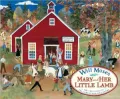
The poem about Mary and her little lamb is one of the most popular rhymes in America, but did you know that the rhyme is true? There once was a little girl named Mary who saved the life of a tiny lamb. The two became best friends, and that little lamb followed Mary everywhere - even to school, where the poet John Roulstone visited and immortalized the two in verse.With his trademark folk art style, Will Moses paints the true story behind the famous nursery rhyme and shows how Mary went from being a small-town Massachusetts girl to an American folk hero.
Editorials
Publishers Weekly
Moses (Raspberries!) proves that going behind the music needn't uncover sex, drugs, or nervous breakdowns. He introduces readers to the real Mary of "Mary Had a Little Lamb," a 19th-century Massachusetts farm girl named Mary Elizabeth Sawyer who nurses a newborn lamb back to health and wins its woolly, unwavering loyalty. The lamb did indeed follow Mary into school—"bold and proud, just as if she had always belonged there"—on the same day that a visitor named John Roulstone was in attendance. In his era's version of a tweet, Roulstone penned a pithy verse about the incident that proved tailor-made for repetition, embellishment, and musical adaptation (an afterword explains how the poem went viral, so to speak). Moses's spot art can feel a little wooden, but his talent opens up in the full pages and spreads, where his doll-like characters, flattened perspectives, and expansively detailed settings show that the apple hasn't fallen far from the tree (his great-grandmother is Grandma Moses). Even children too young to be nostalgic for nursery rhymes will enjoy this pop culture lesson wrapped up as a trip back in time. Ages 1–up. (Sept.)Children's Literature -
The true story behind "Mary had a little lamb..." is introduced by the first two verses of the original rhyme. The "real" Mary is Mary Elizabeth Sawyer, a lover of animals and of sheep in particular. One morning in the barn she finds a frail lamb, deserted by its mother. She determines to nurse it and keep it alive. Soon it is playing with her and chasing after her everywhere. When school begins, Mary says goodbye to the lamb, but it does indeed follow her. Mr. John Roulstone, a visitor, witnesses the amusing sight and returns to the school the next day to give Mary the now famous poem he has written about her and her lamb. Moses, a descendent of the famous Grandma Moses, accompanies the simple story with folk-art like oil paintings. Single page scenes depict aspects of the actions. There are four text-less double-page scenes with more details of the home interior, barn, countryside, and schoolroom. Moses' illustrations are more naturalistic and even fuller of the details of 19th century New England than his ancestor's. There are added notes on Moses' approach to the story and Sawyer's life, plus the words and music to the song. Reviewer: Ken Marantz and Sylvia MarantzSchool Library Journal
Gr 1–3—Readers will probably be surprised to learn that the familiar nursery rhyme is actually based on a pamphlet written by Mary Elizabeth Sawyer, a farm girl who loved animals, especially sheep. When its mother rejected a frail lamb twin, Mary raised it herself, and the lamb became a beloved pet that followed her everywhere—once even to school. John Roulstone, a visitor at school that day, wrote a verse about the incident and gave it to Mary. End matter provides musical notation and additional information about Sawyer, who was born in 1806 and attended the Redstone Schoolhouse in Sudbury, MA; Sarah Josepha Hale, who published the poem with added verses; and Lowell Mason, who composed music for it. Moses's rich oil paintings, rendered in his characteristic folk-art style, beautifully depict rural 19th-century life. They include spreads, framed pictures with images of books and hens in the margins, and vignettes accompanying the lengthy text. Mary's large farmhouse kitchen has a spinning wheel, a pump at the sink, and pots simmering in the hearth. Animals romp in the fields, and in the distance, horses and carriages ride along a dirt road past the church and other low-lying buildings. Desks attached to benches line Mary's schoolroom where children write on slates and draw humorous pictures on the blackboard in the teacher's absence. Moses's Mother Goose (Philomel, 2003) would be a perfect accompaniment to this interesting story.—Marianne Saccardi, formerly at Norwalk Community College, CTKirkus Reviews
The "real" story of Mary and her lamb, as the subtitle states, as told and illustrated in Moses' familiar folk-art style. Most people assume this poem is a Mother Goose rhyme, but this is not the case. It's a true story of a little girl named Mary whose lamb followed her to school. In his foreword, Moses recalls the background of the tale and how he discovered it by chance. His narrative of the event as he imagines it follows, and the backmatter provides both the song and the history of the rhyme. Mary Elizabeth Sawyer was born in 1806 in Sterling, Mass., and attended the Redstone Schoolhouse in Sudbury, Mass. John Roulstone witnessed the lamb episode and wrote the first stanza of the poem. Later, in 1830, Sarah Josepha Hale published it and added three more stanzas. What lends quaintness to the tale are Moses' rustic, oil paintings that pair nicely with the vintage tale. Each scene and wordless double-page spread is filled with details of bygone days to fascinate kids. Not just an illustrated version of the rhyme, this is a fleshed-out account of a lamb's tail/tale that all children and adults should know. (Picture book. 5-9)Book Details
Published
September 15, 2011
Publisher
Penguin Group (USA) Incorporated
Pages
40
Format
Hardcover
ISBN
9780399251542