
Consumer Goods Industry - History, Journalism, Media & Communications, News & Media Biography, Business Biography
Available on Bookshop
Write a review
Books.org participates in affiliate programs including Bookshop.org and the Amazon Services LLC Associates Program. We may earn a commission from qualifying purchases made through links on this page, at no additional cost to you.
Log in to track your reading progress.
Overview
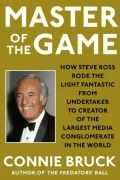
From the best-selling author of The Predators' Ball comes the story of the most flamboyant businessman and dealmaker of his generation, Steve Ross. When Steven Spielberg first heard Steve Ross tell his life story, it was such a dramatic rags-to-riches narrative that he thought it was a movie. In a career that started in Brooklyn and spanned Wall Street, Hollywood, and the Mafia, Steve Ross took his father-in-law's funeral business and a parking lot company and grew them into the largest media and entertainment company in the world, Time Warner. In the upper strata of American business that Ross reached before his death, he was an anomaly. Outrageous, glamorous, charismatic, he presided over an enterprise that was more medieval fiefdom than corporate bureaucracy. He negotiated his enormous and complicated deals, from movies and records to cable and publishing, with shrewdness and brilliance. He rewarded his favorite aides and sidekicks extravagantly; he courted Hollywood stars like Barbra Streisand and Steven Spielberg with luxurious gifts; he charmed and outsmarted his rivals. Ross used whateveror whomever - it took to romance someone into making a deal. He saved himself and let his best friend, Jay Emmett, take the fall in the government's Westchester Premier Theatre investigation. While Atari was hemorrhaging money in the early '80s, Ross announced a stock buy-in to boost the price, and then sold off his own stock for a gross of more than $20 million before announcing the company's failure. The principles upon which Ross built his domain would not be taught in any business school, and many of his peers were convinced that Ross's ways would lead to his, and his company's undoing. But it was those very attributes - combined with mathematical wizardry and vision (or what one friend called "the ability to see around corners") - that enabled Ross to best most adversaries, outnegotiate every dealmaker, confound his critics, and ultimately create the Time Warner empSynopsis
Award-winning journalist Connie Bruck’s biography of media mogul Steve Ross captures the highs and lows of Ross’s career in a narrative “as fast-paced as the life it depicts” (Publishers Weekly). Born to Jewish immigrant parents in 1920s Brooklyn, Steven Jay Rechnitz would become an unstoppable force in the world of business, a figure both revered and reviled by those who knew him. His early ventures—a limousine rental service operated under the auspices of his father-in-law’s Manhattan funeral home and a parking lot company whose co-owners harbored dubious connections to the criminal underworld—inspired a taste for substantial risk that was outpaced only by Ross’s success in turning that risk into profit. In a career that spanned both Wall Street and Hollywood, Ross’s mastery of obfuscation, deflection, denial, and his imaginative approach to the law finally culminated in the empire he had long craved: Time Warner, the largest media and entertainment company in the world. Extraordinary in its depth of coverage, startling in its frankness, Master of the Game is a riveting journey through the mind and career of a man who was by turns flamboyant, charismatic, and completely outrageous—an unstoppable force in the pursuit of an outsized dream.Editorials
Publishers Weekly -
This account of the man who began his career as a funeral director and rose to become the chairman of the largest media company in the world is as fast-paced as the life it depicts. Through interviews with some 250 people, including Ross himself, Bruck ( The Predators' Ball ) chronicles Ross's rapid transformation from an unknown, if ambitious, businessman to a media tycoon that began with his purchase of Warner Bros.-Seven Arts in 1969, a company that would eventually become Warner Communications. Bruck does not shy away from describing Ross's character flaws and business mistakes, and she notes that allegations of questionable business practices dogged him much of his business life. Indeed, one of the longest sections of the book deals with the Westchester Premiere Theatre kickback scandal of the late '70s and early '80s in which several of Ross's top aides were convicted of fraud and perjury, although he himself avoided prosecution. Another lengthy chapter examines the Atari disaster, in which the rapid rise and fall of the video game company--a Warner subsidiary--nearly bankrupted Warner. For all his shortcomings, Ross, who died in 1992 at the age of 65, is depicted here as a charming, shrewd and visionary man who loved entertainers and the entertainment business. He emerges as better qualified to lead Time Warner than Gerald Levin who succeeded him, and who is portrayed by Bruck as a brilliant but uninspiring man who, the author suggests, will find it difficult to fully integrate Time Warner for the multimedia age. Although Bruck's book is riveting, one nevertheless wonders if there isn't more to Ross's story waiting to be told. Photos not seen by PW . (Apr.)Library Journal
Bruck, famous for her muckraking book about Michael Milken (Predator's Ball, LJ 3/15/89), unveils another power person's reckless spending habits and questionable management actions. Bruck uncovers details about Ross and the Time-Warner merger that are not in Richard Clurman's To the End of Time (LJ 2/1/92). Unfortunately, the abundant detail loses the reader at times, and Bruck is so focused on the wrongdoings of Ross and those at Time, Inc., that she offers little insight about the future of the company. Nonetheless, academics and business people will probably demand this book. Weakly recommended. [Previewed in Prepub Alert, LJ 12/93.]-Rebecca A. Smith, Harvard Business Sch. Lib.Booknews
The biography of American businessman Steve Ross, who declares to have learned his greatest business lessons while working in a funeral home. Ross later engineered the merger of Warner Communications and Time Inc. into the largest media and entertainment conglomerate in the world. Annotation c. Book News, Inc., Portland, OR (booknews.com)David Rouse
Bruck wrote the best-selling, hard-hitting, and controversial "Predators' Ball" (1988), which exposed the excesses of Drexel Burnham Lambert and Michael Milken. Now she profiles the charismatic, manipulative Steve Ross, who successfully engineered the last big buy-out of the 1980s in the bitter takeover battle between Time, Inc. and Warner Communications, which Ross headed. While Richard Clurman has already written "To the End of Time: Seduction Conquest of the Media Empire (1992), a well-regarded account of the takeover battle from Time's point of view, Bruck offers an engrossing biographical and psychological portrait of Ross himself. Based on extensive interviews with more than 250 sources, including Ross himself before his death, she deftly chronicles Ross' rise to power and fortune. This likely best-seller grew out of two pieces Bruck originally did in 1990 and 1992 for the "New Yorker".Book Details
Published
April 2, 2013
Publisher
Simon & Schuster
Pages
400
ISBN
9781476737706