
Children - Fiction & Literature
Available on Bookshop
Write a review
Books.org participates in affiliate programs including Bookshop.org and the Amazon Services LLC Associates Program. We may earn a commission from qualifying purchases made through links on this page, at no additional cost to you.
Log in to track your reading progress.
Overview
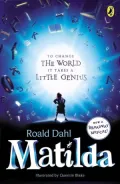
Matilda is a genius. Unfortunately, her family treats her like a dolt. Her crooked car-salesman father and loud, bingo-obsessed mother think Matilda's only talent is as a scapegoat for everything that goes wrong in their miserable lives. But it's not long before the sweet and sensitive child decides to fight back. Faced with practical jokes of sheer brilliance, her parents don't stand a chance.Matilda applies her untapped mental powers to rid the school of the evil, child-hating headmistress, Miss Trunchbull, and restore her nice teacher, Miss Honey, to financial security.
Synopsis
The classic story from Roald Dahl, about an exceptional young girl with extraordinary powers. Adapted into a Tony Award-winning Broadway musical and a Netflix film!Matilda is a sweet, exceptional young girl, but her parents think she's just a nuisance. She expects school to be different but there she has to face Miss Trunchbull, a menacing, kid-hating headmistress. When Matilda is attacked by the Trunchbull she suddenly discovers she has a remarkable power with which to fight back. It'll take a superhuman genius to give Miss Trunchbull what she deserves and Matilda may be just the one to do it!
Here is Roald Dahl's original novel of a little girl with extraordinary powers. This much-loved story has recently been made into a wonderful new musical, adapted by Dennis Kelly with music and lyrics by Tim Minchin.
Editorials
Publishers Weekly -
Matilda is an extraordinarily gifted four-year-old whose parentsa crass, dishonest used-car dealer and a self-centered, blowsy bingo addictregard her as ``nothing more than a scab.'' Life with her beastly parents is bearable only because Matilda teaches herself to read, finds the public library, and discovers literature. Also, Matilda loves using her lively intelligence to perpetrate daring acts of revenge on her father. This pastime she further develops when she enrolls in Crunchem Hall Primary School, whose headmistress, Miss Trunchbull, is ``a fierce tyrannical monster . . . .'' Adults may cringe at Dahl's excesses in describing the cruel Miss Trunchbull, as well as his reliance on overextended characterization at the expense of plot development. Children, however, with their keenly developed sense of justice, will relish the absolutes of stupidity, greed, evil and might versus intelligence, courage and goodness. They also will sail happily through the contrived, implausible ending. Dahl's phenomenal popularity among children speaks for his breathless storytelling charms; his fans won't be disappointed by Matilda. Blake's droll pen-and-ink sketches extend the exaggerated humor. Ages 9-11. Oct.Criticas
Gr 2-6-Resourceful Matilda is saddled with two hellish parents and an even worse headmistress. The evil Mrs. Trenchbull is out to get Miss Honey, Matilda's beloved teacher, and thinks nothing of flinging young innocents into nail-festooned boxes by their hair. Not to worry: Superbright Matilda dishes out revenge in high-comic style in this delicious page-turner for readers looking for laughs.—Cheryl Scheer, Denver P.L., CO Copyright 2003 Reed Business Information.
Children's Literature
She taught herself to read by the time she was three. When she was four, she'd finished all the children's books in the library and moved on to Dickens, Austen, Hemmingway and H.G. Wells. Matilda Wormwood is a genius cursed with heartless, half-witted, self-centered parents. Her father is a dishonest used car salesman; her mother, a soap-opera addict whose idea of a gourmet meal is a TV dinner. Unconcerned with their daughter's education, they enroll her late in the Crunchem Hall Primary School. Matilda's prodigious talents are soon recognized by her teacher. Miss Honey tries to secure an advanced placement for her gifted student. However, the school's muscle-bound, kid-hating headmistress won't consider it. A sadist in green britches, Miss Trunchbull's cruelty knows no bounds. Matilda learns to tap into her psychic powers. With mind over matter, she frees Crunchem Hall from Trunchbull's reign of terror and secures Miss Honey's professional and financial future. Her own "happily ever after" comes when she convinces her parents to leave her in Miss Honey's care as they flee the country two steps ahead of the police. It's a quirky tale that's delightfully Dahl. 1998 (orig.School Library Journal
Gr 4-6 Dahl's latest piece of madcap mayhem is a story filled with the elements that his fans cravesardonic humor, the evilest of villians, the most virtuous of heroines, and children who eventually defeat those big bad grown-ups. In this book, Matilda isn't just smart, she is ``extra-ordinary. . .sensitive and brilliant,'' reading Great Expectations as a four year old. Unfortunately, her TV-addict parents neither recognize nor appreciate their daughter's genius. Neglected Matilda finds mentors in librarian Mrs. Phelps and teacher Miss Honey, a woman as sweet as her name implies. Miss Honey, Matilda, and other students are tormented by the child-hating headmistress Trunchbull. Trunchbull has also cheated orphaned niece Miss Honey out of her rightful inheritance, leaving the teacher in extreme poverty. Having practiced revenge techniques on her father, Matilda now applies her untapped mental powers to rid the school of Trunchbull and restore Miss Honey's financial security. If the conclusion is a bit too rapid, the transitions between Matilda's home and school life a bit choppy, and the writing style not as even as in some of Dahl's earlier titles, young readers won't mind. Dahl has written another fun and funny book with a child's perspective on an adult world. As usual, Blake's comical sketches are the perfect complement to the satirical humor. This may not be a teacher's or principal's first choice as a classroom read-aloud, but children will be waiting in line to read it. Heide Piehler, Shorewood Public Lib . , Wis.Book Details
Published
February 7, 2013
Publisher
Penguin Young Readers Group
Pages
240
Format
Paperback
ISBN
9780142425381