
English Fiction & Prose Literature - General & Miscellaneous - Literary Criticism, J. R. R. Tolkien - The Lord of the Rings, Science Fiction & Fantasy - Literary Criticism, J.R.R. Tolkien - The Lord of the Rings
Available on Bookshop
Write a review
Books.org participates in affiliate programs including Bookshop.org and the Amazon Services LLC Associates Program. We may earn a commission from qualifying purchases made through links on this page, at no additional cost to you.
Log in to track your reading progress.
Overview
NOMINATED FOR THE 2002 HUGO AND LOCUS AWARD
When J.R.R. Tolkien created the extraordinary world of Middle-earth and populated it with fantastic, archetypal denizens, reinventing the heroic quest, the world hardly noticed. Sales of The Lord of the Rings languished for the better part of two decades, until the Ballantine editions were published here in America. By late 1950s, however, the books were selling well and beginning to change the face of fantasy. . . . forever.
A generation of students and aspiring writers had their hearts and imaginations captured by the rich tapestry of the Middle-earth mythos, the larger-than-life heroic characters, the extraordinary and exquisite nature of Tolkien's prose, and the unending quest to balance evil with good. These young readers grew up to become the successful writers of modern fantasy. They created their own worlds and universes, in some cases their own languages, and their own epic heroic quests. And all of them owe a debt of gratitude to the works and the author who first set them on the path.
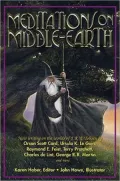
In Meditations on Middle-earth, sixteen bestselling fantasy authors share details of their personal relationships with Tolkien's mythos, for it inspired them all. Had there been no Lord of the Rings, there would also have been no Earthsea books by Ursula K. Le Guin; no Song of Ice and Fire saga from George R. R. Martin; no Tales of Discworld from Terry Pratchett; no Legends of Alvin Maker from Orson Scott Card. Each of them was influenced by the master mythmaker, and now each reveals the nature of that influence and their personal relationships with the greatest fantasy novels ever written in the English language.
If you've never read the Tolkien books, read these essays and discover the depthy and beauty of his work. If you are a fan of The Lord of the Rings, the candid comments of these modern mythmakers will give you new insight into the subtlety, power, and majesty of Tolkien's tales and how he told them. Meditations on Middle-Earth is a 2002 Hugo Award Nominee for Best Related Work.
Synopsis
Hugo Award Nominee: George R. R. Martin, Ursula K. Le Guin, Terry Pratchett, Harry Turtledove, and others reveal how Tolkien inspired and influenced them. When J. R. R. Tolkien created the extraordinary world of Middle-earth and populated it with fantastic, archetypal denizens, reinventing the heroic quest, the world hardly noticed. Sales of The Lord of the Rings languished for the better part of two decades, until the Ballantine editions were published in America. By the late 1950s, however, the books were selling well and beginning to change the face of fantasy . . . . forever. A generation of students and aspiring writers had their hearts and imaginations captured by the rich tapestry of the Middle-earth mythos, the larger-than-life heroic characters, the extraordinary and exquisite nature of Tolkien's prose, and the unending quest to balance evil with good. In Meditations on Middle-earth, writers share details of their personal relationships with Tolkien's mythos, for it inspired them all. Had there been no Lord of the Rings, there would also have been no Earthsea books by Ursula K. Le Guin; no Song of Ice and Fire saga from George R. R. Martin; no Tales of Discworld from Terry Pratchett; no Legends of Alvin Maker from Orson Scott Card. Each of them was influenced by the master mythmaker, and now each reveals the nature of that influence and their personal relationships with the greatest fantasy novels ever written in the English language. A Locus Award NomineeEditorials
Publishers Weekly
An unapologetic tie-in with the release of the first highly anticipated Lord of the Rings film, this anthology presents appreciative essays in honor of the master of Middle-earth from such major fantasy and SF authors as Harry Turtledove, Raymond Feist, Terry Pratchett, George R.R. Martin and the late Poul Anderson. All thank Tolkien, some sardonically, for making the fantasy genre so popular. Ursula K. Le Guin discusses obvious and concealed poetry in the trilogy, while Douglas A. Anderson treats Tolkien's critics, admitting that the posthumously published writings, edited by the author's son, Christopher, are "not always easy to read," a view seconded by several other contributors. Less successful as a scholarly exercise is Orson Scott Card's "How Tolkien Means," which focuses on allegory, a mode Tolkien rejected. Most contributors celebrate the beauty of the writing in the major books, although Michael Swanwick finds them "sad with wisdom" in his essay, "A Changling Returns." Swanwick takes the lead in pointing out the importance of the humble hobbit Sam Gamgee as a character. In a dialogue between illustrators and brothers Tim and Greg Hildebrandt, Tim admits that "Tolkien was never a big supporter of illustration to accompany works of fantasy." Alas, Howe's vague and unimaginative pencil sketches only serve to support Tolkien's case. Editor Haber offers an adoring but welcome antidote to the more pompous exegeses of the "author of the century." (Nov. 23) FYI: For more on hobbit fever, see "Movie Hype Is No Fantasy" and "Lord of the Rings Redux" (PW, Sept. 10). Copyright 2001 Cahners Business Information.Book Details
Published
October 11, 2002
Publisher
St. Martin's Press
Pages
288
ISBN
9781429974738