
Urban/Metropolitan Planning Policies, Globalization, Regional Planning, City Planning & Urban Design, Sustainable Development, Urban Planning & Studies
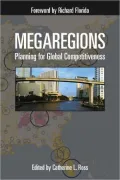
Megaregions: Planning for Global Competitiveness
Catherine Ross, Catherine Ross (Editor), Adjo A. Amekudzi (Contribution by), Tridib Banerjee (Contribution by), Jason Barringer (Contribution by)
Available on Bookshop
Write a review
Books.org participates in affiliate programs including Bookshop.org and the Amazon Services LLC Associates Program. We may earn a commission from qualifying purchases made through links on this page, at no additional cost to you.
Log in to track your reading progress.
Overview
The concept of “the city” —as well as “the state” and “the nation state” —is passé, agree contributors to this insightful book. The new scale for considering economic strength and growth opportunities is “the megaregion,” a network of metropolitan centers and their surrounding areas that are spatially and functionally linked through environmental, economic, and infrastructure interactions.
Recently a great deal of attention has been focused on the emergence of the European Union and on European spatial planning, which has boosted the region’s competitiveness. Megaregions applies these emerging concepts in an American context. It addresses critical questions for our future: What are the spatial implications of local, regional, national, and global trends within the context of sustainability, economic competitiveness, and social equity? How can we address housing, transportation, and infrastructure needs in growing megaregions? How can we develop and implement the policy changes necessary to make viable, livable megaregions?
By the year 2050, megaregions will contain two-thirds of the U.S. population. Given the projected growth of the U.S. population and the accompanying geographic changes, this forward-looking book argues that U.S. planners and policymakers must examine and implement the megaregion as a new and appropriate framework.
Contributors, all of whom are leaders in their academic and professional specialties, address the most critical issues confronting the U.S. over the next fifty years. At the same time, they examine ways in which the idea of megaregions might help address our concerns about equity, the economy, and the environment. Together, these essays define the theoretical, analytical, and operational underpinnings of a new structure that could respond to the anticipated upheavals in U.S. population and living patterns.
Editorials
University of California, Berkeley -
“This book deftly navigates through the largely uncharted waters of megaregions in 21st century America. With contributions from some of the best minds in the field, it challenges us to pursue public infrastructure investments that increase global competitiveness, redress spatial inequalities that occur when trade-sheds expand, and forge new forms of governance that protect natural habitats and resources across multistate regions.”Book Details
Published
August 7, 2012
Publisher
Island Press
Pages
336
ISBN
9781610911368