
Machinery & Tools, Science & Technology Experiments, Physics
Log in to track your reading progress.
Overview
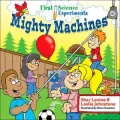
How do machines work? Kids will have a blast constructing a mini-seesaw to illustrate the way a lever operates or creating their very own pulley from an empty spool, string, ribbon, pails, pennies, a broom, and two chairs. They’ll find out why they can’t put in a screw using only their fingers and examine the different parts of compound machines. In another experiment, a child’s bicycle becomes a laboratory for understanding whether wheels have to be smooth to run. A good time will be had by all.Synopsis
Even young children can understand the science behind sight, sound, smell, touch, and taste, thanks to these simple explanations and safe, easy experiments. With a drinking glass, water, plastic wrap, tape, spoon, small toy, and an adult's help, create an optical device that magnifies objects. Kids will learn what makes things feel hot and cold, how scratch and sniff cards work, why you can't taste well when you've got a cold, and how all the senses work together.Editorials
School Library Journal
Gr 3-5-After a note to adults that includes safety precautions, this book states the basic principles of physics that explain why simple machines work. Readers are then directed to create a scale, similar to a fishing scale, from a wooden ruler, rubber band, paper clip, and small bag of rice. This device is used to measure effort in many of the following demonstrations of the work done by simple machines. Short chapters present brief introductions to and experiments about levers, pulleys, wheels and axles, inclined planes, wedges, and screws. All of the projects use inexpensive and easily accessible materials. Unfortunately, the writing tends to be dry and is occasionally confusing. The cartoon artwork, which features determined-looking, goggle-eyed children, is more decorative than helpful. The book covers a lot of ground, and some clarity is lost because the illustrations are not detailed enough. Patricia Armentrout's "Simple Devices" series (Rourke, 1997; o.p.) and Salvatore Tocci's Experiments with Simple Machines (Children's, 2003) present similar material more effectively.-Kathryn Kosiorek, Cuyahoga County Public Library, Brooklyn, OH Copyright 2004 Reed Business Information.Book Details
Published
November 18, 2004
Publisher
Sterling Juvenile
Pages
48
Format
Hardcover
ISBN
9781402709005