
20th Century American History - Economic Aspects - Post World War II, 20th Century American History - Social Aspects - Post World War II, United States - Civilization, United States - Economic History, Post-World War II American History - General & Miscel
Log in to track your reading progress.
Overview
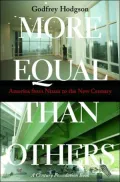
"During the past quarter century, free-market capitalism was recognized not merely as a successful system of wealth creation but as the key determinant in the health of political and cultural democracy. Now, renowned British journalist and historian Godfrey Hodgson takes aim at this popular view in a book that promises to become one of the most important political histories of our time. More Equal Than Others looks back on twenty-five years of what Hodgson calls "the conservative ascendancy" in America, demonstrating how a conservative agenda has come to dominate American politics." More Equal Than Others addresses a broad range of issues, with chapters on politics, the new economy, immigration, technology, women, race, and foreign policy, among others.Editorials
Allen D. Boyer
In More Equal Than Others, an up-to-the-minute critique of modern American life, the British historian Godfrey Hodgson combines intelligent discussions of pressures that have shaped American society during the last quarter-century (emerging feminism, booming immigration, the drawn-out struggle for racial equality and the dawning computer age) with a factoid-packed jeremiad against the triumph of the suburb -- the demographic zone where half the population now lives, where two-thirds of new jobs are located, whose voting strength overawes Congress and which, he writes, has become ''the normal and perhaps also the normative American environment.'' He argues that the development and marketing of suburbia has led to a stratification of wealth and interest among communities of like-minded residents, even to a politicized class struggle between ''the Democratic cities and the Republican suburbs.''— The New York Times
Publishers Weekly
Hodgson sets out to say some things outside "the two ruling narratives of American history over the past three decades: the liberal recessional or conservative triumphalism." Above all, he observes, "Great and growing inequality has been the most salient social fact about the America of the conservative ascendancy. It is hard not to ask whether that was not one of the conservatives' strategic goals." Yet inequality is mentioned more than discussed, while conservative mechanisms that may increase it are barely even mentioned until 100 pages later. Despite occasional flashes of insight, Hodgson, biographer of Daniel Patrick Moynihan and a scholar at the Rothermere American Institute at Oxford University, repeatedly muddles matters with generous dollops from those ruling narratives-such as the Democratic Leadership Council's analysis of what ailed the Democrats in the 1980s-regurgitated as gospel. Similarly, he attributes white backlash to "the noisy claims of radical black leadership" in his chapter on race, while his chapter on women blames articulate feminists not so much for antagonizing men and conservative women but for letting their middle-class "cultural" movement get in the way of a second, "primarily economic" women's movement, "silent and largely the sum of private decisions." He rightly notes that the Internet boom was built on decades of government-funded, university-nurtured research, then says, "[T]he legendary entrepreneurs deserve every bit of their fame and fortune." Hodgson inadvertently demonstrates what he seeks to explain: how inequality can grow so sharply, yet be marginalized in political discourse. (Apr.) Copyright 2004 Reed Business Information.New York Times Book Review
In More Equal Than Others, an up-to-the-minute critique of modern American life, the British historian Godfrey Hodgson combines intelligent discussions of pressures that have shaped American society during the last quarter-century . . . With a factoid-packed jeremiad against the triumph of the suburb—the demographic zone where half the population now lives, where two-thirds of new jobs are located, whose voting strength overawes Congress. . . . Although Hodgson writes as a liberal, he levels [his] charges across party lines.— Allen D. Boyer
Financial Times
[A] wonderfully written, wide-ranging and profoundly depressing book. Hodgson's theme is that the US has changed for the worse in the past 25 years: inequality is supplanting equality, even equality of opportunity.— Kathleen Burk
Political Science Quarterly
Godfrey Hodgson . . . delivers a relentless indictment of an American grown . . . far too sure of itself. In More Equal Than Others, he argues that a wave of right-wing triumphalism has overtaken the country since the Soviet Union's death from exhaustion. In its train, it has brought us a sanctification of the unfettered market, an intensification of Americans' long-standing contempt for government, and—most appallingly—a complacent acceptance of unprecedented inequalities in wealth, education, and opportunity.— Matthew A. Crenson
The Spectator
[Hodgson] sees a country which the postwar liberal consensus has indeed moved right, turning free-market capitalism from an economic theory into a cultural template. The result is an America in which financial segregation increasingly preserves opportunity for a wealthy elite. . . . [He] argues convincingly that American society has come to resemble old-fashioned Europe, with its strictly class-structured elites.— Michael Carlson
The Independent
The most thoughtful, thorough and sorrowful book imaginable on what has happened in these years.— Bernard Crick
New York Times Book Review
In More Equal Than Others, an up-to-the-minute critique of modern American life, the British historian Godfrey Hodgson combines intelligent discussions of pressures that have shaped American society during the last quarter-century . . . With a factoid-packed jeremiad against the triumph of the suburb—the demographic zone where half the population now lives, where two-thirds of new jobs are located, whose voting strength overawes Congress. . . . Although Hodgson writes as a liberal, he levels [his] charges across party lines.Financial Times
[A] wonderfully written, wide-ranging and profoundly depressing book. Hodgson's theme is that the US has changed for the worse in the past 25 years: inequality is supplanting equality, even equality of opportunity.The Spectator
[Hodgson] sees a country which the postwar liberal consensus has indeed moved right, turning free-market capitalism from an economic theory into a cultural template. The result is an America in which financial segregation increasingly preserves opportunity for a wealthy elite. . . . [He] argues convincingly that American society has come to resemble old-fashioned Europe, with its strictly class-structured elites.The Independent
The most thoughtful, thorough and sorrowful book imaginable on what has happened in these years.Political Science Quarterly
Godfrey Hodgson . . . delivers a relentless indictment of an American grown . . . far too sure of itself. In More Equal Than Others, he argues that a wave of right-wing triumphalism has overtaken the country since the Soviet Union's death from exhaustion. In its train, it has brought us a sanctification of the unfettered market, an intensification of Americans' long-standing contempt for government, and—most appallingly—a complacent acceptance of unprecedented inequalities in wealth, education, and opportunity.Book Details
Published
February 23, 2004
Publisher
Princeton, N.J. : Princeton University Press, c2004.
Pages
408
Format
Hardcover
ISBN
9780691117881