
Europe - Ethnic & Race Relations, Jewish Movements & Sects - General & Miscellaneous, Europe - History of Judaism, Jewish History - Europe - General & Miscellaneous, German History - Religious Aspects, Jewish Philosophy
Log in to track your reading progress.
Overview
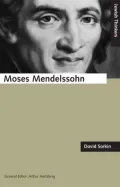
Moses Mendelssohn (1729–1786) was the premier Jewish thinker of his day and one of the best-known figures of the German Enlightenment, earning the sobriquet ‘the Socrates of Berlin’. He was thoroughly involved in the central issue of Enlightenment religious thinking: the inevitable conflict between reason and revelation in an age contending with individual rights and religious toleration. He did not aspire to a comprehensive philosophy of Judaism, since he thought human reason was limited, but he did see Judaism as compatible with toleration and rights. David Sorkin offers a close study of Mendelssohn’s complete writings, treating the German, and the often-neglected Hebrew writings, as a single corpus and arguing that Mendelssohn’s two spheres of endeavour were entirely consistent.Synopsis
Moses Mendelssohn (1729-1786) was the premier Jewish thinker of his day and one of the best-known figures of the German Enlightenment, earning the sobriquet 'the Socrates of Berlin'. He was thoroughly involved in the central issue of Enlightenment religious thinking: the inevitable conflict between reason and revelation in an age contending with individual rights and religious toleration. He did not aspire to a comprehensive philosophy of Judaism, since he thought human reason was limited, but he did see Judaism as compatible with toleration and rights. David Sorkin offers a close study of Mendelssohn's complete writings, treating the German, and the often-neglected Hebrew writings, as a single corpus and arguing that Mendelssohn's two spheres of endeavour were entirely consistent.Book Details
Published
August 27, 2012
Publisher
Halban
Pages
242
ISBN
9781905559510