
Join Books.org — it's free

American Fiction, Phases of Life - Fiction, Arts & Entertainment - Fiction
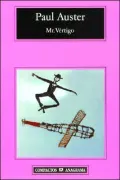
Mr. Vertigo (Spanish Edition) by Paul Auster β€” book cover

Mr. Vertigo (Spanish Edition)

by Paul Auster
Write a review
Log in to track your reading progress.

Overview

In Mr. Vertigo, his dazzling eighth novel, Paul Auster introduces a quintessentially American hero who, early in his life, masters the art of the unimaginable, and then must live out his days long after the magic has been lost and forgotten. It is 1927, the year of Babe Ruth and Charles Lindbergh - and of Walter Claireborne Rawley, a streetwise orphan from Saint Louis who becomes "Walt the Wonder Boy," a diminutive showman famous for stunning audiences across the country with his feats of levitation. Walt's teacher is Master Yehudi, a mysterious iconoclast who rescues him from poverty and instills in him the faith, fearlessness, and devotion to hard work essential to such a magnificent venture. Inevitably, Master Yehudi and Walt fall prey to the sinners thieves, and villains of America in its pre-depression heyday, from the Kansas Ku Klux Klan to the Chicago mob, and Walt's resilience, like that of his young nation, is over and again challenged. Paul Auster, a "literary original" (Wall Street Journal) whose "bounties of intelligence, mystery and literary magic nourish and delight the mind" (Chicago Sun-Times), embraces both the realist and the mythic traditions in American literature. Walt and Yehudi are classic entrepreneur adventurers, and what they sell in Walt's performance is defiance of the natural laws governing men. This is an extraordinary, exuberant novel that captures the aspirations and excesses of a country ready to soar.

About the Author, Paul Auster

Paul Auster
Paul Auster's unique novels are often like Chinese boxes, continually opening further to reveal new layers. He approaches his writing as he has approached his life, to an extent: as something of a nomad in a perpetually changing, mysterious landscape.

Biography

Much later, when he was able to think about the things that happened to him, he would conclude that nothing was real except chance. But that was much later. In the beginning, there was simply the event and its consequences.

This sentence from the opening of Paul Auster's first novel, City of Glass, could also serve as a template for the author's career, both in circumstance and theme. City of Glass is perhaps the best known of Auster's postmodern detective New York Trilogy, which is rounded out by Ghosts and The Locked Room. Though the novels nominally involve cases to be solved, at base they are about the mystery of identity and how easily it can be lost or altered. In City of Glass, a mystery writer mistakenly receives a phone call for detective Paul Auster and assumes his identity, becoming embroiled in a case. The trilogy was a welcome breath of fresh air for both detective stories and postmodernist writing, and it put Auster on the publishing map.

Setting out to write his subsequent novel, Auster kept in mind the subtitle "Anna Blume Walks Through the 20th Century." The result was a woman's post-apocalyptic urban journey, In the Country of Last Things. Subsequent works such as Moon Palace, The Music of Chance, Leviathan, and Mr. Vertigo offered heroes caught up in strange worlds, playing out their stories over existential subtexts. The Music of Chance carries references from Beckett's Waiting for Godot in its story about a drifter who ends up teaming with a card player named Jack Pozzi to hustle two wealthy eccentrics in a fateful poker game. In Mr. Vertigo, a boy who has the ability to levitate goes on the road in the 1920s as "the Wonder Boy," moving through a panorama of pre-Depression America.

Auster's ability to blur the line between fantasy and reality has resulted in unique stories that never operate solely as good yarns. The New York Times wrote of Leviathan -- a dead man's coincidence-ridden story, as narrated by his friend -- "Thus in the literary looking glass of Leviathan, in which things are not always what they seem, our pleasure in reading the story is enhanced by the challenge of making other connections." Auster's fondness for allegory has earned him both praise for his cleverness and criticism from reviewers who, even as they praise his talent, occasionally find him heavy-handed.

The director Philip Haas adapted The Music of Chance for the 1993 film starring James Spader and Mandy Patinkin. But it was Wayne Wang who drew Auster to the movie business in earnest, convincing him to write the screenplay for 1995's Smoke, which was adapted from the short story "Auggie Wren's Christmas Story." The film did well enough to get producer Miramax on board for a sequel bringing back star Harvey Keitel, Blue in the Face. This time, Auster not only wrote the script but co-directed with Wang; he later went full-fledged auteur with the 1998 film (also starring Keitel) Lulu on the Bridge.

In 1999, Auster made the unconventional choice of writing from a canine's point of view in Timbuktu -- although as Auster noted in the Guardian, Mr. Bones "is and isn't a dog." In telling the story of himself and his owner, a homeless "outlaw poet" named Willy G. Christmas, Mr. Bones offers a meditation on mortality, human relationships, and dreams. "If anything," Auster said in a chat with Barnes & Noble.com readers, "I thought of Willy and Mr. Bones as a rather screwball, nutty, latter-day version of Don Quixote and Sancho Panza, the befuddled knight-errant and his loyal squire." The New York Times called Timbuktu his "most touching, most emotionally accessible book."

Auster earned some of his best reviews with his tenth novel The Book of Illusions, about a widower who develops an obsession with an obscure silent-film star and is surprised with an invitation to meet the presumed-dead actor. Book magazine called it "certainly his best...the book [has] the drive and dazzle reminiscent of the classic hardboiled yarns of Raymond Chandler and Dashiell Hammett."

Auster is an author who, in both his fiction and his nonfiction, rekindles hope for the romantic, the coincidental, and the magical in everyday life. He does this not with fantastic story lines but by heightening the significance of twists and coincidences that happen to us all the time -- if we approach things in a certain light, our lives become like movies. Auster spins the projector.

Good To Know

Auster's wife Siri Hustvedt, whom he met in 1981, is also a novelist and essayist; writing about her novel The Blindfold, the Village Voice Literary Supplement called Hustvedt "a writer of strong, sometimes astonishing gifts." Auster's first wife was writer Lydia Davis.

Desperately poor in the late '70s and working unhappily as a French translator to make ends meet, Auster wrote a detective novel called Squeeze Play to make some money. He also invented a card game called Action Baseball that he tried to sell to game manufacturers. However, Squeeze Play is "not a legitimate book," he told the Guardian; it was published under a pseudonym. Later, an inheritance from his father allowed Auster the financial freedom to focus more on his writing.

Auster has enjoyed a remarkably international following, even in the days before his Hollywood projects raised his profile; his novels have been translated into several languages, and web sites from Germany to Japan pay him homage.

Reviews

There are no reviews yet. Log in to write one.

Editorials

Publishers Weekly - Publisher's Weekly

It will come as no surprise to the gifted Auster's (Moon Palace, The Music of Chance) many fans that walking on air, the implausible premise of his marvelously whimsical seventh novel, is treated with convincing gravity. Walt Rawley recounts his life: an orphan born in 1924 with ``the gift,'' he was seized by his master, Mr. Yehudi, a Hungarian Jew who taught him to levitate. Yehudi takes the boy from St. Louis to his own Kansas menage, which consists of Mother Sioux and Aesop, a young black genius. (Also influencing Walt's life is classy, henna-headed Marion Witherspoon, a seductive mom figure from Wichita.) After harsh training, Walt tours with his mentor as ``the Wonder Boy,'' aka Mr. Vertigo. Crammed into this road saga is the potent Americana of myth: the 1920s carnival circuit, Lindbergh's solo, the motorcar, the ethnic mix, the Ku Klux Klan and the Mob, baseball and Kansas, ``land of Oz.'' Diverse mishaps descend, but eventually Walt glides into old age and writing. The characters speak a lusty lingo peppered with vintage slang, while a postmodern authorial irony tugs their innocence askew. The prose grows particularly electric when demystifying ``loft and locomotion.'' Implicit is an analogy between levitation and the construct of fiction: both require fierce discipline to maintain a fleeting illusion. (Aug.)

Library Journal

Rescued from the streets of St. Louis and taught to fly by Master Yehudi, Walter Rawley soon becomes a national sensation. The boy wonder foils a kidnapping by his evil uncle, but his powers of levitation suddenly wane with the onset of puberty, and he declines from miracle worker to Depression-era mobster. Auster provides a dazzling display of narrative power, but his story remains a metaphysical muddle. Fluctuating between the fabulous and the mundane, it establishes no firm foundation in either realm. If Yehudi's mysterious powers are real, why must his wards die in a Klan lynching and why must Yehudi himself resort to suicide? If the alleged powers are spurious and Auster's aging narrator is unreliable, the extent of his unreliability needs sharper definition. Auster's previous novel, Leviathan (LJ 7/92), is a much more absorbing study of the elusiveness of truth.-Albert E. Wilhelm, Tennessee Technological Univ., Cookeville

Jonathan Yardley

A charmer pure and simple…Nothing less than the story of America itself
β€”Washington Post

Jay Cantor

Mr. Auster adopts a more vernacular style than usual (though it's a brilliantly filigreed demotic, making it, of course, highfalutin in its own way).... The author's openness to chance and laundromats could lead to the slack picaresque throughout, but his story is usually held taut by the metaphorical meanings of flight.... The story is witty, inventive in its language, and invitingly playful with its metaphors. It has a fairy tale's compulsion to it.
β€”The New York Times

The Washington Post

The author of Leviathan returns with a dazzling, picaresque, new novel in which Walter Claireborne Rawley, now an octogenarian, recounts his extraordinary vaudevillian adventures as "Walt the Wonder Boy" in 1924. "One hears every page of this novel, and sees it as well."

Book Details

Published
January 28, 2005
Publisher
Anagrama
Format
Paperback
ISBN
9788433967794

More by Paul Auster

Similar books