
Join Books.org — it's free

Short Story Anthologies, Detective Fiction, Other Mystery Categories, Historical Fiction
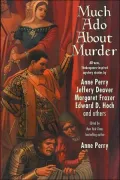
Much Ado About Murder by Anne Perry β€” book cover

Much Ado About Murder

by Anne Perry
Write a review
Log in to track your reading progress.

Overview

New York Times bestselling author Anne Perry and a stellar cast of today's finest mystery authors have come up with a few stabs at the Bard. Featuring stories by:

ANNE PERRY β€’ JEFFERY DEAVER β€’ MARGARET FRAZER β€’ EDWARD D. HOCH β€’ and others.

About the Author, Anne Perry

Anne Perry's first novel was The Carter Street Hangman, which came out in 1979. Since then she has authored a number of bestselling titles including The Twisted Root, Half Moon Street, and Bedford Square.

Biography

Born in London in October 1938, Anne Perry was plagued with health problems as a young child. So severe were her illnesses that at age eight she was sent to the Bahamas to live with family friends in the hopes that the warmer climate would improve her health. She returned to her family as a young teenager, but sickness and frequent moves had interrupted her formal education to the extent that she was finally forced to leave school altogether. With the encouragement of her supportive parents, she was able to "fill in the gaps" with voracious reading, and her lack of formal schooling has never held her back.

Although Perry held down many jobs—working at various times as a retail clerk, stewardess, limousine dispatcher, and insurance underwriter—the only thing she ever seriously wanted to do in life was to write. (In her '20s, she started putting together the first draft of Tathea, a fantasy that would not see print until 1999.) At the suggestion of her stepfather, she began writing mysteries set in Victorian London; and in 1979, one of her manuscripts was accepted for publication. The book was The Cater Street Hangman, an ingenious crime novel that introduced a clever, extremely untidy police inspector named Thomas Pitt. In this way an intriguing mystery series was born…along with a successful writing career.

In addition to the Thomas and Charlotte Pitt novels, Perry crafts darker, more layered Victorian mysteries around the character of London police detective William Monk, whose memory has been impaired by a coach accident. (Monk debuted in 1990's The Face of a Stranger.) She also writes historical novels set during the First World War (No Graves as Yet, Shoulder the Sky, etc.) and holiday-themed mysteries (A Christmas Journey, A Christmas Secret, etc), and her short stories have been included in several anthologies.

Good To Know

Some fun and fascinating outtakes from our interview with Anne Perry:

The first time I made any money telling a story I was four and a half years old—golden hair, blue eyes, a pink smocked dress, and neat little socks and shoes. I walked home from school (it was safe then) with my lunchtime sixpence unspent. A large boy, perhaps 12 or 13, stopped me. He was carrying a stick and threatened to hit me if I didn't give him my sixpence. I told him a long, sad story about how poor we were—no food at home, not even enough money for shoes! He gave me his half crown—five times sixpence! It's appalling! I didn't think of it as lying, just escaping with my sixpence. How on earth he could have believed me I have no idea. Perhaps that is the knack of a good story—let your imagination go wild, pile on the emotions—believe it yourself, evidence to the contrary be damned. I am not really proud of that particular example!

I used to live next door to people who had a tame dove. They had rescued it when it broke its wing. The wing healed, but it never learned to fly again. I used to walk a mile or so around the village with the dove. Its little legs were only an inch or two long, so it got tired, then it would ride on my head. Naturally I talked to it. It was a very nice bird. I got some funny looks. Strangers even asked me if I knew there was a bird on my head! Who the heck did they think I was talking to? Of course I knew there was a bird on my head. I'm not stupid—just a writer, and entitled to be a little different. I'm also English, so that gives me a second excuse!

On the other hand I'm not totally scatty. I like maths, and I used to love quadratic equations. One of the most exciting things that happened to me was when someone explained non-Euclidean geometry to me, and I suddenly saw the infinite possibilities in lateral thinking! How could I have been so blind before?

Here are some things I like—and one thing I don't:

  • I love wild places, beech trees, bluebell woods, light on water—whether the light is sunlight, moonlight, or lamplight; and whether the water is ocean, rain, snow, river, mist, or even a puddle.

  • I love the setting sun in autumn over the cornstooks.

  • I love to eat raspberries, pink grapefruit, crusty bread dipped in olive oil.

  • I love gardens where you seem to walk from "room to room," with rambling roses and vines climbing into the trees and sudden vistas when you turn corners.

  • I love white swans and the wild geese flying overhead.

  • I dislike rigidity, prejudice, ill-temper, and perhaps above all, self-righteousness.

  • I love laughter, mercy, courage, hope. I think that probably makes me pretty much like most people. But that isn't bad.
  • Reviews

    There are no reviews yet. Log in to write one.

    Editorials

    Publishers Weekly

    Much Ado About Murder, an all-original Shakespeare-themed anthology edited by Anne Perry, gathers tales by 17 top mystery writers, most of them stars in the historical category, from both sides of the Atlantic. Contributors include Carole Nelson Douglas, Robert Barnard, Marcia Talley, Edward Marston, Margaret Frazer and Peter Robinson.

    Kirkus Reviews

    Perry (Death of a Stranger, p. 1180, etc.) and 16 accomplices take on the daunting job of rewriting Shakespeare. The high points include Carole Nelson Douglas's Mixmaster approach to The Merchant of Venice and The Tempest, in which Portia, having made her name in the ultimate courtroom drama, defends Caliban when he's accused of murdering Antonio; Marcia Talley's witches'-eye burlesque of Macbeth, in which the weird sisters' economic and domestic problems dwarf the tragedy of their Scottish clients; Robert Barnard's attempt to give voice to the Silent Irishman in Hamlet (addressed in the line "Now I might do it, Pat") in a farce that seriously undermines the melancholy Dane's status as proto-modernist hero; and more earnest considerations by Peter Robinson and Gillian Linscott of how characters Shakespeare represented as ideals of feminine docility might take bloody revenge on their oppressors, showing how a popular genre may take its revenge on the oppressive canons of high culture. Less radical (and less successful) revisions by Brendan DuBois, Peter Tremayne, Sharan Newman, P.C. Doherty, Lillian Stewart Carl, Simon Brett, Kathy Lynn Emerson, Edward Marston, Jeffery Deaver, and editor Perry consider Shakespearean characters offstage, in historical contexts, or onstage, as actors in performances of Shakespeare in various historical periods. Genuinely witty interpolations and extrapolations of the plays, in which Shakespeare and mystery both profit from the resulting cross-pollination, alternate with more pedestrian tales. The latter's disconcertingly Shakespearean cast may well make you miss iambic pentameter and blame the Bard for creating such conventional victims, villains, anddetectives.

    Book Details

    Published
    December 1, 2002
    Publisher
    New York : Berkley Prime Crime, c2002.
    Pages
    352
    Format
    Hardcover
    ISBN
    9780425186503

    More by Anne Perry

    Similar books