
Basic Sciences, Education - General & Miscellaneous, Biology & Life Sciences, Physiology, Biology & Life Sciences, Educational Theory, Research & History
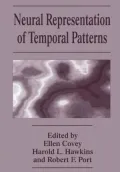
Neural Representation of Temporal Patterns
E. Covey (Editor), H.L. Hawkins (Editor), R.F. Port (Editor)
Available on Bookshop
Write a review
Books.org participates in affiliate programs including Bookshop.org and the Amazon Services LLC Associates Program. We may earn a commission from qualifying purchases made through links on this page, at no additional cost to you.
Log in to track your reading progress.
Synopsis
Boththeanalysisandgenerationoftemporalpatternsarefundamental tasks ofbiological systems. Throughout the animal kingdom, every sensory modality is designed to analyze patterns ofinformation distributed over time. Human speech and music, a visual scene in whichobjects moveorastationaryscenethatwescanwithoureyes, apatternofpressurethat changesas we moveourfingertips overan object, theelectrical field detected byafish as it swimspastobjectsinastream, orthepatternofultrasonicechoesdetectedbyabatas itflies throughacave, alldependuponspecificdistributionsofinformationovertime. Itisperhaps evenmoreobviousthatallformsofaction mustincludeatimedimension. Walking, running, talking, reaching for an object, writing, orpressing keys in aparticularorderall require the generation ofspecific patterns of muscle contractions distributed over time. Finally, most forms of behavior require a transformation from a temporal pattern of sensory input to a temporalpatternofmotoroutput, aswell as interactivemodulationofsensoryinputsystems by motoroutput systems and vice versa. Despitethefactthattheprocessesofanimallifeareinseparablefromthetimedimension, mostexperimental and theoreticalresearch on neuralcircuitry hasemphasizedtheencoding ofstatic or spatially distributed information. Within recent years, a large body ofdata has becomeavailableregardingthetimecourseoffundamentalneuralprocesses, sothatwefinally haveatourdisposalsomeofthenecessarytoolsandinformationtodiscovermechanismsused by neural circuitry to deal with time. The study of how the nervous system represents information distributed overtime is currently an exciting new frontier in neurobiology, and one in which rapid progress is likely to be made overthe next decade.Editorials
Booknews
Papers from the April 1993 workshop present findings on questions related to temporal pattern representation and discuss possible future strategies for studying temporal pattern analysis, detailing the many approaches to the representation of time-varying information in the nervous system. Contains sections on temporal pattern analysis and generation; learning and memory; and practical applications, incorporating perspectives from neurobiology; experimental psychology of perception and memory; and computer science techniques. Annotation c. Book News, Inc., Portland, OR (booknews.com)Book Details
Published
April 30, 2013
Publisher
Springer-Verlag New York, LLC
Pages
272
Format
Paperback
ISBN
9781461357858