
General & Miscellaneous Art, Art Styles & Periods, Art of the Americas
Log in to track your reading progress.
Overview
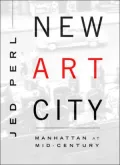
A fascinating, panoramic exploration of art and culture in mid-twentieth-century New York City from one of our most important and influential art critics.New Art City takes us from the solitude of the artist’s studio to the uproarious bars where artists gathered, from the ramshackle bohemian neighborhoods of downtown Manhattan to the Midtown streets where steel-and-glass skyscrapers were rising and art galleries were proliferating. We encounter a kaleidoscopic range of artists. There are legendary figures–Jackson Pollock, David Smith, Willem de Kooning, Joseph Cornell, Andy Warhol, and Donald Judd–as well as still undervalued ones, such as the galvanic teacher Hans Hofmann, the lyric expressionist Joan Mitchell, the adventuresome realist Fairfield Porter, and the eccentric thinker John Graham. We encounter, too, the writers, critics, patrons, and hangers-on who rounded out the artists’ world. Jed Perl helps us see what the artists were creating and understand how they confronted an exploding art audience. And he makes clear how the economic boom of the late 1950s and the increasingly enthusiastic response to Abstract Expressionism ushered in the rapacious art world of the 1960s and the theatricality of Pop Art.
Artists drew strength from the dizzying onslaught of Manhattan, and produced a tidal wave of new forms. These included Hofmann’s brazen flourishes of color; Pollock’s quicksilver skeins of paint unfurling panoramic arabesques; and the crushed, jagged, turning-back-on-itself calligraphy of de Kooning’s gnomic alphabets. And there was much more: Burgoyne Diller’s levitating rectangles; Nell Blaine’sexplosive renderings of quotidian scenes; Ellsworth Kelly’s extraordinary simplifications, suggesting sails or semaphores.
A brilliant tapestry of social history, biographical portraiture, and criticism, New Art City illuminates a revolutionary, unprecedented time and place in American culture.
Editorials
John Updike
Can there be that much to say about so concentrated a space and span of time? Have no fear: Perl, the art critic for The New Republic, is a fiercely fluent word-spinner, and he comes laden with a staggering knowledge of American artists and their critics from, say, 1948, when Willem de Kooning had his first one-man show and Jackson Pollock began to drip in earnest, down to 1982, when Donald Judd began to colonize the flat wilderness of Marfa, Tex., with 100 same-sized aluminum boxes.— The New York Times
Publishers Weekly
Perl, the art critic for the New Republic, celebrates the heterogeneous achievements of the New York art world in this elegant, erudite work that sweeps gracefully from the 1940s, when the city was "the place of dazzling contradictions," to the "jangling urgency" of art in the 1970s. Contending that the personal characteristics of an artist's work are shaped by his relationship to the city, especially to its art scene, Perl finds in postwar New York a "dialectical extravaganza" in which painters and sculptors set about redefining their place in history-aiming not to shatter traditions but to forge new ones. Although giants such as de Kooning and Pollock make significant appearances, this history is equally concerned with "minor characters" who exerted more subtle influences, such as the painter Earl Kerkam, whose approval Pollock dearly valued. Perl's conversational tone is at times so intimate that the effect is more that of a curator offering a private tour of his exhibition than an art historian's lecture. Or, perhaps, a walking tour that takes readers from downtown studios and artists' taverns to the Guggenheim and Museum of Modern Art and back again, with a guide whose perceptive eye always steers us toward an unnoticed treasure. 328 illus. (Oct.) Copyright 2005 Reed Business Information.Library Journal
In this original, expansive, and generously illustrated exploration of the increasingly international art world of mid-20th-century New York City, influential New Republic art critic Perl (Paris Without End) examines the social and cultural factors that resulted in New York's becoming the art capital of the world and the center for the emergence of new art forms like Abstract Expressionism and Pop Art. Covered here are the individual histories and works of famous and lesser-known artists-e.g., Jackson Pollock, Willem de Kooning, Hans Hofmann, and Joan Mitchell-as well as contributions in other media (e.g., architecture, drama, and dance) and the various venues where artists lived, developed, and displayed their works. What results is an authoritative yet personal account, sufficiently well documented despite the absence of endnotes and a bibliography, that leaves room for new interpretations pertaining to artistic free will, individual consciousness, and self-determination in American society. Recommended mostly for large public, undergraduate, and academic library collections encompassing the fine arts and interdisciplinary cultural studies.-Cheryl Ann Lajos, Free Lib. of Philadelphia Copyright 2005 Reed Business Information.Kirkus Reviews
A comprehensive account of the New York art scene in the 1950s and '60s. The Manhattan-centric "heroic period" of American art here unfolds in novelistic detail. Notables of the New York School (Pollock, de Kooning, Warhol) sit side by side with smaller stars (Hans Hofmann, Philip Guston, Mercedes Matter, Fairfield Porter), and new insight is brought to each, with a blend of anecdote and idea that gives a real sense of the times. Excitement is palpable in the fierce individualism cultivated by seminal teacher Hofmann, who encouraged an anachronistic blend of new and old reflected in the attitudes and influences of the artists. Positing a predominant romanticism that was a conglomerate of "isms"-expressionism, surrealism, primitivism, existentialism, nihilism-what emerged was a fulminating scene where, as de Kooning asserted, "one idea is as good as the next." Dialecticism governs the whole as Perl brings to light unlikely connections (Duchamp and Mondrian, Donald Judd and Paul Katz) and the impact of various mediums upon one another, such as dancer Merce Cunningham's influence on the plastic arts. Himself a painter, New Republic art critic Perl eschews gossip in favor of analysis of the artists' life and work, including who they were reading (Sartre, Balzac, B.H. Friedman) and where they congregated (Cedar Tavern, the Artist's Club), as well as the influence of the city itself-he devotes a whole chapter to its geography. It's a revealing journey, encompassing the charged commingling of artists absorbed in largely solitary studio efforts during modernism's tail end, to Pop art's fixation on reproduction, consumerism and celebrity. Art history as it should be: neither star-struck norpretentious, and full of heart.Book Details
Published
October 4, 2005
Publisher
Alfred A. Knopf
Pages
656
Format
Hardcover
ISBN
9781400041312