
Astrology & Divination, Mechanical Physics, Physics, Theories of Science, Astronomy, Physics, Astronomy
Available on Bookshop
Write a review
Books.org participates in affiliate programs including Bookshop.org and the Amazon Services LLC Associates Program. We may earn a commission from qualifying purchases made through links on this page, at no additional cost to you.
Log in to track your reading progress.
Overview
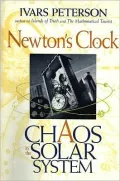
With his critically acclaimed best-sellers The Mathematical Toursist and Islands of Truth, Ivars Peterson took readers to the frontiers of modern mathematics. His new book provides an up-to-date look at one of science's greatest detective stories: the search for order in the workings of the solar system. In the late 1600s, Sir Isaac Newton provided what astronomers had long sought: a seemingly reliable way of calculating planetary orbits and positions. Newton's laws of motion and his coherent, mathematical view of the universe dominated scientific discourse for centuries. At the same time, observers recorded subtle, unexpected movements of the planets and other bodies, suggesting that the solar system is not as placid and predictable as its venerable clockwork image suggests. Today, scientists can go beyond the hand calculations, mathematical tables, and massive observational logs that limited the explorations of Newton, Copernicus, Galileo, Kepler, Tycho Brahe, and others. Using supercomputers to simulate the dynamics of the solar system, modern astronomers are learning more about the motions they observe and uncovering some astonishing examples of chaotic behavior in the heavens. Nonetheless, the long-term stability of the solar system remains a perplexing, unsolved issue, with each step toward its resolution exposing additional uncertainties and deeper mysteries. To show how our view of the solar system has changed from clocklike precision to chaos and complexity, Newton's Clock describes the development of celestial mechanics through the ages--from the star charts of ancient navigators to the seminal discoveries of the 17th centure; from the crucial work of Poincaré to the startling, sometimes controversial findings and theories made possible by modern mathematics and computer simulations. The result makes for entertaining and provocative reading, equal parts science, history, and intellectual adventure.
Synopsis
An up-to-date look at one of science's greatest detective stories: the search for order in the workings of the solar system— "Masterly. . . . Eminently readable. . . . Lucid" ( Wall Street Journal ). "[Peterson] is well-suited to wean the general reader away from one of everyday science's most comforting and tenacious illusions—namely, that the solar system operates on a giant stable clockwork system." — Publishers Weekly In the late 1600s, Sir Isaac Newton provided what astronomers had long sought: a seemingly reliable way of calculating planetary orbits and positions. Newton's laws of motion and his coherent, mathematical view of the universe dominated scientific discourse for centuries. At the same time, observers recorded subtle, unexpected movements of the planets and other bodies, suggesting that the solar system is not as placid and predictable as its venerable clockwork image suggests. Today, scientists can go beyond the hand calculations, mathematical tables, and massive observational logs that limited the explorations of Newton, Copernicus, Galileo, Kepler, Tycho Brahe, and others. Using supercomputers to simulate the dynamics of the solar system, modern astronomers are learning more about the motions they observe and uncovering some astonishing examples of chaotic behavior in the heavens. Nonetheless, the long-term stability of the solar system remains a perplexing, unsolved issue, with each step toward its resolution exposing additional uncertainties and deeper mysteries. To show how our view of the solar system has changed from clocklike precision to chaos and complexity, Newton's Clock describes the development of celestial mechanics through the ages—from the star charts of ancient navigators to the seminal discoveries of the seventeenth century; from the crucial work of Poincaré to the startling, sometimes controversial findings and theories made possible by modern mathematics and computer simulations. The result makes for entertaining and provocative reading, equal parts science, history, and intellectual adventure. "Peterson, a science journalist, has told his story in a lively and very readable fashion. Necessarily, he has included a modest amount of technical detail, but the volume should be fully intelligible to lay readers with a bit of background in the physical sciences. Recommended for academic and public libraries." — Library Journal "A very tough subject made lucid. Not for science illiterates, but astronomy and physics buffs will lap it up." — Kirkus ReviewsBook Details
Published
July 15, 1993
Publisher
Holt, Henry & Company, Inc.
Pages
250
ISBN
9781466813878