
United States Military Aviation - General & Miscellaneous, Armed Forces - United States - General & Miscellaneous, United States Military Aviation - Regimental Histories, Commandos and Special Forces, United States Air Force
Log in to track your reading progress.
Overview
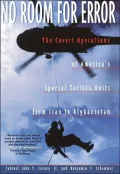
"When the U.S. Air Force decided to create an elite "special tactics" team in the late 1970s to work in conjunction with special-operations forces fighting terrorists and highjackers and defusing explosive international emergencies, John T. Carney was the man they turned to. Since then Carney and the U.S. Air Force Special Tactics units have circled the world on sensitive clandestine missions. They have operated behind enemy lines, gathering vital intelligence. They have combated terrorists and overthrown dangerous dictators. They have suffered many times the casualty rate of America's conventional forces. But they have gotten the job done - most recently in stunning victories in the war on terrorism in Afghanistan, which Carney calls "America's first special-operations war." Now, for the first time, Colonel Carney lifts the veil of secrecy and reveals what really goes on inside the special-operations forces that are at the forefront of contemporary warfare." Part memoir, part military history, No Room for Error reveals how Carney, after a decade of military service, was handpicked to organize a small, under-funded, classified ad hoc unit known as Brand X, which even his boss knew very little about. Here Carney recounts the challenging missions: the secret reconnaissance in the desert of north-central Iran during the hostage crisis; the simple rescue operation in Grenada that turned into a prolonged bloody struggle. With Operation Just Cause in Panama, the Special Tactics units scored a major success, as they took down the corrupt regime of General Noriega with lightning speed. Desert Storm was another triumph, with Carney's team carrying out vital search-and-rescue missions as well as helping to hunt down mobile Scud missiles deep inside Iraq.Editorials
Publishers Weekly
Colonel John T. Carney Jr. is the first commanding officer of the U.S. "special tactics" units. Ably assisted by West Point graduate and veteran Ranger Schemmer, he has written a timely book that's part memoir and part history. Carney was an air force officer whose career was going slowly until he was assigned to Combat Control School. A descendant of the WWII pathfinders the men who jumped first and marked the way for paratroopers the combat controllers were an overlooked bunch in the air force. Stationed on a base in Texas, the hardworking Carney turned his lackluster command into a top-flight outfit that soon got noticed. Nicknamed "Brand X," Carney managed to get his command attached to the new Delta Force only after a lot of infighting among the services. After even more rigorous training, the combat controllers were an integral part of the failed rescue attempt of the U.S. hostages in Iran in 1980. Carney pulls no punches in strongly criticizing official stories of the success of Operation Urgent Fury, which liberated Grenada. By 1989, when American forces overthrew Manuel Noriega in Panama, the special forces had learned even more from their operations and acted more in unison, even though some army units still didn't want any of Carney's men attached to their units. (Carney is quick to point out how these units foundered when his men were kept out of action.) Carney's men were used to locate Iraqi Scuds during the Gulf War with varying success; operations in Somalia and Haiti, among others, reinforced the need for special operations units such as those Carney describes. His dramatic tales place special operations history in perspective, particularly as the war in Afghanistan has been led by special forces units. Of America's 277 combat deaths in six major operations since 1980, 36% were special forces. (On sale Oct. 29) Copyright 2002 Cahners Business Information.Kirkus Reviews
The man who formed the first US special-tactics unit makes a clear, detailed, clinical analysis of operations from the failed Iranian rescue mission to the recent successes in Afghanistan. In 1977, Carney, an Air Force officer, was chosen to lead a six-man team nicknamed Brand X. Created to fight terrorism, the unit trained to combat hijackings, rescue hostages, and recover stolen nuclear weapons. Skilled in HALOs (high altitude, low opening parachute jumps), Brand X could secure, clear, and light landing fields for Navy SEALs and the Army Delta Force and Rangers. With journalist Schemmer (The Raid, not reviewed), Carney evaluates US special operations since 1980, most of which he took part in. The Iranian hostage rescue failed for multiple reasons, including no dress rehearsal, unfamiliarity with low-level desert flight, and branch service compartmentalization that lead to non-sharing of critical information. President Reagan called the 1983 invasion of Grenada a brilliant victory, but Carney shows it to have been a messy affair resulting in multiple deaths by friendly fire. Better success came with the 1989 invasion of Panama to depose Manuel Noriega, when Brand X safely coordinated multiple air strikes and drops in a confined area. In the Gulf War, General Schwarzkopf led with a huge tank assault; special forces played only a limited role, its purpose to soothe the Israelis by clearing Scud missiles from western Iraq. Retired by the time of Afghanistan, Carney appreciates the way special units organized the anti-Taliban forces there, making unnecessary large numbers of US ground troops. Carney trained as a chef after leaving the service and later joined the private sector as a militaryconsultant. He ends with an affecting appeal for donations to a scholarship fund for children whose fathers died in special-forces operations. A precise military study, only marginally adapted for a general reader.Book Details
Published
October 31, 2003
Publisher
New York : Ballantine Books, 2002.
Pages
352
Format
Hardcover
ISBN
9780345453334