
Vietnam War - General & Miscellaneous, Military Intelligence, 20th Century American History - Vietnam War, United States - Espionage
Available on Bookshop
Write a review
Books.org participates in affiliate programs including Bookshop.org and the Amazon Services LLC Associates Program. We may earn a commission from qualifying purchases made through links on this page, at no additional cost to you.
Log in to track your reading progress.
Overview
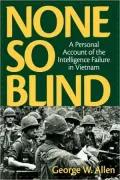
From the first large-scale Viet Minh offensive against the French in 1950, to the fall of Saigon in 1975, the United States tried desperately to understand the nature of the fierce Communist-led struggle to create a unified, independent Vietnam. American intelligence played a key role in gathering information on the political and military situation in Vietnam and on the strengths and weaknesses of both sides. But as George Allen shows in this eye-popping memoir, intelligence appraisals were consistently ignored or rejected by policymakers in every administration from Eisenhower through Nixon—because these assessments undermined the mistaken assumptions of the White House, the State Department, and the Pentagon. From his vantage point as a chief official with the CIA and army intelligence, Mr. Allen reveals specifically how American leaders, unwilling to face up to “bad news” from intelligence sources, largely excluded intelligence from important policy deliberations until it was too late. None So Blind is a remarkable contribution to the history of the Vietnam War.Synopsis
In this personal account of the intelligence failure in Vietnam, Mr. Allen reveals specifically how American leaders largely excluded intelligence from important policy deliberations until it was too late. Don't miss this book! --John Prados
Rapport
Allen's book is as engrossing as it is mind-boggling. A must-read.
Editorials
The VVA Veteran
Illuminating!Providence Sunday Journal -
Valuable...an important piece of the Vietnam puzzle.Harold P. Ford
A unique work by a unique author.... Allen had the guts to speak truth to power.John Prados
The CIA's premier Vietnam intelligence expert reveals the inside story of disputes on the war.... Don't miss this book!Lloyd Gardner
Indispensable.... A must book.The Journal Of Intelligence History -
If the reader can only read one book about the problems of strategic intelligence in Vietnam, this one is recommended.The Journal of Intelligence History
If the reader can only read one book about the problems of strategic intelligence in Vietnam, this one is recommended.Gregory
Valuable...an important piece of the Vietnam puzzle.— Providence Sunday Journal
Publishers Weekly
Historians and other pundits will add this to their arsenals in the continuing re-evaluation of the war.Rapport
Allen's book is as engrossing as it is mind-boggling. A must-read.VVA Veteran
Illuminating!Library Journal
The author, who specialized in Vietnam during his 30 years (1949-79) in military intelligence and the CIA, lays the blame for America's tragic failure in that country squarely on the heads of top policymakers in Washington, DC. He argues that in their frantic search for victory over communism, they ignored professional experts at home and in Indochina who offered opinions and information contrary to what the White House wanted to hear. Allen does believe that the government has learned from that giant mistake and is now more likely to incorporate intelligence into its deliberations. This manuscript was originally written over 20 years ago but has been revised and updated since. It is essentially correct in its arguments but could have been better documented (some footnotes are included, although one might have expected more references). It is also not entirely original, though it does give an insider's view. Other works in this category include Frank Snepp's Decent Interval: An Insider's Account of Saigon's Indecent End (o.p.), Sam Adams's War of Numbers: An Intelligence Memoir (LJ 4/15/94), Warner Smith's Covert Warrior: A Vietnam Memoir (o.p.), and James E. Parker's Last Man Out: A Personal Account of the Vietnam War (LJ 3/15/97). Suitable for public and academic libraries. (Index and maps not seen.) Daniel K. Blewett, Coll. of DuPage Lib., Glen Ellyn, IL Copyright 2001 Cahners Business Information.Booknews
There is a saying that one always asks advice from the person who is going to say what one wants to hear. Essentially, the Pentagon, the White House, and the State Department were guilty of this by consistently ignoring intelligence advice that Ho Chi Minh's movement tapped the Vietnamese people's desire for freedom and that it would be impossible for the French or the Americans to impose an outside government on them, according to former U.S. Army and CIA analyst Allen. He here recounts the meetings, decisions, and bureaucratic wranglings in the government that he experienced in the period that he concentrated on Vietnam (1949-1968). Annotation c. Book News, Inc., Portland, OR (booknews.com)Kirkus Reviews
A retired CIA officer describes his considerable involvement in the Vietnam War and offers a somewhat self-serving account of the failure of American policy. Allen compares himself to Cassandra, and, if his claims here (vetted by the CIA) are even partially true, the comparison is apt. Not long after the 1954 fall of Dien Bien Phu, Allen (and some unnamed colleagues who agreed with him) began offering to military commanders and politicians and diplomatic officers what they considered realistic assessments of the political and military situation in Vietnam, but no one believed them-or even wanted to hear their generally dark predictions. The author begins with a little personal history. Born in 1926, he saw action in the South Pacific during WWII. Afterwards, he joined the new Central Intelligence Agency and became a specialist in Indochinese affairs. He witnessed the increasing Vietnamese involvement of the US in the early 1950s and credits himself with predicting the assault on Dien Bien Phu (no one listened); he warned his superiors in 1954 that the US should not get involved in Vietnam (no one listened); and he saw the Tet Offensive coming (no one listened). During the 1950s and '60s he was continually in and out of Vietnam-and, at one point, spent two years separated from his family. He believes that one of our principal failures was permitting the communists to win the ideological and psychological battles with the Vietnamese. He describes a chaotic situation during the 1960s and '70s: There was, he says, no coordinated, integrated plan of intelligence among the military, the CIA, and the South Vietnamese-but there "was "an insatiable hunger for good news from those US leadersprosecuting the conflict, so the naysayers like Allen were gradually marginalized. Allen is no prose stylist: in his hackneyed text, burrs are under saddles, babies are thrown out with bathwater, and feet are held to the fire. Plodding and pedantic-but with poignant reminders that the tragedy of Vietnam need not have happened. (3 maps, not seen)Book Details
Published
October 1, 2001
Publisher
Dee, Ivan R. Publisher
Pages
320
Format
Hardcover
ISBN
9781566633871