
Women's Biography, Family Memoirs - Biography, Medical Figures, Women's Biography, Patient Narratives
Available on Bookshop
Write a review
Books.org participates in affiliate programs including Bookshop.org and the Amazon Services LLC Associates Program. We may earn a commission from qualifying purchases made through links on this page, at no additional cost to you.
Log in to track your reading progress.
Overview
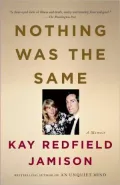
Kay Redfield Jamison, award-winning professor and writer, changed the way we think about moods and madness. Now Jamison uses her characteristic honesty, wit and eloquence to look back at her relationship with her husband, Richard Wyatt, a renowned scientist who died of cancer. Nothing was the Same is a penetrating psychological study of grief viewed from deep inside the experience itself.
From the eBook edition.
Editorials
Reeve Lindbergh
The great gift Jamison offers here, beyond her honesty and the beauty of her writing, is perspective: a clear-eyed view of illness and death, sanity and insanity, love and grief. As she writes, she often invokes the words of scientists, philosophers, novelists and poets, from Sigmund Freud to Graham Greene to Edna St. Vincent Millay. The excerpts are well chosen, but the voice that rings truest is her own, with its disciplined mix of openness and restraint. Once again, Jamison seems to be telling the truth, no matter how difficult it may be, in a way that avoids self-pity and inspires courage. To write the truth with such passion and grace is remarkable enough. To do this in loving memory of a partner is tribute indeed.—The Washington Post
Kirkus Reviews
A manic-depressive clinical psychologist finds solace after the death of her husband. Redfield (Psychiatry/Johns Hopkins Univ. School of Medicine; Exuberance: The Passion for Life, 2004, etc.) stunned readers when she recounted her battle with harrowing mental illness in her 1995 memoir An Unquiet Mind. Continuing her journey, the author analyzes her life with celebrated scientist Richard Wyatt, who suffered the recurrence of Hodgkin's disease after 20 years in remission. Persistence and relentless ambition prevented a lifelong battle with dyslexia from impeding Wyatt's collegiate studies. He earned a psychiatric residency at Harvard and went on to become Neuropsychiatry chief at the National Institute of Mental Health. By the end of his life, he was considered a pioneer in the field. Jamison's manic mood swings caused friction early on in their romantic relationship, and though Wyatt was new to love, he cherished Jamison "in a way I never questioned." The ebb and flow of their often turbulent coupling was buoyed by unconditional devotion and extreme patience ("My rage was no match for Richard's wit"), and they married in 1994, only to have Wyatt's cancer recur five years later. Risky stem-cell transplants and high-dose chemotherapy afforded them added time together, but little more than a year later, the cancer took his life. Before his death, they spent languid days of quiet time pondering "only small and binding things." When Jamison admitted to sobbing "But what will I do without you?" and started to prepare funeral arrangements, her ordeal becomes overwhelmingly heart-wrenching. Alone and unmoored, Jamison amazingly skirted the pitfalls of her formerly depressive state and foundclarity, managing to make peace with her husband's death. A soul-baring love letter to the author's loving life partner that also addresses the debilitating condition that restricted her from enjoying life to its fullest. First printing of 75,000Book Details
Published
January 11, 2011
Publisher
Knopf Doubleday Publishing Group
Pages
224
Format
Paperback
ISBN
9780307277893