
Ethics & Moral Philosophy - Theoretical, 18th Century German Philosophy - Kant
Log in to track your reading progress.
Overview
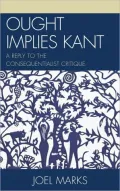
Ought Implies Kant offers an original defense of the ethical theory of Immanuel Kant, and develops an extension of that theoryOs account of moral duty to include direct duties to nonhuman animals. The discussion centers on a critical examination of consequentialism, the view that the rightness or wrongness of an action is determined solely by its consequences. Kantianism, by contrast, claims that the core of ethics is to treat all persons_or, in Joel MarksOs view, all living beings_as ends-in-themselves. The consequentialist criterion would seem to permit, indeed require, violating the dignity of persons (not to mention the dignity of other animals) if this would result in a better outcome. This volume treats the consequentialist challenge to Kantian ethics in several novel ways. To begin with, the utilitarian version of consequentialism is delineated and defended by means of a conceptual device dubbed by the author as the Consequentialist Continuum. Marks then provides an exhaustive and definitive exposition of the relatively neglected Epistemic Objection to utilitarianism. While acknowledging the intuitive appeal of utilitarianismOs core conviction_that we should always do what is for the best_Marks argues that this is an impossible injunction to fulfill, or even to attempt to fulfill, because all of the relevant results of our actions can never be known. Kantianism is then introduced as a viable alternative account of our ethical obligations. Marks argues that Kantianism is well within the scope of normal human competence and conforms equally well to our ethical intuitions once the theoryOs proper interpretation is appreciated. However, KantOs own version must be extended to accommodate the rightful moral consideration we owe to nonhuman animals. Finally, Marks employs the notion of a Consequentialist Illusion to explain utilitarianismOs hold on our moral intuitions, while developing a form of Consequentialist Kantianism to address them. An original and penetrating examination of a central debate in moral philosophy, this book will be of interest to philosophical ethicists, upper-level and graduate philosophy students, and the intellectual reading public.Book Details
Published
January 16, 2009
Publisher
Lexington Books
Pages
132
ISBN
9780739133521