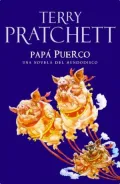
Terry Pratchett
A beloved British author who genre-jumps from humorous fantasy to science fiction to young adult books, Terry Pratchett is perhaps best known for his series of novels set in the fantastical setting of Discworld.
Biography
Welcome to a magical world populated by the usual fantasy fare: elves and ogres, wizards and witches, dwarves and trolls. But wait—is that witch wielding a frying pan rather than a broomstick? Has that wizard just clumsily tumbled off the edge of the world? And what is with the dwarf they call Carrot, who just so happens to stand six-foot six-inches tall? Why, this is not the usual fantasy fare at all—this is Terry Pratchett's delightfully twisted Discworld! Beloved British writer Pratchett first jump-started his career while working as a journalist for Bucks Free Press during the '60s. As luck would have it, one of his assignments was an interview with Peter Bander van Duren, a representative of a small press called Colin Smythe Limited. Pratchett took advantage of his meeting with Bander van Duren to pitch a weird story about a battle set in the pile of a frayed carpet. Bander van Duren bit, and in 1971 Pratchett's very first novel, The Carpet People, was published, setting the tone for a career characterized by wacky flights of fancy and sly humor.
Pratchett's take on fantasy fiction is quite unlike that of anyone else working in the genre. The kinds of sword-and-dragon tales popularized by fellow Brits like J.R.R. Tolkein and C. S. Lewis have traditionally been characterized by their extreme self-seriousness. However, Pratchett has retooled Middle Earth and Narnia with gleeful goofiness, using his Discworld as a means to poke fun at fantasy. As Pratchett explained to Locus Magazine, "Discworld started as an antidote to bad fantasy, because there was a big explosion of fantasy in the late '70s, an awful lot of it was highly derivative, and people weren't bringing new things to it."
In 1983, Pratchett unveiled Discworld with The Color of Magic. Since then, he has added installments to the absurdly hilarious saga at the average rate of one book per year. Influenced by moderately current affairs, he has often used the series to subtly satirize aspects of the real world; the results have inspired critics to rapturous praise. ("The most breathtaking display of comic invention since PG Wodehouse," raved The Times of London.) He occasionally ventures outside the series with standalone novels like the Johnny Maxwell Trilogy, a sci fi adventure sequence for young readers, or Good Omens, his bestselling collaboration with graphic novelist Neil Gaiman.
Sadly, in 2008 fans received the devastating news that Pratchett had been diagnosed with early onset Alzheimer's. He has described his own reaction as "fairly philosophical" and says he plans to continue writing so long as he is able.
Good To Know
Pratchett's bestselling young adult novel Only You Can Save Mankind was adapted for the British stage as a critically acclaimed musical in 2004. Discworld is not just the subject of a bestselling series of novels. It has also inspired a series of computer games in which players play the role of the hapless wizard Rincewind.
A few fun outtakes from our interview with Pratchett:
"I became a journalist at 17. A few hours later I saw my first dead body, which was somewhat…colourful. That's when I learned you can go on throwing up after you run out of things to throw up."
"The only superstition I have is that I must start a new book on the same day that I finish the last one, even if it's just a few notes in a file. I dread not having work in progress.
"I grow as many of our vegetables as I can, because my granddad was a professional gardener and it's in the blood. Grew really good chilies this year.
"I'm not really good at fun-to-know, human interest stuff. We're not ‘celebrities', whose life itself is a performance. Good or bad or ugly, we are our words. They're what people meet.