
Philosophical Positions & Movements - General & Miscellaneous, Modern Philosophy - General & Miscellaneous, General & Miscellaneous Historiography, Rhetoric
Log in to track your reading progress.
Overview
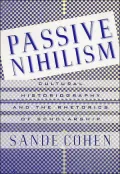
In Passive Nihilism, Sande Cohen skeptically reads the epistemological and political claims of "high academic" discourse. Examining the rhetoric of texts as distinct as the historiography of Carlo Ginzburg, Derrida's Specters of Marx, Bruno Latour's attempt to fold cultural studies in science studies, art curatorial discourse, and the "success" of neopsychoanalysis, Cohen argues that such texts are models of late twentieth-century idealism, giving moral satisfaction instead of rigorous criticism. His readings of these texts attempt to show why such humanistic discourse has less and less credibility, as the texts he analyses try to use rhetoric to install epistemically dubious ideas of the subject, the social, and history. Focusing on how these texts create senses of time and history or how they attempt to "close the gap" between subjectivity and language, language and history, Cohen emphasizes that contemporary criticism is unable to challenge its own idealistic sense of unity, authority, and command. Passive nihilism is the result: acceptance of negativity as the condition for intellectual production. Cohen borrows from de Man and Deleuze so as to suggest how language can be made more dangerous, slipping away from aesthetic unity and the penchant in the humanities for epistemic satisfaction. This challenging text offers a conception of the humanities that will be of interest to critics concerned with contemporary theories.Editorials
Hayden White
Cohen is one of the most original scholars working in the field of cultural criticism today.— Lingua Franca
Hayden White
Sande Cohen is one of the most original scholars working in the field of cultural criticism today.Booknews
Finds contemporary models of history, culture, and language are reactive and that their mix of epistemology, rhetoric, and politics is too explosive for the interpretations associated with normal criticism. Reading texts ranging from professional histories to Derrida, Carlo Ginzburg, and Bruno Latour, argues that the concept of passive nihilism sustains such discourses, giving the human sciences a reactive and idealist gloss. Annotation c. by Book News, Inc., Portland, Or.Book Details
Published
September 1, 1998
Publisher
New York, N.Y. : St. Martin's Press, 1999, c1998.
Pages
242
Format
Hardcover
ISBN
9780312213626