
General & Miscellaneous Law
Available on Bookshop
Write a review
Books.org participates in affiliate programs including Bookshop.org and the Amazon Services LLC Associates Program. We may earn a commission from qualifying purchases made through links on this page, at no additional cost to you.
Log in to track your reading progress.
Overview
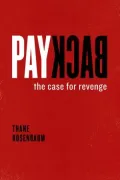
We call it justice—the assassination of Osama bin Laden, the incarceration of corrupt politicians or financiers like Rod Blagojevich and Bernard Madoff, and the climactic slaying of cinema-screen villains by superheroes. But could we not also call it revenge? We are told that revenge is uncivilized and immoral, an impulse that individuals and societies should actively repress and replace with the order and codes of courtroom justice. What, if anything, distinguishes punishment at the hands of the government from a victim’s individual desire for retribution? Are vengeance and justice really so very different? No, answers legal scholar and novelist Thane Rosenbaum in Payback: The Case for Revenge—revenge is, in fact, indistinguishable from justice. Revenge, Rosenbaum argues, is not the problem. It is, in fact, a perfectly healthy emotion. Instead, the problem is the inadequacy of lawful outlets through which to express it. He mounts a case for legal systems to punish the guilty commensurate with their crimes as part of a societal moral duty to satisfy the needs of victims to feel avenged. Indeed, the legal system would better serve the public if it gave victims the sense that vengeance was being done on their behalf. Drawing on a wide range of support, from recent studies in behavioral psychology and neuroeconomics, to stories of vengeance and justice denied, to revenge practices from around the world, to the way in which revenge tales have permeated popular culture—including Hamlet, The Godfather, and Braveheart—Rosenbaum demonstrates that vengeance needs to be more openly and honestly discussed and lawfully practiced.Fiercely argued and highly engaging, Payback is a provocative and eye-opening cultural tour of revenge and its rewards—from Shakespeare to The Sopranos. It liberates revenge from its social stigma and proves that vengeance is indeed ours, a perfectly human and acceptable response to moral injury. Rosenbaum deftly persuades us to reconsider a misunderstood subject and, along the way, reinvigorates the debate on the shape of justice in the modern world.
Synopsis
We call it justice—the assassination of Osama bin Laden, the incarceration of corrupt politicians or financiers like Rod Blagojevich and Bernard Madoff, and the climactic slaying of cinema-screen villains by superheroes. But could we not also call it revenge? We are told that revenge is uncivilized and immoral, an impulse that individuals and societies should actively repress and replace with the order and codes of courtroom justice. What, if anything, distinguishes punishment at the hands of the government from a victim’s individual desire for retribution? Are vengeance and justice really so very different? No, answers legal scholar and novelist Thane Rosenbaum in Payback: The Case for Revenge—revenge is, in fact, indistinguishable from justice. Revenge, Rosenbaum argues, is not the problem. It is, in fact, a perfectly healthy emotion. Instead, the problem is the inadequacy of lawful outlets through which to express it. He mounts a case for legal systems to punish the guilty commensurate with their crimes as part of a societal moral duty to satisfy the needs of victims to feel avenged. Indeed, the legal system would better serve the public if it gave victims the sense that vengeance was being done on their behalf. Drawing on a wide range of support, from recent studies in behavioral psychology and neuroeconomics, to stories of vengeance and justice denied, to revenge practices from around the world, to the way in which revenge tales have permeated popular culture—including Hamlet, The Godfather, and Braveheart—Rosenbaum demonstrates that vengeance needs to be more openly and honestly discussed and lawfully practiced.Fiercely argued and highly engaging, Payback is a provocative and eye-opening cultural tour of revenge and its rewards—from Shakespeare to The Sopranos. It liberates revenge from its social stigma and proves that vengeance is indeed ours, a perfectly human and acceptable response to moral injury. Rosenbaum deftly persuades us to reconsider a misunderstood subject and, along the way, reinvigorates the debate on the shape of justice in the modern world.
Editorials
Publishers Weekly
The need to punish wrongdoers is natural, and ancient societies embraced, even codified it. Novelist (The Myth of Moral Justice), essayist, and law professor Rosenbaum reflects on this while discussing how fictional revenge sagas are not signs of modern-day "closet barbarian", but that such plots fulfill needs that ought to be met in legal systems. Suppressing revenge desires is de rigeur in real life; with "justice" sought in its stead. But this is obfuscation via language; "revenge is justice with an individual face." Rosenbaum inhabits both the fact-based legal world and the emotion-based arts realm, able to address everything from talion to The Princess Bride. His satisfying work gives us permission, contrary to contemporary politeness, to assert "honor in payback." Far from wanting chaos, Rosenbaum argues that leaving aggrieved parties on legal margins, and their emotions outside its doors, leads to more violence, even madness. He suggests that in the real world's cold rationality, it's only through art we publicly admit "evil does, indeed, exist in the world." And in light of the emerging field of narrative medicine, to seal this gap we could acknowledge lawyers as agents with a social contract to a client's emotional life. Refreshingly honest, Rosenbaum renders a consequential, often gruesome topic uplifting, even fun. (Apr.)Scott Turow
“Because it is often regarded as ‘un-Christian’ revenge has acquired a bad name. In this incisive analysis, Thane Rosenbaum argues that revenge is a hunger in most injured hearts and the very fundament of our idea of justice. This is a compelling and provocative book, immensely valuable both for its close reasoning and its honesty.”Susan Jacoby
“This erudite book, which combines the history of our criminal justice system with the most recent headline crime news, is bound to create political and legal controversy because it challenges the sacred cow maintaining that there is no place for revenge, or retribution, in our legal system. Thane Rosenbaum argues persuasively that criminal justice must acknowledge retributive needs if it is to work effectively. Many, including me, will disagree with some of his ideas—especially his contention that victims should have a much larger role in determining the ultimate penalties for those convicted of crimes. But these are vital questions, too often unexamined, and this is a book that opens a much-needed public dialogue.”Daniel Jonah Goldhagen
"One of our most original and compelling thinkers about the law and its limitations, Thane Rosenbaum takes on the theme whose name dare not be spoken in polite circles: revenge. With his singular panache and mastery of sources from Supreme Court cases to popular culture to--gasp--life itself, Rosenbaum takes us on a substantive and stylistic tour de force that leads to the 'shocking' conclusion that if the law won't set things right, which it so often fails to do, then it is okay, indeed moral, for us to do so ourselves."Rich Cohen
“In this brilliant book, Thane Rosenbaum finds language for what all of us, at one time or another, have felt in our bones—that there is a law higher than those made by legislatures or courts; and that, when evil appears among us, an appropriate response is the oldest: revenge. Independent thinking at its best, Rosenbaum's fiercely argued text dares to speak truth to cowardice and calls us to understand and accommodate the demand that a punishment fit the crime and that the score be settled in the Chicago Way.”Book Details
Published
April 10, 2013
Publisher
University of Chicago Press
Pages
328
Format
Hardcover
ISBN
9780226726618