
Quantum Physics, Physical & Theoretical Chemistry, Thermodynamics, Statistical Physics
Available on Bookshop
Write a review
Books.org participates in affiliate programs including Bookshop.org and the Amazon Services LLC Associates Program. We may earn a commission from qualifying purchases made through links on this page, at no additional cost to you.
Log in to track your reading progress.
Overview
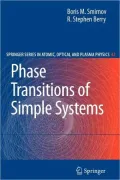
This monograph develops a unified microscopic basis for phases and phase changes of bulk matter and small systems, based on classical physics. It describes the thermodynamics of ensembles of particles and explains phase transition in gaseous and liquid systems. The origins are derived from simple but physically relevant models of how transitions occur between rigid and fluid states, of how phase equilibria arise, and how they differ for small and large systems.
Synopsis
Thermodynamic concepts of aggregate states and their phase transitions - veloped during the 19th Century and are now the basis of our contem- rary understanding of these phenomena. Thermodynamics gives an universal, macroscopic description of the equilibrium properties of phase transitions - dependent of the detailed nature of the substances. However understanding the nature of phase transitions at the microscopic level requires a di?erent approach, one that takes into account the speci?cs of the interparticle int- actions. In this book, we lay the groundwork that connects the microscopic phenomena underlying phase changes with the macroscopic picture, but in a somewhat restricted way. We deal only with systems in which electronic excitations are not important, only with atomic systems, and only with - mogeneous systems. We also restrict our analysis to systems in which only pairwise interactions need be included, and, in many parts of the treatment, to systems in which one need consider only the interactions between nearest neighbor atoms. In establishing these restrictions, we can be guided by the solid and liquid states of inert gases and the phase transitions between them, althoughthesubsequentanalysisisrelevantandapplicableforaseriesofother physical systems. To study the behavior of a system of many interacting identical par- cles, we work extensively with its potential energy surface (PES), a surface in a many-dimensional space whose independent variables are the monomer coordinates or some transformation thereof. A central property of any m- tidimensional PES is its large number of local minima.Book Details
Published
November 19, 2010
Publisher
Springer-Verlag New York, LLC
Pages
257
Format
Paperback
ISBN
9783642090738