
United States History - Social Aspects, 20th Century American History - General & Miscellaneous, 20th Century American History - Prohibition, Drugs & Controlled Substances - Social Aspects
Log in to track your reading progress.
Overview
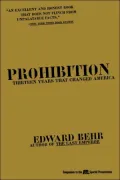
On the stroke of midnight on January 16, 1920, America went dry. For the next thirteen years the 18th Amendment to the Constitution would specifically deny every citizen the right to buy or sell alcoholic drink. Those thirteen years were to change America forever: instead of regulating social behavior and eliminating the scourge of "the Devil's brew," Prohibition incited Americans to bend or break the law by virtually any means possible. In these pages, Edward Behr traces the rise of the Temperance movement from Colonial times onward. Indeed, pioneer America was a free-wheeling, hard-drinking country. Whiskey was so plentiful it was often used for legal - and illegal - tender. Throughout the latter half of the nineteenth century and into the early years of the twentieth, various crusading forces, some well-meaning, some hypocritical, were increasingly demanding an end to intemperance and the abolition of all alcoholic beverages. Between 1920 and 1933, they succeeded. Here is the full, rollicking story of those thirteen years, taking us back to the Jazz Age and its flappers, to the "beautiful and the damned" who drank their lives away in speakeasies; to the Saint Valentine's Day massacre, and to the bootleggers, rumrunners, and high-living gangsters who flagrantly and defiantly flouted the law; to a lady from a Kansas City knitting circle who single-handedly axed a saloon to splinters; to teetotaler Henry Ford's Detroit, where Ford had homes searched to make sure his workers were dry. And, for the first time, Prohibition reveals the full story of George Remus, lawyer turned kingpin of the bootleggers, whose influence reached into the highest echelons of government.Editorials
Publishers Weekly -
Prohibition did not go into effect until 1920, but, with the early Americans notorious for heavy drinking, numerous groups had been trying to ban alcohol for decades. Although there were several well-known temperance advocates in the early 1800s, prohibitionists were derailed by a series of more pressing national mattersthe abolitionist movement, the Civil War and Reconstruction. The "dry" cause picked up speed in 1893 with the formation of the Anti-Saloon League. Led by Wayne Wheeler, the ASL was a formidable lobbying group that was able to turn prohibition into a patriotic issue during WWI. With the conclusion of the war, and with the ASL and Wheeler at the height of their powers, passage of the Volstead Act was a foregone conclusion. Behr (The Last Emperor) tracks the 13 years of Prohibition primarily through the actions of Wheeler, bootlegger George Remus and Chicago mayor "Big Bill" Thomson, and in doing so stresses the corruption of politicians and law enforcement officials that made carrying out the 18th Amendment all but impossible. Behr calls Prohibition a disaster that helped cause some of today's problems by spurring the growth of organized crime. He also sees similarities between Prohibition and the current fight against drugs, and argues that an overhaul of antidrug legislation is long overdue. Although Behr's work is not a comprehensive examination of the Prohibition era, it is informative and entertaining from start to finish. Photos not seen by PW. (Oct.)Library Journal
A&E, the Arts and Entertainment cable television channel, intends to produce a three-part miniseries based on this book, an interesting and readable history of the prohibition era. A journalist by trade, Behr masterly integrates family tales and expert interviews into his account of bootlegging, speakeasies, gangsterism, and racketeering. Although much of his book repeats what is already known about the troubled Twenties, it manages to break new ground by thoroughly telling the story of George Remus, a Cincinnati lawyer who became an influential bootlegger. Several chapters are devoted to Remus's business practices and associations with the likes of Harry Daugherty, Warren G. Harding's attorney general. The Remus story nicely illustrates the pervasive corruption of the period and will likely receive much attention in the upcoming television program. As A&E's interest in the book might suggest, it is written for general audiences. Recommended for public and undergraduate collections.Raymond J. Palin, St. Thomas Univ., Miami, Fla.Book Details
Published
September 2, 1997
Publisher
Arcade Publishing
Pages
272
Format
Paperback
ISBN
9781559703949