
Media - General & Miscellaneous, Holocaust - General & Miscellaneous, Historical Films, Holocaust - Study & Teaching
Available on Bookshop
Write a review
Books.org participates in affiliate programs including Bookshop.org and the Amazon Services LLC Associates Program. We may earn a commission from qualifying purchases made through links on this page, at no additional cost to you.
Log in to track your reading progress.
Overview
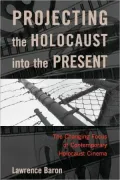
Most Holocaust survivors and scholars contend that the event was so catastrophic and unprecedented that it defies authentic representation in feature films. Yet it is precisely the extremity of the "Final Solution" and the issues it raised that have fueled the cinematic imagination. Recognizing that movies reach a greater audience than eyewitness, historical, or literary accounts, Lawrence Baron argues that they mirror changing public perceptions of the Holocaust over time and place. After tracing the evolution of the most commonly employed genres and themes in earlier Holocaust motion pictures, Baron focuses on how films from the 1990s make the Holocaust relevant for contemporary audiences. He discusses significant forgotten films such as The Search, Martha and I, Mendel, and Triumph of the Spirit, as well as movies about non-Jewish victims and children. To convey the significance of the Holocaust to generations born after it happened, Baron covers movies like Max, The Grey Zone, Nowhere in Africa, and The Pianist, and analyzes the use of the Holocaust as a plot element in action-adventure fantasy movies like X-Men. The book concludes with a user-friendly thematic bibliography, filmography, and Internet reference guide.About the Author:
Lawrence Baron is a history professor at San Diego State University
Synopsis
In this accessible, clear, jargon free, and comprehensive text, Projecting the Holocaust into the Present offers an insightful historical perspective on how public conceptions of the Holocaust in film have changed over time.
Editorials
Communication Book Notes Quarterly
Offers rich, detailed, and thoughtful analysis of international holocaust film by an author who has been teaching classes on Jewish History and the Holocaust for many years. . . . This is an important book on an important topic and should be in all film collections.— Eleanor Block
CHOICE
Combining scrupulous research and keen insight with prior film criticism and artistic, social, and historical information, Baron (history, San Diego State Univ.) renders this somber and difficult subject most accessible. The study is distinguished by the various schools of thought on how Holocaust subjects should or should not be treated on film. The author avoids repeating and recycling ideas, instead juxtaposing new findings and insights with established views, thereby delivering well-rounded and informative coverage of a dynamic subject with myriad facets and repercussions...An excellent resource for those interested in film or in political science, history, or psychology. . . . Essential. Upper-division undergraduates through faculty and professionals.— L. D. Talit, Central Connecticut State University
H-Net: Humanities and Social Science Reviews Online
Baron's study provides an excellent overview of recent movies dealing with the Holocaust. While broadening the common notion of "Holocaust cinema," Baron's cultural historicist approach casts light onto the increasingly larger role visual media play in the process of raising public awareness of historic events. Teachers and students of cultural, intellectual and film history will find the volume particularly helpful due to its format of individual film reviews, its nearly comprehensive filmography and its extensive bibliographical information.— Heike Polster, Department of Germanic Languages and Literatures, Washington University
Journal of Popular Film and Television
[...] I wish to recommend this book without reservation to anyone even remotely interested in the subject. For me, it serves as reality check in my memory, and delineates what "bearing witness" means. To the reader, it may provide invaluable insights on what can be done to explain the inexplicable.— Frank Manchel, University of Vermont
Film & History
Some authors provide sound scholarship, others supply detailed analysis, but few combine these accomplishments with prose that bridges the gap from the academic to the general reader. Historian Lawrence Baron has done just that while dealing with the often-contorversial area of cinematic representations of the Holocaust.Choice
Combining scrupulous research and keen insight with prior film criticism and artistic, social, and historical information, Baron (history, San Diego State Univ.) renders this somber and difficult subject most accessible. The study is distinguished by the various schools of thought on how Holocaust subjects should or should not be treated on film. The author avoids repeating and recycling ideas, instead juxtaposing new findings and insights with established views, thereby delivering well-rounded and informative coverage of a dynamic subject with myriad facets and repercussions...An excellent resource for those interested in film or in political science, history, or psychology. . . . Essential. Upper-division undergraduates through faculty and professionals.— L. D. Talit, Central Connecticut State University
H-Net: Humanities and Social Science Reviews Online
Baron's study provides an excellent overview of recent movies dealing with the Holocaust. While broadening the common notion of 'Holocaust cinema,' Baron's cultural historicist approach casts light onto the increasingly larger role visual media play in the process of raising public awareness of historic events. Teachers and students of cultural, intellectual and film history will find the volume particularly helpful due to its format of individual film reviews, its nearly comprehensive filmography and its extensive bibliographical information.— Heike Polster, Department of Germanic Languages and Literatures, Washington University
Shofar: An Interdisciplinary Journal Of Jewish Studies
Baron's well-researched, heavily annotated but still quite readable volume offers statistical analyses to indicate trends and genres which are then exemplified by detailed synopses and analyses of selected films within each category and decade, complete with reactions from critics, box office receipts, and awards bestowed.Film & History: An Interdisciplinary Journal
Some authors provide sound scholarship, others supply detailed analysis, but few combine these accomplishments with prose that bridges the gap from the academic to the general reader. Historian Lawrence Baron has done just that while dealing with the often-contorversial area of cinematic representations of the Holocaust.Deborah Carmichael
Some authors provide sound scholarship, others supply detailed analysis, but few combine these accomplishments with prose that bridges the gap from the academic to the general reader. Historian Lawrence Baron has done just that while dealing with the often-controversial area of cinematic representations of the Holocaust. Because World War II genocide remains so dark a subject, it is easiest to see the era in high contrast black and white. This author points to the complexities of history, filmmaking, and cultural perceptions by contextualizing his work within classic films of the Shoah (from 1945-1979) while identifying trends and shifts in how stories of the Holocaust are now brought to the screen in the twenty-first century. Few previous works study more than the obvious contemporary movies, Schindler's List (1993) or Life is Beautiful (1997). This author looks at a wide range of films, including X-Men as "Holocaust pop metaphor" indicating that the shadow of past atrocities pervades our culture. Baron meticulously developed a database of films to discern changes in filmic Holocaust narratives.Communication Booknotes Quarterly -
Offers rich, detailed, and thoughtful analysis of international holocaust film by an author who has been teaching classes on Jewish History and the Holocaust for many years. . . . This is an important book on an important topic and should be in all film collections.CHOICE -
Combining scrupulous research and keen insight with prior film criticism and artistic, social, and historical information, Baron (history, San Diego State Univ.) renders this somber and difficult subject most accessible. The study is distinguished by the various schools of thought on how Holocaust subjects should or should not be treated on film. The author avoids repeating and recycling ideas, instead juxtaposing new findings and insights with established views, thereby delivering well-rounded and informative coverage of a dynamic subject with myriad facets and repercussions...An excellent resource for those interested in film or in political science, history, or psychology. . . . Essential. Upper-division undergraduates through faculty and professionals.H-Net: Humanities and Social Science Reviews Online -
Baron's study provides an excellent overview of recent movies dealing with the Holocaust. While broadening the common notion of "Holocaust cinema," Baron's cultural historicist approach casts light onto the increasingly larger role visual media play in the process of raising public awareness of historic events. Teachers and students of cultural, intellectual and film history will find the volume particularly helpful due to its format of individual film reviews, its nearly comprehensive filmography and its extensive bibliographical information.German Studies Review, Vol. 30, No. 3 (2007) -
A valuable addition to the extant scholarship on Holocaust cinema. . . . Baron's accessible and stimulating book fills in some significant gaps in studies of Holocaust feature films and is a useful reference for specialists as well as those with a more general interest in the subject.Journal of Popular Film and Television -
[...] I wish to recommend this book without reservation to anyone even remotely interested in the subject. For me, it serves as reality check in my memory, and delineates what "bearing witness" means. To the reader, it may provide invaluable insights on what can be done to explain the inexplicable.Film & History: An Interdisciplinary Journal
Some authors provide sound scholarship, others supply detailed analysis, but few combine these accomplishments with prose that bridges the gap from the academic to the general reader. Historian Lawrence Baron has done just that while dealing with the often-contorversial area of cinematic representations of the Holocaust.Richard Libowitz
Well-researched... quite readableShofar: An Interdisciplinary Journal Of Jewish Studies
Baron's well-researched, heavily annotated but still quite readable volume offers statistical analyses to indicate trends and genres which are then exemplified by detailed synopses and analyses of selected films within each category and decade, complete with reactions from critics, box office receipts, and awards bestowed.Book Details
Published
October 1, 2005
Publisher
Rowman & Littlefield Publishers, Inc.
Pages
318
Format
Paperback
ISBN
9780742543331